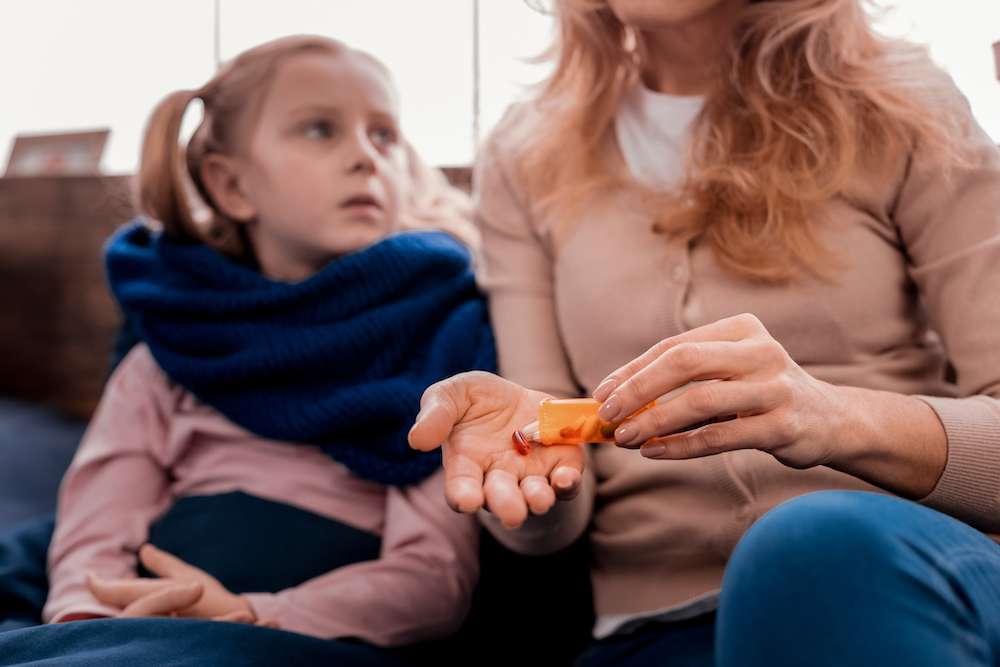
A rep for the company says Johnson & Johnson discussed children’s pain relief, but never targeted children with its drugs.
Johnson & Johnson contributed to the opioid crisis in Oklahoma in part by marketing opioid drugs to children, according to allegations made by the state of Oklahoma in a lawsuit against the company.
“In perhaps one of the most reprehensible documents produced by defendants, this shows the depths to which J & J would go to earn a profit on their products—target potential ‘replacement customers’ at an early age to get them using (and addicted to) opioids,” one court document reads, according to The Washington Post.
The company strongly denies this claim. A representative said that Johnson & Johnson, whose subsidiaries manufacture opioid products, discussed children’s pain relief, but never targeted children with its drugs.
However, Bradley Beckworth, an attorney who is representing Oklahoma in the lawsuit, said that targeting children with dangerous products is not unheard of.
“The recruitment of children… is the same kind of thing the tobacco industry did,” he said. “It’s the same kind of thing that other drugs companies do. Just marketing opioids to cancer patients and surgery patients was not enough. They wanted to expand the customer base.”
The allegations stem from a lawsuit that Oklahoma brought against Johnson & Johnson, Purdue Pharma and Teva Pharmaceutical, which makes and distributes generic opioids.
Since then, the state has been focused on Johnson & Johnson and Teva Pharmaceutical. The lawsuit alleges that both companies, which provided materials for opioids, contributed quietly to the crisis behind the scenes.
“Johnson & Johnson helped create the worst public health crisis in United States history,” said Bradley Beckworth. “They grew the demand. They spread the lies and they fed it with their own product… We’ll show that at trial.”
The state’s lawsuit aims to hold the drug manufacturers liable for the harm caused by their products under the state’s public nuisance laws. University of Oklahoma College of Law professor Andrew M. Coats said that the case is fairly solid.
He said, “It has a good deal of merit to it, because our statute on public nuisance is pretty broad,” he said.
However, a representative for Johnson & Johnson said that the company was following the law.
“The production of raw materials and active pharmaceutical ingredients used to manufacture Schedule II medications in the U.S. is strictly controlled, limited and monitored by the DEA, FDA, and other regulators,” a statement from the company read. “The DEA sets quotas based on the agency’s assessment of the need for medicines containing these substances, and our businesses complied with these laws and regulations.”
Curry and Smith discussed how they manage their anxiety on the show’s latest episode.
On the latest episode of Jada Pinkett Smith’s Facebook series Red Table Talk, Willow Smith opened up about her struggles with anxiety.
The episode’s conversation was wide-ranging, but when the subject came to anxiety, Jada asked her daughter Willow, “What are some of the things that you do? What are some of your techniques to deal with your anxiety?”
Willow responded, “Recently I have been, like, I just get really frustrated and I just feel like there is so much energy. I get frustrated and then in my head I feel manic.” So when anxiety hits, Willow says she “[drops] down” and starts doing push-ups.
Chef Ayesha Curry, wife of NBA superstar Steph Curry who was a guest on the show, confessed that she suffers from anxiety as well. “I have anxiety too, really bad, to the point where I actually take medication for it. And I think it’s something that everybody, in some way, has moments. I think open communication and putting your feelings on the line, that helps me a lot, [and] just letting someone know, ‘I’m kind of having an anxiety attack now.’”
Last year on Red Table Talk, Willow also opened up to her mother about practicing self-harm. She experienced fame at a young age with her debut single “Whip My Hair,” and she confessed, “I feel like I lost my sanity at one point. It was after that whole ‘Whip My Hair’ thing and I had just stopped doing singing lessons and I was kind of just in this gray area of, ‘Who am I? Do I have a purpose? Is there anything I can do besides this?’ And after all of that kind of settled down and it was like a kind of lull, I was listening to a lot of dark music. It was just so crazy, and I plunged into this black hole, and I was, like, cutting myself.”
It was a secret she apparently kept from her mother, and Willow added, “I never talk about it because it was a short, weird point in my life. But you have to pull yourself out of it.”
The results of a new study involving the show has sparked a heated debate about its complicated subject matter.
Ever since the debut of the Netflix series 13 Reasons Why—about a high school girl who left behind audio tapes listing the 13 reasons why she ended her life—controversy has swirled over the graphic nature of the show.
Critics of the show accuse it of romanticizing suicide. Some school officials voiced concern around the show’s debut that it would produce a “contagion effect” among students already at risk of depression or self-harm.
The debate has reignited with the release of a new study in April that claimed the show “was associated with a 28.9% increase in suicide rates” among U.S. youth ages 10-17 in the month that followed the show’s March 2017 debut.
“The results of this study should raise awareness that young people are particularly vulnerable to the media,” said study author Lisa Horowitz, PhD, in a statement. “All disciplines, including the media, need to take good care to be constructive and thoughtful about topics that intersect with public health crises.”
However, as BuzzFeed News reported, the study determined correlation, not causation. Therefore, as some mental health experts say, it is not only unfair but also inaccurate to blame 13 Reasons Why for rising youth suicide rates.
“People tend to sort of read the headline and jump to some kind of conclusion, when these things are really complicated,” said Victor Schwartz, medical director at the Jed Foundation, a non-profit organization supporting youth mental health and suicide prevention.
“This is sort of the culmination of a series of reports that seem to corroborate some of the concerns that many of us expressed when the show came out,” Schwartz added. “But again, obviously, with any of these things, it’s always difficult to prove causation.”
The show, which will continue with the release of Season 3 sometime this year, has been dealing with this kind of backlash since the beginning.
Since then, Netflix has updated the trigger warnings that appear before episodes and createdBeyond the Reasons, a behind-the-scenes documentary discussing the thought behind the show and why they chose not to shy away from difficult scenes.
Jay Asher, the author of the novel that the series is based on, said the difficult subject matter depicted on the show is worth talking about. “The whole issue of suicide is an uncomfortable thing to talk about, but it happens. And so we have to talk about it. It’s dangerous not to talk about it.”
Netflix also created the website 13reasonswhy.info where you’ll find suicide prevention resources.
Helen Hsu, a California-based clinical psychologist who served as a “mental health consultant of sorts” on the show, was not convinced by the findings of the new study. “Everybody wants a simple answer for a very complex social problem,” she told BuzzFeed News.
“Nobody’s randomly doing this show for shock value. I think we all feel really strongly that stigma has to be broken and these things have to be talked about,” said Hsu.
“He served too much time but it gives me so much joy to fund this life-saving work,” Kardashian West tweeted.
While Kim Kardashian West may be best known for being a social media star and for being married to Kanye West, she has also helped get low-level drug offenders out of prison.
According to People, Kardashian announced on Friday (May 3) that she helped release a man named Jeffrey Stringer, a low-level drug offender who has spent over 20 years in jail.
“We did it again!” she tweeted. “Had the best call w/ this lovely family & my attorney who just won release for their loved one Jeffrey in Miami. He served 22 years of [a] life sentence for [a] low level drug case. He served too much time but it gives me so much joy to fund this life saving work.”
Brittany Barnett, an attorney who worked with Kardashian to get Stringer released, told NBC Miami, “Someone’s life is in your hands. Their entire life. I don’t take it lightly. It’s an honor and a privilege for me to do this work and for Jeffrey to trust me with his life… To have served 22 years in prison, laboring under the dark cloud of dying there, and to get a second chance at life, it’s beautiful.”
Kardashian petitioned President Trump last year to help free Alice Marie Johnson, another nonviolent drug offender who was slapped with a life sentence. When Johnson was sentenced in 1996, she was a first-time drug offender, and she had no opportunity for parole.
Johnson told CNN she was “a telephone mule, passing messages between the distributors and sellers. I participated in drug conspiracy, and I was wrong.”
Once Johnson was free, a new piece of legislation, the First Step Act, was approved by Congress, and Trump signed it into law in December 2018.
As the First Step Act’s official website explains, “The U.S. Senate and House of Representatives have voted overwhelmingly to pass the First Step Act… On December 21, 2018 President Trump signed the bill into law, bringing us one step closer to fixing a broken criminal justice system that has torn too many families apart and destroyed too many lives.”
“I never in a million years thought we would get to the point of getting laws passed,” Kardashian said. “That was really a turning point for me.”
Kardashian is currently studying to be a lawyer, and she hopes to take the bar exam by 2022.
The state is set to vote on whether to add depression and insomnia to the medical marijuana program’s qualifying list of conditions.
A diagnosis of depression or insomnia may qualify Ohioans for the state’s medical marijuana program.
In June, state officials will vote on whether to add five more ailments to its list of qualifying conditions for medical marijuana—anxiety, autism spectrum disorder, opioid use disorder, depression and insomnia. If they vote to add depression and insomnia to the list, Ohio would be the first state to do so.
Currently 33 states have established medical marijuana programs, with a different set of qualifying conditions for each state.
Ohio’s list includes rare conditions, the Cincinnati Enquirer notes, such as sickle cell disease, fibromyalgia and Tourette’s syndrome. Ohio is also currently the only state that allows marijuana for the treatment of chronic traumatic encephalopathy (CTE), a neurodegenerative disease seen often in football players, boxers and military veterans caused by repeated head trauma.
Treating opioid use disorder with medical marijuana is already allowed in 4 states—Illinois, New Jersey, New York and Pennsylvania. Anxiety is a qualifying condition in New Jersey and West Virginia. Autism spectrum disorder is a qualifying condition in Colorado, Delaware, Iowa, Louisiana, Michigan, Minnesota, Pennsylvania, Puerto Rico, South Carolina and Utah.
Ohio approved medical marijuana in 2016 with 21 initial qualifying conditions that allow residents to obtain a medical marijuana card with a doctor’s recommendation. This is the first time since then that the State Medical Board has used its power to add to the list of qualifying conditions. The board will hold a final vote on adding the five conditions on June 12.
The Enquirer found that at least 3.5 million Ohioans suffer from at least one of the 21 qualifying conditions on its current list. If all five conditions are approved by the State Medical Board in June, the number of eligible Ohioans will nearly double.
The Enquirer’s report emphasized that there is little clinical research on marijuana “since the federal government considers marijuana as dangerous as heroin”—i.e., as long as marijuana remains in Schedule I, a category of drugs defined as having no medical value and a high potential for abuse, it will remain difficult to conduct research on it.
It seems inevitable that this will change, however. Ten states have decided to legalize marijuana for not only medical use, but recreational use as well. The state of Illinois may join them next. Governor J.B. Pritzker announced plans to legalize marijuana on Saturday (May 4).
And last week it was reported that Harvard and MIT alumnus Charles R. Broderick donated $9 million to both schools to study cannabis.
Ritalin (main ingeredient methylphenidate) is a central nervous system (CNS) stimulant drug that has become the primary drug of choice in treating ADHD or attention-deficit hyperactivity disorder in children and adults. But, some people tend to abuse this medication either recreationally or for study purposes. So…when does dosing become dangerous?
First question: can you overdose on Ritalin? YES! When do users risk OD-ing on Ritalin? How much of the medication is enough to cause toxic and even fatal levels in your system? We review safety guidelines for Ritalin use and dosage safety in the article below. Then, we invite your questions in the designated section at the bottom of the page. We try to respond to all questions personally…or we’ll refer you to someone who can help.
Ritalin strengths
Ritalin tablets are available in three strengths as immediate release tablets including chewable tablets for oral administration:
5 mg
10 mg
20 mg
But, Ritalin’s main ingredient – methylphenidate – is also available as sustained release tablets (Ritalin SR), extended release capsules, extended release oral suspension, extended release capsules (Ritalin LA), and as transdermal patches.
Immediate release Ritalin doses are usually be split into 2-3 doses to be taken throughout the day. Ritalin SR tablets have a duration of action of approximately 8 hours; while Ritalin LA are usually taken orally once daily in the morning.
How much Ritalin is safe?
Depending on your age, weight, and other factors, you might be prescribed anywhere from 10-60 mg of Ritalin a day. Dosage is individualized according to the needs and responses of each patient, so a safe dose of Ritalin for someone else may not be safe for you.
Basically, the safe dosage, frequency, and duration of treatment is suggested by your doctor and you should not take more Ritalin, more often, or in a different way than prescribed.
How much Ritalin can you take at once?
While the dosage range varies for children, the average daily dose of methylphenidate for adults is 20 to 30 mg/day. Most texts on the matter recommend that the daily dose should not exceed 60 mg, although some individuals may require higher doses.
How much Ritalin to overdose?
Ritalin overdose is possible at doses that are significantly higher than what you are usually used to. So, if you don’t have a tolerance to Ritalin and you are a recreational or first time user, overdose may happen as a consequence of taking more than your body can handle to process. But if you are dosing regularly, Ritlalin levels that provoke an OD will generally tend to be higher.
Acute toxicity due to Ritalin overdose results in symptoms similar to those of an acute amphetamine overdose. Physical and behavioral symptoms of Ritalin overdose may include:
agitation
cardiac arrhythmias
confusion
convulsions (may be followed by coma)
delirium
dryness of mucous membranes
euphoria
flushing
hallucinations
headache
hyperpyrexia
hyperreflexia
hypertension
muscle twitching
mydriasis
palpitations
sweating
tachycardia
tremors
vomiting
IMPORTANT: If you or someone you know has taken too much Ritalin and shows signs of overdose, CALL your local Poison Control Center at 1-800-222-1222. If the victim has collapsed or is not breathing, call local emergency services at 911.
Sudden death has been reported in association with CNS stimulant treatment at usual doses in children and adolescents with structural cardiac abnormalities or other serious heart problems. Ritalin and other stimulant products should not be used in children or adolescents with known serious structural cardiac abnormalities, cardiomyopathy, serious heart rhythm abnormalities, or other serious cardiac problems.
Adults taking stimulant drugs at usual doses for ADHD have suffered from sudden death, stroke, and myocardial infarction. Adults have a greater likelihood than children of having serious structural cardiac abnormalities, cardiomyopathy, serious heart rhythm abnormalities, coronary artery disease, or other serious cardiac problems. Individuals with such abnormalities should generally not be treated with stimulant drugs like Ritalin.
How much Ritalin should I take?
It really depends on your condition, physical health, age, body mass, and other factors. People are usually prescribed Ritalin tablets at the following rates:
Ritalin doses for adults
Tablets should be taken in divided doses 2-3 times daily, preferably 30 to 45 minutes before meals. Average doses are in the range of 20 mg to 30 mg daily. But some patients may require 40 to 60 mg a day. In others, however, a dosage of 10 mg to 15 mg daily will be adequate.
Ritalin SR (sustained release tablets) have a duration of action of approximately 8 hours. Therefore, Ritalin-SR tablets may be used in place of Ritalin tablets when the 8 hour dosage of Ritalin-SR corresponds to the titrated 8-hour dosage of Ritalin.
Ritalin doses for children (6+ years)
Ritalin should be initiated in small doses, with gradual weekly increments. Tablet doses should start at 5 mg twice daily (before breakfast and lunch) with gradual increments of 5 to 10 mg weekly. Daily dosage above 60 mg is not recommended.
If improvement is not observed after appropriate dosage adjustment over a 1 month period, Ritalin should be discontinued.
ARTICLE OVERVIEW:Been caught with drugs in the state of Mississippi? Not certain how the legal proceedings will go? We review laws, penalties, and basics for alternate sentencing like drug court and voluntary rehab.
Like much of the south, Mississippi has zero tolerance when it comes to their drug possession laws. Therefore, a drug possession charge is taken very seriously. Strong penalties go with convictions. Penalties for holding controlled substances depends on the amount you have on you. In Mississippi, possession charges are put into one of two categories. These include:
Personal Amount. Depending on the drug, you can only have so much on you for it to be considered a personal amount. For example, a personal amount of cocaine is considered less than one-tenth of a gram, or one dosage unit. In terms of Scheduled I and II CDS, once you possess more than one-tenth of a gram, you risk being charged with…
Sales of Controlled Substances in Mississippi. This is when authorities believe you’re either distributing or trafficking drugs. These penalties are always much more intense than that of a personal amount (see below for details).
Specific Laws and Schedules
There are two specific laws in Mississippi that cover the charges for drug possession and distribution: Ms. Code Ann. § 41-29-113: House Bill 1031, and Ms. Code Ann. § 41-29-115: Senate Bill 2379. [1] [2]
In Mississippi, a drug is referred to as a “controlled dangerous substance,” or CDS. Like other states, Mississippi classifies each drug according to a schedule. These are defined under MS. Code Ann. § 41-29-113 [3]. CDS Schedule I are considered to be the most dangerous drugs. So, getting caught in possession of these kinds of drugs will result in harsher penalties.
Opioid pain medications like codeine, fentanyl, and hydrocodone
Schedule III Substances
Anabolic steroids
Ketamine
Nalorphine
Stimulants
Schedule IV Substances
Certain depressants such as alfaxalone, barbital
Certain stimulants such as cathine, phentermine
Schedule V Substances
Certain prescription depressants
Certain prescription stimulants
The Legal Process in Mississippi
Within the state of Mississippi, the stages of a criminal case work in 9 distinct steps. [4]. These The rules of criminal procedure in cases of drug possession are as follows.
1. Investigation
If police are suspicious of a crime, they’ll collect all the evidence they can on the crime scene. They’ll also interview witnesses. The length of investigations varies depending on the circumstance of the crime. However, most drug possession crimes don’t require much of an investigation considering the drug itself is all the evidence a police officer needs.
2. Arrest, Initial Appearance, and Bond Setting
Upon arrest, you’ll be taken to your town or city’s police headquarters. From there, you’ll immediately be placed before a judge to make an initial appearance. During this time, a bond will be set for your release.
3. Preliminary Hearing
If you aren’t able to pay the bond, then you’ll be entitled to a preliminary hearing. This might be referred to as a probable cause hearing. Through this, the court system will decide whether or not enough probable causes exists to convict you of a crime.
4. Indictment
Your case will then be brought before a grand jury. It should be noted, all that will be shown to this jury is the evidence the prosecutor chooses to present. During this time, you will not be able to defend yourself.
5. Arraignment
Not too long afterward, the Court will give your case an arraignment. During this time, you’ll be told your official charges and given the opportunity to inquire as to whether or not you need an attorney. From there, you’ll be asked to submit a plea to the charges and then the court will set an initial trial date.
6. Discovery
During this part of the legal process, you’ll now have the ability to file a motion for discovery. In order to do so, the State will produce all evidence to you. In turn, you’ll also be allowed to present evidence in your favor to the State.
7. Plea Negotiations
You may want to make a deal with the State and resolve the case before having to go to trial. Most people go through with a plea negotiation when they’re trying to reduce their punishment. There are many plea negotiations the state of Mississippi has to offer (see below). You’ll want to talk to your lawyer about the matter.
8. Trial
If there is no agreement made based on your plea, then you must go to trial. A trial usually begins with an opening statement by the prosecutor and attorney defending you. From there, the State will present its case by calling witnesses and introducing the evidence taken against you.
Then, you will have your opportunity to present your witnesses and evidence, proving your innocence. After your presentation, the State will go again against you. They bring back evidence they had shown prior. From there, the judge will tell the jury of all the laws applicable to your case. Then you’ll be offered a closing argument along with the prosecutor. And the case is finally submitted. The jury will come to its decision and you will receive …
9. Sentencing, if applicable
If you’re found guilty of a drug possession crime in the State of Mississippi, then you’ll receive a sentence. This is usually a separate hearing in which both you and the prosecutor will be allowed to present your evidence again. Furthermore, the Court may ask for a pre-sentence investigation, or PSI, which would be managed by a probation officer. This investigation will look into your background and determine whether or not the sentence is appropriate for your circumstances.
Burden of Proof
Under Mississippi law, the prosecutor must demonstrate specific elements in order to properly convict you. These elements include:
1. LEGALITY. The evidence that you were in possession of a controlled dangerous substance when you were arrested.
2. KNOWLEDGE. The evidence that you knew of the illegal nature of this controlled dangerous substance and you knew it was present at the time of your arrest.
3. CONTROL. The evidence that you had control over both the presence and location of the controlled dangerous substance.
Sentencing
Drug sentencing will entirely depend on your case. As mentioned earlier, Mississippi considers the schedule of the drug and how much of it was in your possession in order to determine your sentence. The higher the schedule and the more of a drug, the higher your penalization.
Still, the purpose of a trial is to figure out all the details surrounding the charges. A trial will paint a picture of the circumstances and, in turn, the idea is that you will be penalized accordingly. In order learn more about potential sentences, you’ll want to talk to a lawyer. Also, you may qualify for alternative sentencing (see below).
Misdemeanor Possession
When you’re charged with a misdemeanor, your punishment is taken less seriously than that of a felony. However, in the state of Mississippi, very few drug possession crimes are considered a misdemeanor. Typical misdemeanor penalties include:
A fine of up to $1,000.
Jail time between 6 months and 1 year.
What might be considered misdemeanor drug possession in Mississippi? If you have less than 30 grams of marijuana, then you’ll probably be charged with a misdemeanor. This is because marijuana has recently been removed from the list of Schedule I drugs in Mississippi. Also, if you’re caught solely with drug paraphernalia, you’ll also only be charged a misdemeanor. With any other drug possession crime, you’ll be charged with a felony.
Felony Possession
In the state of Mississippi, most cases of drug possession result in a felony charge. Levels of severity in the charge depend on your circumstances. People in possession of a Schedule I drug will end up with a more severe penalty than someone in possession of a Schedule V drug. Still, even just a personal amount of a top schedule controlled dangerous substance will land you a felony.
Typical punishments for a felony charge include:
A fine of up to $10,000
Prison time between 1 to 4 years.
Other Penalties
Often, you’ll find yourself facing other penalties due to your drug possession crime. The state of Mississippi decides on these crimes on a case to case basis. Due to this, it’s not entirely certain which penalties you’ll face for your crime. In order to get a better sense, you’ll want to talk to your lawyer. Other penalties for possession of a controlled dangerous substance include:
Ineligibility to obtain certain employment.
Ineligibility to obtain certain types of government employment.
Ineligibility to qualify for certain types of college scholarship or financial aid.
Ineligibility to qualify for public housing.
Ineligibility to receive a state license or certification.
Potential community service.
Potential enrollment in drug treatment programs.
Probation.
Suspension of your driver’s license.
Alternative Sentencing
In Mississippi, you do have the opportunity to face alternative sentences [5]. It’s difficult for people with drug possession crimes to qualify for these considering Mississippi’s zero tolerance policy on controlled dangerous substances. Still, if you’re looking to reduce jail time and other punishments, it’s in your best interest to take a look at these.
In order to get a real sense of which alternative sentences you apply for, you’ll want to talk the matter over with your lawyer. Some options include:
1. Drug Court.
These specialized courts are used solely for drug offenders and their purpose is to reduce crime on the streets. [6] The idea is drug abusers will benefit more from rehabilitation rather than traditional punishments. Rehabilitation often includes supervised drug testing and treatment services. You’ll receive counseling, incentives, and must make consistent court appearances. If you successfully complete your drug treatment, then your charges will be dropped.
2. Non-adjudicated Probation
If you enter as a guilty plea, you might be offered non-adjudicated probation. This works like probation in the sense that you’ll need to pay fines and court costs, report to a supervising officer, and take regular drug tests. However, if you complete it all successfully, you’ll be discharged.
3. House Arrest – Intensive Supervision Program
Under very certain circumstances, people can avoid incarceration through house arrest. You must be screened and approved in order to qualify. If you are approved, you’ll have to wear an electronic monitor which checks to make sure you’re always in agreement with your curfew requirements. A house arrest will allow you to work, go to church and receive both medical attention and drug treatment. If you break your house arrest circumstances, you will be charged with further penalties.
4. Pre-trial Diversion
If you’re a first offender of a non-violent crime who wasn’t charged with drug sales or possession of a controlled dangerous substance with intent to distribute, you can qualify for a pre-trial diversion in Mississippi. Through this type of sentence, you’ll be placed on special probation where you must attend court on a regular basis. It should be noted, rules for pre-trial diversion vary from court to court.
5. Recidivism Reduction Program
Also known as RRP, this program aims to rehabilitate drug-offenders rather than incarcerate them. You can expect to be placed into a rigorous drug treatment program and receive important therapy.
6. Restitution Center
If you owe a good amount of fines, you might be sentenced to a restitution center while you’re on probation. This is where you’ll be educated of your crimes and the criminal system. You will also be monitored and aided in finding work.
When to Contact a Lawyer
Immediately upon your arrest, you should consider finding yourself a lawyer. Part of the reason is drug possession charges in Mississippi are taken very seriously and almost always have strong consequence. However, due to the fact that penalties vary from case to case, a lawyer will be able to figure out the best possible solution for YOU.
Can’t afford a lawyer?
Then the State will provide you with one as long as you qualify. If you do qualify, it’s important to take as much advice from this lawyer as possible for the sake of your trial. In order to get a real sense of which lawyers in Mississippi are best for your case, you should check out the Mississippi Bar Association and their member directory. [7]
Your Questions
Have more questions about drug possession laws in Mississippi?
Feel free to ask them in the comments below. If you have more information to share pertaining to these laws or advice about Mississippi’s legal system, we’d also love to hear from you. We try to get back to everyone in a prompt and personal manner.
If you’ve found this article, you might be searching for ways to repair a “broken relationship”. But the truth is, you’ve got to fix…you! Here, we’ll take a brief look at root causes for loving an addict. What gets you to this desperate place to begin with?
Then, we’ll challenge you to take action. If you have any questions, please leave them in the comments section at the end. In fact, we try to respond to all real life questions personally and promptly.
Getting to the Root of Co-Addiction
If you find yourself in the situation where you love an addict and you cannot let them go, then you need to get down to the root of your issues, not theirs. If you have found that you meet the criteria of a co-addict; it is time to look at how this situation developed.
Codependent and Co-addictive behaviors may have roots that date back to childhood. The behavior may be so severely suppressed that the co-addict does not even relate to or remember when they lost their sense of self. For example, if a young child faces:
sexual abuse
emotional abuse
verbal abuse
psychological abuse
neglect or abandonment by a parent
…they may have tried to resist. In this resistance they find that the abuser only becomes more irate. Their response to fight for their well-being gets them nowhere. Over time, the child may learn that their feelings are less important and become submissive to that person, parent and/or abuser.
Are You Becoming More Submissive?
The abuse or act of submissive behavior may even be mild; a controlling parent, a self-absorbed parent or a caregiver who abandons a child. Even if these roles are not as pronounced as what we think of as outright abuse, the child is still learning that their voice only angers this person and they develop a passive, submissive disposition.
More specifically, with a co-addict, the development of submissive behavior might be a result of a childhood relationship with an addict. For example, if a child’s parent/s or caregivers are addicts then the child may learn early on that they must put their parent and their addiction first. They are naturally going to come second to a parent’s addiction so they lose their voice, their sense of self and learn to grow up taking care of an addict parent or family member. This behavior can become something that is ingrained and will be carried out into all other areas and relationships in their life.
Do You Value the Addict More Than Yourself?
It is also possible that the adult co-addict or codependent is aware of the abusive relationship they endured which imprinted their lack of sense of self. In either case, the adult codependent is a person who puts more value on the person they love then on their own welfare. A co-addict or codependent may lose their identity. The only identity they create is through the person they are codependent on.
Addict and Co-addict: A Perfect Match
Don’t you find it strange that most addicts marry codependents or co-addicts who end up putting their addiction and problems above their own?
This relationship is actually a pretty natural one. Co-addicts need to hide behind others and be submissive and addicts need someone to take care of them and put up with their behaviors. An addict is naturally attracted to a codependent or co-addict. In fact, being in any type of relationship with one is how most addicts survive and continue their addiction as long as they do.
The Challenge: Are You Ready to Look at Yourself?
If you can look at your past trauma, childhood relationships and experiences, you may start to uncover why you chose an addict as a partner. Being with an addict or a person whose needs are put above yours may be comfortable for you, familiar, and feel like second nature. If you can understand why you are in this type of relationship and unravel the life events which helped you get here; then you can start to work on your part which contributes to this troubling relationship dynamic.
How can you fix the relationship and the dynamics of it if you do not understand why it happened in the first place? You cannot and that is why a co-addict must get down to the root of their problems and stop deflecting them with the addict’s problems. That is the only way for a co-addict to sort out and then make changes in their life.
No. Wellbutrin won’t show up on a standard urine screen, such as a DOT 5 panel screen, that are used by many employers.
Why? Because most medical professionals agree that you cannot get high on or addicted to antidepressants, so the abuse potential for Wellbutrin is low. However, Wellbutrin will show up on special blood tests which look specifically for prescription drugs. More here on drug testing for Wellbutrin. We invite your questions about Wellbutrin use and testing at the end.
Why order a drug test for Wellbutrin?
Can I get high on Wellbutrin? No. For most of the population, Wellbutrin is not a drug that can get you high, but it does cause a physical dependence with long-term use. Therefore, Wellbutrin drug testing may be ordered for medical reasons on occasion. While Wellbutrin abuse isn’t a huge problem, isolated cases exist of people attempting to get high on Wellbutrin by crushing and snorting pills. This can be dangerous, as snorting Wellbutrin or smoking Wellbutrin leads to emergency room visits for seizures.
Be cautious! Abusing Wellbutrin recreationally or in doses/ways other than prescribed can lead to addiction. Learn more about Antidepressant Addiction Treatment Programs and Help to get ready to find the best recovery options for you.
Types of Wellbutrin tests
Wellbutrin will show up on a blood toxicology screen specifically ordered for Wellbutrin. Blood testing for Wellbutrin shows the amount of Wellbutrin in your system, so doctors will be able to tell if it’s consistent with normal prescription use or not.
Wellbutrin detection
Blood toxicology screens for Wellbutrin measure the amount of prescription drugs in blood serum. The testing isn’t meant to screen for intermittent use of illicit drugs, since those often fall beneath the threshold required for a positive result. Instead, the test that doctors order for Wellbutrin is looking for medications which could be the cause of someone’s symptoms. Additionally, blood tests for Wellbutrin are used to monitor Wellbutrin use in people with prescription drug dependence.
Wellbutrin cutoff levels
Typical therapeutic use of Wellbutrin results in blood plasma concentrations of 10-100 ng/mL. Higher concentrations due to Wellbutrin abuse or overdose can cause health complications, or increased adverse effects from the medication.
Positive drug testing for Wellbutrin
If you have a prescription for Wellbutrin, there likely won’t be any questions if you test in the normal range. In fact, a positive blood test for Wellbutrin is unlikely to impact your employment or cause legal trouble due to the low abuse potential of this drug. However, Wellbutrin drug testing may be ordered to determine if your dosage needs to be changed, or to determine how to proceed if your doctor is slowly tapering your use of the drug.
Wellbutrin drug test questions
Do you still have questions about drug testing for Wellbutrin? Please leave your questions or comment here and we will do our best to answer you with a personal and prompt response. If we don’t know the answer, we will try to refer you to medical authorities who do.
“The Eskimos had fifty-two names for snow because it was important to them: there ought to be as many for love.” Margaret Atwood
There seems to be a cliche in our culture that every sex addict is a cold-hearted sociopath devoid of caring. The truth is that sex addicts report a wide range of complex emotions, but typically haven’t learned a healthy relational model for appropriately expressing and regulating their emotions.
As it is, love is a most mysterious feeling. It is often interchanged with more technically specific feelings of longing, preoccupation, attraction, affinity, appreciation, validation, comfort, commitment, and security. When we speak of love, it is very easy to get lost among assumptions and projections. This is because, perhaps more than any other emotion, love means something different to everyone. Love will even mean something different to the same person at different times.
Even non-addicts may occasionally find themselves questioning the nature, reality, and consequence of love in their lives. Such confusion might be traced to conflicting information that is perpetuated about sex and love around the world. We don’t have to look very far to find strange and distorted concepts about the true nature of sex and love in any culture.
Sex addicts and expressions of love
Often sex addicts first get into treatment to save a relationship (sex addiction and marriage are rarely compatible). In treatment, sex addicts who relate with any of the 10 types of sex addiction do report feelings of love. While it might seem that the reasons for cheating are to get out of a relationship, most sex addicts I’ve met do not want to get out of their primary relationship. They express genuine love for their partner, whatever that looks like.
At the same time, sex addicts will sometimes express momentary feelings of love for prostitutes and other acting out partners. Contrary to all these feelings, there can be a complete avoidance of love in any relationship. This raises many questions, with no easy answers. How can the sex addict feel love and yet show such lack of caring through their actions? Are sex addicts deceptive or truthful when they say they love?
A sex addict typically sexualizes situations and tries to manipulate outcomes. The sex addict brain will use people, places and things to escape reality. This is not an honest and transparent way to interact. Some addicts might even think they’re being honest, might think they love, but they might be in denial and might not actually know that they’re being deceptive. Others might experience a clear awareness that they are being deceptive when proclaiming their love, but they too might be in denial and might be avoiding true feelings of love.
An addict is emotionally unavailable
If there is one trait that applies to all sex addicts, and all types of addicts, it is emotional unavailability. What does this mean?
All addictions serve to numb overwhelming feelings of stress and trauma through substance abuse. In the case of sex addiction, addicts will compulsively substitute pornography, prostitutes, binge sex, stalking, obsessing for appropriate feeling and relating. Feeling and relating are two aspects of intimacy. In fact, sex addiction is often referred to as an intimacy disorder. Intimacy is related to the verb “to intimate”: to make known. Sex addicts are usually incapable of making themselves truly known as they often lack the tools for healthy self-knowledge.
Why?
Most addicts have suffered trauma – either in childhood through early neglect or abuse, or later on in life through a pivotal traumatic event. When such events have not healed, we refer to this as unprocessed trauma. It’s possible that the love experienced between an addict and co-addict might more aptly be described as a form of trauma bonding.
Early childhood attachment patterns
There are four basic attachment patterns that are imprinted during infancy. These are secure, insecure-ambivalent, insecure-avoidant and disorganized/disoriented. Secure attachment is established when the primary caretaker is able to relate appropriately with the child by sharing love and affection, responding to the child’s needs in a timely manner, setting healthy boundaries that support the psychological growth of the child, and repairing any disruptions to these interactions. Repairing is one of the most important stages for secure attachment and will impart a healthy model for how to repair difficulties in any relationship with tools for handling stress and trauma.
Without a significant psychological event establishing a new pattern, these four infancy attachment patterns will develop into the following four adult attachment patterns:
Secure Attachment – A relational pattern typified by the capacity for healthy intimacy.
Anxious-Preoccupied Attachment – A relational pattern typified by a general need for enmeshment at the expense of intimacy.
Dismissive-Avoidant Attachment – A relational pattern typified by a general need for independence at the expense of intimacy.
Fearful-Avoidant Attachment – A relational pattern typified by a general need for self-protection at the expense of intimacy.
Secure attachment and intimacy is possible
Through therapeutic treatment and/or recovery in support groups and 12-Step programs, sex addicts learn new patterns of secure attachment implicitly modeled for them by therapists, support groups, and sponsors. In therapy, this is called Empathic Attunement, the capacity to connect, resonate and calibrate with a client’s state of being for the purpose of developing relational intimacy as a continuous and dynamic process.
Creating secure patterns of attachment is a slow process that actually changes the neural pathways of the sex addict’s brain that were established over a lifetime. To use a simile, it is like re-routing a nation’s transport infrastructure to reach a remote island – and the remote island is healthy love. Healthy love is a place that is not accessible to the sex addict, but it resides inside all of us. With the help of a higher power (higher than the sex addict’s own overpowering addiction – be it therapist, support group, or sponsor,) the sex addict can develop reliable tools to locate and develop true healthy love.
Questions about sex addiction and love
Do you have questions about sex addiction and love? Do you want to bring some light to your own personal experience as a sex addict? Please leave your questions, comments and feedback here. We do our best to respond to all comments with a personal and prompt reply ASAP.