Category: Addiction News

  • Could ‘digital pruning’ work for you?

    Could ‘digital pruning’ work for you?

    Recent research out of Durham University has suggested that the practice of ‘digital pruning’, as coined by the researcher Hockin-Boyers, may be the answer to our tech-life problems. In her study of young weightlifting women who are in recovery from eating disorders she discovered that they were not as ‘vulnerable’ to the ills of social media as previous research may suggest. She found that this was due to a practice common amongst these women to edit their feeds which she titled ‘digital pruning’.

    Adults today are spending an average of 102 minutes a day on social media (whether that be Facebook, Twitter, YouTube or Instagram). Those hours we spend online, as we have talked about before, are not always positive, and can increase mental ill-health if we are not careful about how we use screen time. So, this new idea of ‘digital pruning’ could be one way to make online life work in an ever-digitised world.

    What is it?

    The first and most important question is what ‘digital pruning’ even is, and how it is potentially relevant to your life. Briefly, it is the practice of unfollowing unhelpful or triggering content in the interests of wellbeing. In the recent research carried out at Durham this took the form of women (specifically those who lifted weights and were in recovery from eating disorders) choosing to unfollow accounts which fell under categories such as ‘fitspo’ or ‘thinspo’ and could be damaging to their recovery. However we believe these methods can be put into practice by anyone: man or woman, with varied vulnerabilities or insecurities in their quest to achieve the healthy digital balance we advocate.

    Could ‘digital pruning’ work for you?
    How does it work?

    These methods could work in various ways for different people. For those in the study the pruning was needed in areas of their life which related to food and eating.

    “Instagram is your personal magazine, and you curate your own magazine. And I try and do that with it. So I try and make sure that it’s, like, a healthy place for me to be, instead of somewhere where there’s like loads of people calorie counting and being like, “this is what’s in my food” or “this is my 4 hour workout”.

    – A participant in THE Durham Study

    We would recommend that if you are to take up digital pruning you do so alongside some other techniques we suggest in order to gain the most benefit from your new digital diet. Most importantly, that means starting with a complete overhaul of your social media followings. We would recommend you do this by going through each of the accounts you follow and Marie-Kondo-style deciding if each spark joy enough for you to continue to actively consume them (and muting or unfollowing those that don’t).

    What could it look like for you?
    Could ‘digital pruning’ work for you?

    Depending on your needs ‘digital pruning’ could take on myriad forms. If you are suffering from doom scrolling it could mean that you unfollow news outlets on all social media platforms. If you are struggling with comparison between your friendship group you could ‘mute’ your friends for a week. Alternatively if you are struggling with alcohol dependency or mental health issues you could choose to follow accounts which support you, and unfollowing those which portray the experiences you are attempting to avoid.

    Could ‘digital pruning’ work for you?

    For more tips on managing your digital wellbeing, take a look at our new book: ‘My Brain Has Too Many Tabs Open‘, publishing in the US and Uk on 7th September 2021.


    View the original article at itstimetologoff.com

  • Get Off Screens And Connect With Our Blue Planet, For World Ocean Day

    Get Off Screens And Connect With Our Blue Planet, For World Ocean Day

    When we spend too much time on screens we become disconnected from the world about us, particularly our natural spaces which bring us so much physical and mental health benefits. In the week of World Ocean Day we want to encourage you to get off screens and reconnect with oceans, seas and open water.

    We’re all familiar with the benefits of green spaces for our mental health, but have you ever considered the impacts of blue spaces? There is something so serene – so grounding – about large bodies of water. In fact, one study found that people living nearer to large lakes were less likely to be hospitalised for anxiety or mood disorders. This suggests that merely being around large bodies of water can have a protective effect on our mental health.

    Whether walking beside a river, a lake, or the sea, many people find that the water has a soothing effect on them. At times when we may be feeling stressed, lethargic, or that our mental health is dipping, making a decision to get off screens and connect with the sea can be extremely powerful.

    A University of Exeter study found that low income households with closer proximity to the sea showed better mental health than those living further from the ocean. One possible explanation for this was that living near the sea was found to mitigate certain health issues – for example, sea air promotes respiratory health and stimulates the immune system. And having fewer physical health problems significantly lowers your risk of developing mental health issues.

    If you are someone who cannot be near water without wanting to dive in, you’ll be pleased to hear that wild swimming is great for your mental health too. Marine biologist Wallace J Nichols hypothesised the ‘blue mind’: the sense of meditative serenity we feel underwater. Essentially, it is the ‘antidote’ to the stressed, chaotic and angry ‘red mind’. Nichols argues that the regularity of a rolling tide eases us and helps us put our worries into perspective, minimising stress. The blue mind can be achieved when you are immersed in water – either visually or physically.

    In particular, cold water swimming has been found to boost mental health, reducing the effects of anxiety and depression in particular. Your swim in the sea is not just good for your heart and muscles; it’s beneficial for your mind as well. The cold will heighten your alertness, un-clouding your thoughts. This can help release and remove any stress and negative thoughts you have been hanging on to. You will feel refreshed. However, despite this spring in your step, you will also feel tired due to the physical exercise and the sea air. This is a good thing! Tiring your body out will enable you to sleep easier and keep you in a healthier and more regular sleep pattern, mitigating the often negative sleep impacts of time spent on screens.

    Get Off Screens And Connect With Our Blue Planet, For World Ocean Day
    Surfers Against Sewage will be holding a paddle-out in Falmouth, near the location of the G7 summit, to raise awareness of the climate and ocean emergency.

    Get off screens on World Ocean Day

    We must protect our oceans, seas, and water sources, not only for their own sake, but also so that they can continue being sources of recovery and restoration for us all. On Tuesday 8th June the globe marks World Ocean Day, a day focused on preserving and restoring our blue planet and working towards a healthier ocean that sustains us. Have a look at the resources which World Ocean Day produces to help everyone celebrate and honour our one shared ocean.

    On Saturday 12 June, marine conservation charity Surfers Against Sewage is holding a paddle-out protest (a paddle-out is a symbolic event where surfers form a circle in the sea, usually in a tribute or as a memorial), coinciding with the G7 summit, asking that world leaders “focus on a need for a green and blue recovery”. And sustainable clothing brand Finisterre will be hosting #Sea7, a live streamed ‘ocean activist training camp’ to connect and engage communities with the facts and means by which they can stand up to protect our ocean.

    Get involved with any, or all, of the events this week around World Ocean Day, but above all – if you can – make a resolution to get off screens and reconnect with our blue planet over the next few days: for all the incredible mental and physical health benefits that time in, or beside, the ocean will give you.

    View the original article at itstimetologoff.com

  • Vitamin Sea: Rediscover the Healing Power of Water

    Vitamin Sea: Rediscover the Healing Power of Water

    Combine your digital detox with a trip to the sea and you’ll double up on the physical and mental health boost.

    The sea has so many benefits, that it’s been referred to by some as ‘vitamin sea’. As an island nation in the UK, we are at most 70 miles from the sea in any one direction and there are over 31,000 miles of coastline for you to explore. It is also free to use and as the weather improves, and restrictions are lifted there is really no excuse to not take advantage of the gorgeous beaches we have at our fingertips.

    But why is the sea so useful when it comes to digital detox? Well, there are lots of physical and mental health benefits that are associated with wild swimming, as we talked about in a previous post. Not only that, but there are also untold benefits related to our use of technology.

    Vitamin Sea: Rediscover the Healing Power of Water

    You can’t bring your phone

    The first, and perhaps most obvious benefit of wild swimming, particularly in the sea, is that you can’t bring your phone. When you are running, cycling or walking it is fair to say that your phone is rarely apart from you- measuring every step. However in this unique form of exercise, there is no pocket for a phone, and the very environment of the water will likely destroy it so it must be left on land. This gives us a rare opportunity to simply be with nature. We can appreciate the beauty and strength of the sea without the option of taking photos or calls. If you are able to get into the habit of swimming in the sea regularly, you can then give yourself a regular break from your screens.

    Breathing techniques
    Vitamin Sea: Rediscover the Healing Power of Water

    Studies have also shown that the breathing patterns used whilst swimming and underwater simulate a parasynthetic nervous system response in a positive way, influencing your brain waves and hormone regulation to impact you positively. Not only are you getting some good exercise therefore, you are also resetting your brain from the addictive qualities of your devices, to allow them to function healthily and positively.

    Cheaper hydrotherapy

    The sea, as we’ve already pointed out, is free which is one of its greatest benefits. Hydrotherapy (water therapy) has been shown to have significant impacts on decreasing anxiety and depression amongst those who regularly swim. One study even found that the use of hydrotherapy (which some pay thousands for) was similar to a commonly prescribed anti-depressant. So, if you live nearish the sea, or a river or lake, (which most of us do in the UK), take advantage of your free resources!

    Vitamin Sea: Rediscover the Healing Power of Water
    Joys of cold water swimming

    Whilst the waters will be warming up at this time of year, we are never going to suggest that the sea in the UK is anything but cold. However, this does not have to be a negative. If you struggle particularly you could get a wet suit, but the cold water is actually a great positive for your physical health. Regular swimming in cold water has been shown to increase seratonin, bodily immunity, organ function and more– so why not get some vitamin sea through your cold water exposure?

    View the original article at itstimetologoff.com

  • 10 Questions That Will Help You in Your Digital Detox

    10 Questions That Will Help You in Your Digital Detox

    We all know how difficult digital detoxes can be, with many struggling to make it through the first few hours, let alone days and months which allow healthier habits to form. Throughout our blogs we have written a lot about techniques and tricks you can use to help you stay on track with your goals. However, we also know that it is your attitude and mental commitment above all else which will support you to stick to this challenge. So, we have put together some questions to help you digital detox effectively and maintain your habits long term.

    1. Why am I doing this?

    The first and most important question, as always, is the reason behind your aim to reduce screen time. Is it because you feel you are missing time with your family? Is it because your sleep is suffering? Perhaps you are unable to concentrate at work and are slowing in your ability to complete tasks? Or perhaps you are simply sick of spending hours a day on Instagram and want to take up other hobbies. Whatever your motivator may be – cling to it. Remind yourself daily of what you hope to achieve and make sure you tie each decision or action regarding phone usage to you goal.

    10 Questions That Will Help You in Your Digital Detox
    2. What is important to me?

    This question is similar to the first in that you must take a look at your life and prioritise your habits and commitments. If the reason you are taking part in a digital detox is for your family then remember to priorities them at all times over your screens. It can be easy to think ‘I’ll just do this first, and then get on to my other responsibilities’ but that behaviour prioritises your phone, so ensure you are giving the important areas of your life their true value.

    3. Who do I want to emulate?
    10 Questions That Will Help You in Your Digital Detox

    One of the best ways to keep yourself on track at the beginning is to pick someone in your life (be it a partner, colleague or family member) whose commitments are similar to yours and whose screen usage you admire. Once you have found this person you can ask them how they balance screen time with other responsibilities and then mimic that behaviour until you find your own groove.

    4. Who can keep me accountable?

    Again, linked to the question above is that of ascertaining who in your life you can rely on to keep you on track. For many it may be the very person you are emulating, or perhaps simply someone else you live with. You could carry out the digital detox together or just have them know your goals and keep an eye on you. However you choose to use them, these accountability buddies can be invaluable to help you digital detox.

    5. Where can I cut out screen time?

    As we have written many times before, one of the best ways to reduce your screen time is to limit your screen usage by location. For example, perhaps you don’t bring phones to the bathroom or the dinner table. Similarly you could commit to not using screens in the bedroom. Whichever spaces you ban screens from, the simple act of committing to a rule will help enormously.

    10 Questions That Will Help You in Your Digital Detox
    6. When can I cut out screen time?

    Similarly, another question to ask yourself is when you can remove screens from your day to day life. Perhaps this could be when you go to the shops, when you carry out a night/ morning routine, when you commute or when you eat. Again, whichever you choose make sure you stick to it so it can help you digital detox.

    7. What are my milestones?

    When you first start reducing screen time it can be hard to focus on the end goal of balance. So, we recommend you set yourself some milestones to work towards, so that it seems easier. This could be: ‘a day without mindlessly scrolling’ or ‘a week without using my phone on a commute’ once you have achieved these the next steps will seem easier.

    8. How do I want to spend my time?

    As you cut out more screen time your free time will expand beyond recognition. So, it’s important that you find hobbies or tasks to fill that time and keep you from reaching for your phone. These could include puzzles, reading, writing letters to friends and family, a new exercise regime or even board games. Whatever the new pastime may be, ensure that you enjoy it so that being off screens is worth it.

    10 Questions That Will Help You in Your Digital Detox
    9. How can I get back on track if I lose my way?

    All of us get off track at times, it is human. So one of the most important questions we want you to ask yourself is how you will get back to your goal if you lose your way. Will you kickstart it with a stricter digital detox? Or reward yourself with fun activities? Maybe you will seek advice from our podcast guests, or books. However you choose to re-motivate yourself, know that failure is part of the process and it is how you confront it that is the real test of your resolve.

    10. What would success look like?

    The most important question you must ask yourself as you continue on this journey and answer these questions to help you digital detox is what you are aiming for. As for your milestones, set a concrete aim for how you want to live, with parameters for time on screens or inversely time spent with the reason for getting off them. This will help you move forward – and achieve true digital balance.

    View the original article at itstimetologoff.com

  • A Digital Detox Will Lift Your Mental Health

    A Digital Detox Will Lift Your Mental Health

    Your relationship with tech may be having a negative effect on your mood. It may be negatively impacting your sleep, increasing your anxiety, and making it difficult to find time for the things you love. Therefore, putting away your digital devices could have a positive effect on your lifestyle, and may lift your mood by giving you a more positive outlook on life in general. Try a digital detox for mental health.

    Removing screens from your leisure hours will give you time that you can put into activities which are nourishing for both your mind and body. In May, for Mental Health Awareness Week, we posted a series on how getting away from screens and connecting with nature can boost your mental health. Hence, a digital detox will also give you more to look forward to as you can make time to do the things you enjoy.

    A Digital Detox Will Lift Your Mental Health
    Putting your devices away and spending time in nature can boost your mental health.

    Our digital devices are not good for our sleep patterns. The blue light causes us to struggle to fall asleep and disrupts our natural sleep rhythms, whilst the luring call of social media can also wreak havoc with our bedtimes. A digital detox will also improve your sleep – and good sleep is crucial for good mental health.

    Many of us are guilty of grabbing our phone and checking social media first thing in the morning. This is a terrible way to start our day. You may not realise it, but we are constantly making comparisons between our own lives and that of others. This is especially dangerous when viewing social media, because you will only see the high points of others’ lives. Whereas we would like to wake up and feel grateful and excited for the day ahead, this instead causes us to feel negative about our own realities,. The feeling of reduced self worth will also likely linger subconsciously throughout the rest of our day.

    Similarly, staying away from tech can preserve your positive mood by keeping us from unpleasant news and stories. It is good to check the news, but sometimes our need to consume story after story can get obsessive. For example, in the last year, most of us have spent time doomscrolling – endlessly scrolling through social media and news sites to read disheartening and depressing news. We work ourselves into states of panic and despair, and the constant stream of bleak content means we struggle to see the positive in our lives.

    Reevaluate your relationship with tech, and what your digital devices do for you. Identify where they are having negative effects on your life – whether through keeping you from sleeping, or gluing you to news sites – and try to remove these habits from your routine. This will lift your mood. In fact, a frequent digital detox for mental health will help us to protect our mental health by reducing sources of distress, resulting in a less negative outlook on life in general.

    If you feel you need someone to guide you through a digital detox, or that you cannot manage yourself alone, check out our digital detox course which will guide you through the process.

    View the original article at itstimetologoff.com

  • Ditch Your Device for a Day on UK Unplugging Day 2021

    Ditch Your Device for a Day on UK Unplugging Day 2021

    UK Unplugging Day takes place this year on Sunday 27th June and we’re encouraging everyone to join in! UK Unplugging Day is the one day in the year where everyone can join together to take part in a 24 hour digital detox.

    During the past year it’s no wonder that all our time on devices increased exponentially. A surge in screen time during lockdown saw people in the UK spend 40% of their day watching TV and online video services, according to a study of the nation’s media habits in the pandemic. And even before the pandemic, both adults and children said they felt they spent too much time on their devices, particularly their smartphones. 54% of US. teens, in a study in 2018, said they spend too much time on their phones, with two-thirds of parents expressing concern over their teen’s screen time. And in the UK, 62% of polled adults have said they ‘hate’ how much time they spend on their phone.

    So, UK Unplugging Day is a chance to reset your relationship with your devices, giving you some time and space to step back and think about how you’d like to better use them going forward. It’s on a Sunday, so that should make it a little bit easier to manage and we’re encouraging everyone nation-wide to take part – so you won’t be alone.

    Why take part in UK Unplugging Day?

    There’s a tonne of evidence pointing to how excess time on screens is impacting our physical and our mental health. We know, for example that the blue-light emanating from our digital devices causes sleep disruption. We know that simply having our smartphone nearby when we’re trying to focus and concentrate can actually reduce our IQ.

    But it’s what we’re missing out on when we spend the majority of our day on a screen that we want to shine a spotlight on, particularly the time we miss out on being outside in nature, and the time we miss focusing on our relationships.

    Ditch Your Device for a Day on UK Unplugging Day 2021
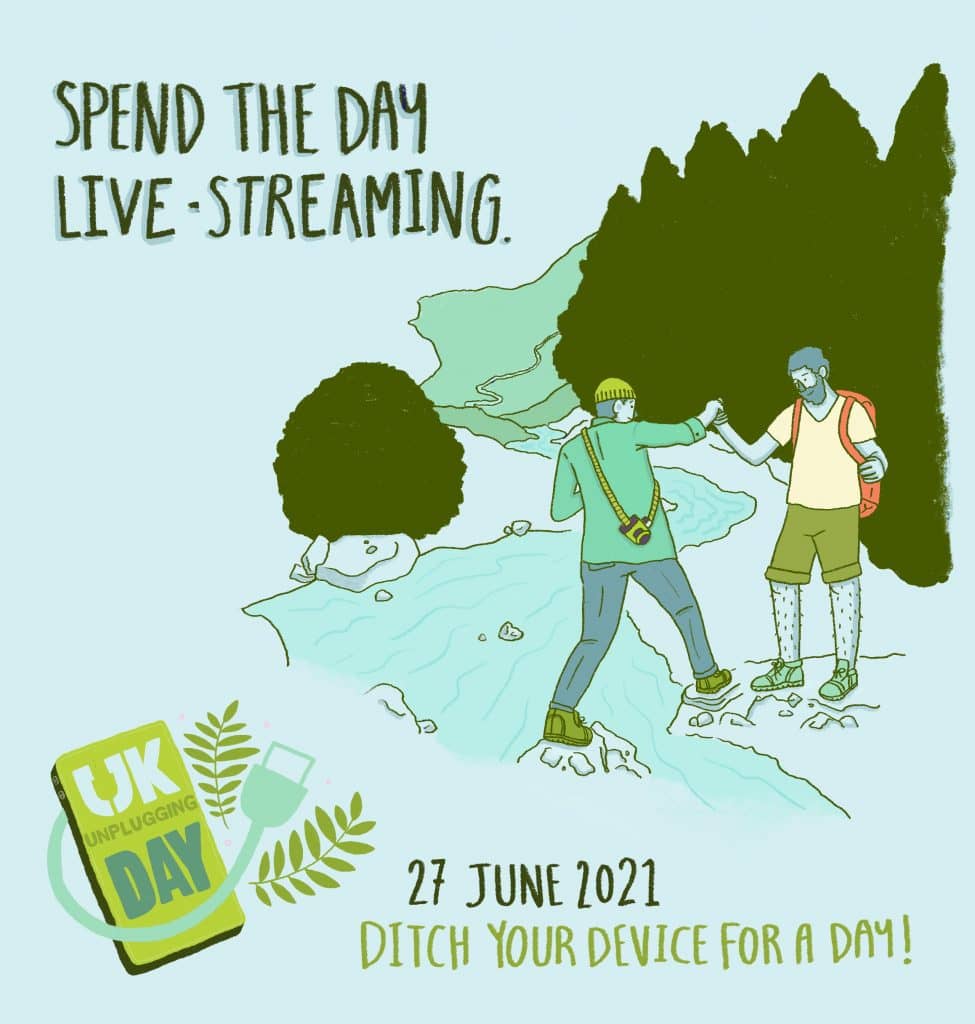
    Spend the day live-streaming on UK Unplugging Day, 27 June 2021

    We’re passionate believers in the restorative power of getting out in nature and it has been part of our manifesto since our founding in 2014. Time in a green space has been shown to lower stress, blood pressure and heart rate, while also lifting our mood and boosting our mental health. Research from 2019 showed that just 20 minutes a day spent in a park — even if you don’t do any exercise — is enough to improve your well-being.

    Ditch Your Device for a Day on UK Unplugging Day 2021
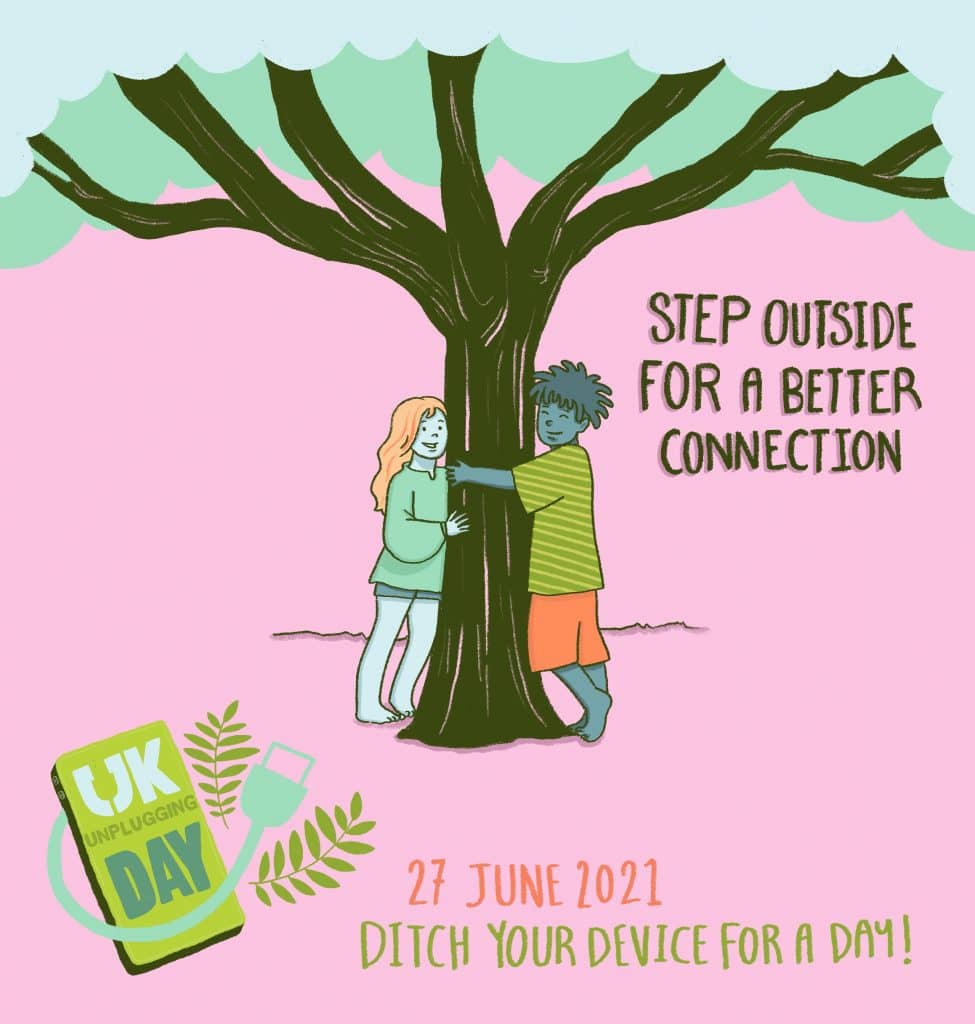
    Step outside for a better connection on UK Unplugging Day, 27 June 2021

    And our relationships are another thing that we could be focusing more on, when we spend more time off screens. More than half of UK adults (54%) in 2018 admitted that connected devices interrupted face-to-face conversations with friends and family. One study found that more than 17% of adults phub others (snub them by looking at their phone) with almost 32% of people complaining that they themselves are ‘phubbed‘ two to three times a day.

    While it might not seem like a big deal when you pick up your phone when your partner, friend, or child is talking, research suggests that the habit of phubbing may be really hurting your relationships and your own mental health.

    Ditch Your Device for a Day on UK Unplugging Day 2021
    Devote the day to organic search on UK Unplugging Day, 27 June 2021

    So, we think taking part in UK Unplugging Day this coming Sunday will benefit you in more ways than you might expect. It’s not just about taking time off screens, it’s also about boosting your mood and mental health and investing in your closest relationships.

    If you’re worried about the FOMO – well, the fact that it’s a national day might help as there are going to be thousands of others going offscreen and giving it a go. Why not get your friends and family to take part too? By switching off on Sunday 27th June, you’ll be joining a growing global community of people who’ve found that regular, scheduled, time off screen benefits their physical and mental health, and indeed every aspect of their lives. Join in and tell us beforehand if you plan to using #UKUnpluggingDay on social media. Have fun!

    View the original article at itstimetologoff.com

  • What Happened to Our Screen Habits in the Pandemic?

    What Happened to Our Screen Habits in the Pandemic?

    Our screen habits have changed dramatically over the pandemic. During the first lockdown the Australian National Network saw an increase of 70-80% on adult screen time,. Ofcom found UK adults spent 40% of their time watching digital video (let alone the time they spent on answering emails, or even sleeping). Despite these incredible numbers, the shift in screen habits caused by COVID-19 has affected us each differently. Some were forced to work or learn from home, others had to continue to work as normal in order to support our communities.

    We relish a dig into screen time research at Time To Log Off so we wanted to examine the particular impact that the pandemic has had on our screen usage. Here are some interesting findings on the impact coronavirus has had on us and our screens.

    What Happened to Our Screen Habits in the Pandemic?

    Kids screen time didn’t go up as much

    According to one study, children’s screen usage rose by around 60% during the pandemic. The American Academy of Paediatrics found in 2019 that children aged 13-18 were spending 6.5 hrs online a day and those aged 8-12 spent 4.5 hrs a day, so the additional time in 2020 made a huge difference.

    For many of those children the additional time spent on screens has been as a result of remote schooling, with education and socialisation necessarily taking place online. This even continues today, with 375,000 UK children currently off school due to coronavirus infections.

    Interestingly, the general trend with children and young people appears to suggest that the increase in their screen time was lower than that of the average adult. Perhaps suggesting that they have been able to find other outlets. Or simply underlining the reality that their previous screen time use was so high it wasn’t dramatically increased by a global pandemic.

    Working from home

    What Happened to Our Screen Habits in the Pandemic?

    Like children, many adults were also being forced to work remotely. Adult screen time was therefore also increased, with many reaching up to 11 hrs a day. Adult social options were also confined largely to screen-based activities. And many adults found themselves not only working eight hour days online, but then also spending a further two or three more hours on screen-based activities to ‘unwind’.

    This trend was clearly understandable, and even now continuing due to a widespread anxiety at the relaxation of COVID rules after so long. But we do recommend adults get back outside and meeting friends and family in person, as much and as soon as possible.

    Screen time differences by gender weren’t significant (but the impact was)

    One factor which did not impact changes in screen habits during the pandemic was gender. Men, women and non-binary people all increased their screen usage at similar rates. But that doesn’t mean that the effects of excess screen time were experienced equally. Women were more likely to report depressive symptoms than other genders. Nearly half of all participants in one survey reported symptoms of depression which rose to well over 50% in women.

    What Happened to Our Screen Habits in the Pandemic?

    The general trend across the last year is that all of our screen habits have increased as (by necessity) we spent more and more time online. For children and young people the rate of increase was somewhat reduced, perhaps due to their already high levels of screen time. For different genders it has had a different impact on mental health. For all, though, it has been momentous.

    View the original article at itstimetologoff.com

  • The Latest In Digital Detox Research

    The Latest In Digital Detox Research

    As we emerge from – what we hope will be – the final lockdown in the UK, we can gain a new perspective on just how much our lives have changed over the last 15 months. In particular, we want to review how our tech habits have changed, and what impacts these changes have had on our overall wellbeing.

    New Research Interrogates the Link Between Higher Screen Time and Depression

    A new study has undermined previous studies on the impact of tech habits on mental health by suggesting that the data gathered for these is flawed. The study argues that any study wherein the participants have self-reported their screen time and habits is likely to be inaccurate, as this method of data-gathering is unreliable. And, earlier this year, Mark Zuckerberg himself claimed that there was no conclusive research linking excessive screen time with worsening mental health.

    However, whilst the data for some studies may be biased, there is still evidence and reason to believe that increased screen time results in reduced mental wellbeing. Not only do other independent studies still maintain that excessive technology use is bad for your mental health, but our understanding of why this may be the case is increasing too.

    Cyberpyschology – an emerging field studying the effect of our interaction with technology on our brains – is not just about analysing trends between internet use and mental health. It is about trying to explain the psychological implications of our technological habits, and how exactly these could give way to mental health conditions. In light of Zuckerberg’s rejection of the hypothesis that heightened social media use could negatively effect mental health, psychologist Jean Twenge argued that there was still evidence indicating a link between the surge in social media and smartphone use, and in mental health conditions experienced by young people.

    For example, over lockdown many of us experienced Zoom burnout: a phenomenon which Stanford researchers confirmed and explained. From the unnatural overexposure to videos of ourselves throughout the day, to the loss of mobility due to having to be sat a desk during a call, it was clear to see how different aspects of the digital platform could have negative impacts on our health. In a similar way, we can see how our digital habits may be effecting our health by evaluating how we feel when we use our devices – for example, by considering what social media does to our self esteem, or how gaming is affecting our posture and mobility.

    So, despite the lack of clarity surrounding whether technology causes mental health conditions, we can still conclude that it takes a toll on our wellbeing. And if it makes logical sense to us that certain experiences linked to our technology use could place us under stress, then we should take necessary precautions to protect our health.

    Excessive Screen Time Linked to Obesity

    Even if the more evidence is needed to link increased screen time to a decline in mental wellbeing, the negative effect of our tech habits on our physical health is undeniable. Our vision, posture and physical fitness have all been found to suffer as a result of excessive screen time.

    Most recently, a study on 9 to 10 year olds in the US found that spending longer on screens throughout the day was associated with a higher BMI. The researchers recorded the screen time of the children, and then measured their BMI a year later. This illustrates the unhealthy buildup of harmful tech habits.

    This study was conducted pre-pandemic. However, had the research been done whilst social restrictions were imposed, it may have yielded even more dramatic results. With sporting and social activities cancelled, and children’s education conducted online, young people’s screen time has rocketed since the pandemic began.

    Excessive screen time is actually defined by the study as only over two hours of usage a day. This may come as a shock; I’m sure many of us are guilty of spending far more than that daily, and know of children who are too. In fact, the latest statistics from USwitch tell us that the average UK adult spends almost half of their day on screens.

    Our Sleep Suffered from our Pandemic Tech Habits

    Confined to our homes and unable to see family and friends, we relied on technology a whole lot more throughout the pandemic. In fact, our tendency to use tech in the hours preceding our bedtime increased, and this wreaked havoc on our sleep schedules.

    An Italian study showed that increased screen time before bed resulted in reduced sleep quality. Participants were found to go to bed later, and to then suffer from exacerbated insomnia symptoms. The consequent reduction in the hours of sleep they got meant they found it harder to get up in the morning.

    This is unsurprising. Research has shown before that blue light disrupts our natural sleep cycles, so when we use backlit screens in the evening, we are making it more difficult for ourselves to wind down and prepare to sleep.

    The Latest In Digital Detox Research

    A Digital Detox Following a Digital Year

    With the benefit of retrospect, we can see how dramatically our tech habits have changed since before the pandemic, and not necessarily for good. Whilst we can be grateful that technology was there to keep us connected whilst under social restrictions, we now need to reevaluate our relationships with our devices.

    Research continues to illustrate the negative impacts tech can have on our health if we are not careful with our usage patterns. Therefore, we encourage you to take a digital detox. You will likely see positive changes to your wellbeing, and this past year and a half has shown us more than anything how important it is to protect both our physical and mental health.

    The Latest In Digital Detox Research

    For more about how to untangle our relationship with tech, pre-order ‘My Brain has Too Many Tabs Open‘, out in the US and UK on 21st September.

    View the original article at itstimetologoff.com

  • The Best Digital Detox Advice We’ve Ever Received

    The Best Digital Detox Advice We’ve Ever Received

    We are living in a world drowning in too much information. Everywhere you turn there are experts who can advise on the minutiae of every decision you make, especially regarding your health and wellness. It is no wonder that so many articles have been written in the last year about being us being overwhelmed, by mental health, work issues, parenting concerns and more. Your digital health need not be another area where you are struggling to choose between conflicting advice, constantly worried that you are not doing the ‘right thing’. So, we have taken all of that stress away and condensed six seasons of our podcast down to give you the inside track on the best digital detox advice we have ever received.

    Cal Newport
    The Best Digital Detox Advice We’ve Ever Received

    Cal Newport is a heavyweight in the world of digital detox advice. He is an associate Professor of Computer Science at Georgetown University in Washington DC and the author of six books about work and productivity, including the bestselling ‘Deep Work’. He knows what he is talking about. He also walks the talk too, having no social media and maintaining most of his life offline. We were very excited to talk to him about his advice and it boiled down to:

    • Take at least 30 days offline before you start to rebuild your digital life
    • Start by figuring out what you care about and then, working backwards, choose which digital tools help you do that, and only use those.
    • Divide your work and home life, e.g. do not do work or have work emails on your phone.
    Thomas Brag
    The Best Digital Detox Advice We’ve Ever Received

    Thomas Brag on the other hand comes at this issue from a completely different perspective as a content creator on YouTube, one of the founder of the Yes Theory channel (over 6 million subscribers). Yet, he was influenced by the work of Cal Newport and took a 30 day sabbatical from social media. His advice was to:

    • Take a period of digital detox and completely unplug.
    • Make your time, on social media in particular more active. Engage, rather than sitting back.

    Andrew Cotter

    The Best Digital Detox Advice We’ve Ever Received

    Our final piece of advice comes from our first episode of the new Season 6 where, if you listen to the end you might be able to hear some canine contributors too. Andrew Cotter is a sports broadcaster who shot to international fame during lockdown due to turning his skills to hilarious commentary on the antics of his two labradors: Olive and Mabel. The videos have been watched over 800 million times. However, he too is aware of the conflicting positives and negatives brought by social media fame as well as the digital world more generally. In speaking to Tanya Goodin, our founder, Andrew Cotter’s advice was to:

    • Try to only focus on positive interactions online.
    • When the negative outweighs the positive, log off.

    Hopefully these top tips from our most esteemed guests (Olive and Mabel, we’re looking at you) will help you find a good balance in your digital life, but if not, or you are looking for more top tips, our podcast: It’s Complicated is always a good place to start.

    View the original article at itstimetologoff.com

  • 4 Biggest Mistakes People Make When They Try To Log Off

    4 Biggest Mistakes People Make When They Try To Log Off

    Trying to log off can be hard. However, there are certain habits you may be subconsciously keeping which could be making it even harder. Here are the biggest mistakes people make when trying to log off:

    They keep their phone in sight and accessible

    Trying to stay off your phone whilst having it in reach is rather like trying to eat healthily when there is a chocolate bar lying right in front of you. Constantly keeping your tech nearby is not going to promote any healthy habits; you are going to be distracted. Having your phone so close by makes it so much easier to give in to the temptation of aimlessly checking it.

    Try instead placing your tech in a drawer or – even better – in a separate room. At the very least, place your phone face down when you are not using it, to prevent your wandering eye from trying to glimpse notifications.

    4 Biggest Mistakes People Make When They Try To Log Off
    Remove your phone from your space when not using it: out of sight, out of mind.

    They keep push notifications on unnecessarily

    Like a moth to a flame, nothing tempts us to go on our tech quite like seeing it lit up with notifications. Turn these off. They will only distract you and make you want to unnecessarily log on, as well as evoking FOMO.

    If you are concerned that you will miss important notifications, for example phone calls, you can customise your notification settings. For example, you could fine-tune them so that your phone still alerts you to calls but not to Instagram likes, or email notifications. That way you can minimise temptation whilst also being free of any anxiety that may accompany the idea of not being reachable by phone.

    They don’t try to find replacements

    There are some instances where we rely on our screens to fill a gap; for example, the commute to work. Our tech gives us something to do and, in trying to cut out technology from certain aspects of their lives, many people make the mistake of not substituting it with anything else.

    Nothing is going to make you reach for your phone like boredom will. If you are trying to cut down your screen-time, make sure to equip yourself with an alternative, such as a book, a project or exercise, to fill the gap. You will find that by keeping boredom at bay, you will experience fewer urges to check your phone.

    They are too harsh on themselves

    In an increasingly digital world, it is a big ask of oneself to go ‘cold-turkey’ and log off. Instead, be realistic with yourself and set small personal goals. These should challenge you, but not make you feel uncomfortable. The more you try to restrict yourself, the more likely you will succumb to temptation. It is far healthier and better for you in the long run to establish a good balance with tech, than to repeatedly fail to adjust your screen-time because your aims are too ambitious.

    Enjoy the time you log off

    There are probably digital activities you really enjoy and don’t want to cut out, such as talking to friends online or watching a certain TV show. Do not feel that you have to deprive yourself of these. Instead, set yourself realistic time limits to ensure you are using your tech responsibly and maintaining a good digital-life balance.

    View the original article at itstimetologoff.com