Tag: relapse prevention

  • How To Party Without Mixing Alcohol And Drugs

    How To Party Without Mixing Alcohol And Drugs

    ARTICLE SUMMARY: Are you a young person in early recovery? Take note! You need to know when to avoid a party. But when you’re ready to hit the scene, practice these refusal lines. More here.

    TABLE OF CONTENTS


    Night Life in Addiction Recovery

    Leaving old habits behind might be challenging and tricky. If you used to mix alcohol with drugs, it can be really uncomfortable to go out again. Can night life ever really be the same? If you’re in recovery, you actually might want to pass it up for a while.

    Why?

    Being near the scene can be dangerous. Just exposing yourself to triggers can lead you to relapse. If you are in treatment, it’s highly advisable you stay away from direct triggers. Sounds. Smells. Images. These are the things that can jeopardize the effort and progress on your road to reaching and maintaining sobriety.

    So how do you party when in recovery? Is it possible to have a good time without the influence of drugs and/or alcohol?

    Of course you can.  Keep reading further to find out how to protect yourself when the environment and people around you act as a temptation. Plus, read about alternative fun activities that do not include the use of alcohol and drugs. All your questions and/or personal experiences about partying without mixing alcohol and drugs are welcomed at the end.

    Can I Party In Drug And Alcohol Addiction Recovery?

    Absolutely!

    Recovery programs exist to teach addicts that sobriety is not boring! On the contrary, recovery opens up a lot of new opportunities. You just need to learn and practice some alternatives to bring you fun and joy without exposing yourself to danger.

    Q: Who should refrain from partying?
    A: If going out endangers your recovery, maybe you should stay home.

    At least for now.

    Why?

    Common Triggers

    When you make a decision to quit mind-altering drugs, some situations are just not healthy. Seeing a set of friends who look like they are having fun. Or, hearing the sound a lighter hit glass. Or, listening to that song that brings back nostalgia and a desire to get high.

    These are all triggers that might set off a desire for you to reach out for drugs and alcohol again.

    Theoretically, there are two types of triggers:

    1. Internal triggers, which usually manifest themselves as negative feelings.
    2. External triggers, that include people, places, things, and situations that provoke you to get back to your old substance abusive behaviors after a period of abstinence.

    When you are in early addiction recovery, you’ve just started developing a sober lifestyle. You aren’t quite used to feeling subtler emotions. We who are in recovery have all been through it.  You’re used to getting high…and dealing with the lows. But, we just don’t have healthy habits ingrained into our brain pattern yet.

    So, it’s best to avoid:

    1. Parties at clubs where you used to drink alcohol or use drugs.
    2. Acquaintances that still drink and take drugs.
    3. Visiting places while you are in an emotional period where drugs and alcohol are expected to be present.

    In fact, a night out can be super confusing. While it can be a learning experience, you need to be in a really stable place in early recovery. This is because hitting the night life can make you feel vulnerable. It might even lower your enthusiasm for change, or impact your self-esteem…both of which eventually may increase the possibility of relapse.

    The Cycle of Craving

    So, here’s a little deeper explanation into why you might want to wait. I’m not suggesting that you not have fun. I’m just saying that changing the way you have fun can be worth it.

    Addiction triggers involve high-risk situations. They are viewed as stressors that spark a thought, feeling, or action which makes you desire drugs/alcohol over and over again. When a trigger strikes in you get a sudden and unexpected urge to use again, it’s called a “craving”. In short, addiction triggers usually lead you to cravings and cravings stimulate your urges to use.

    This is why one of the main focuses of rehab is to teach you to become more aware of your specific triggers. Once you identify the trigger, you can learn how to control the sequence of events. Perhaps you can avoid the trigger totally. Or, you can learn how to change your related thought pattern. Or, maybe you intervene on the behavior-level.

    This is possible only through education. If you learn successful craving or coping management skills, you’ll necessarily learn techniques for fighting craving in recovery.

    Refusing an Offer

    Learning to say NO takes a little practice. Relapse prevention tips and refusal lines are taught during every addiction treatment program. But we’ve noticed that you need to actually practice these lines BEFORE you’re in a tight spot. Here are some suggestions about what you can say/do in different situations.

    1. First, go to events where there are no drugs and alcohol.

    2. Second, connect with friends who support your decision not to use drugs. Ask for support from these friends when others become pushy in their offerings.

    3. When in a problematic situation, make an excuse to leave. Just get out of there.

    When you are offered with drugs or alcohol, use definitive refusal lines such as:

    • I’m good.
    • No, thank you.
    • I can’t.
    • I have some medical issues right now.
    • I pass.

    I made the mistake in early recovery of trying to “explain it all”. No one who’s using wants to hear why you’re not using. They just want you to join them so that they can feel less alone.

    So, the bottom line is that you don’t feel like you need to explain yourself. No one needs to “get it.” They probably don’t want to.

    Alt Partying

    The sober community has many members. Most of us know what it’s like to wake up the next morning, blacked out. But just because we’re not using doesn’t mean that we’ve lost the will to have fun. Recovery is about building a new life, one that drugging and drinking parties are not a part of any more.

    If you want an alternative way to party, think about hosting your friends at your house. You can be the host of a sober party. You don’t need to socialize with just people in recovery. But make sure people know that substances are off limits.

    Some people like board games. Other people just party around food and music. Still others meet and then go to an event together. Whatever. Just get some people together and find something you all like to do. Talk to people at the party and connect. That’s more than a party; that’s creating a community.

    Or, find hobbies that don’t involve alcohol/drugs but are still entertaining such as: table sports, darts, card games, going to the zoo, or to the movies. Dancing is one of most recommended ways lifting your mood.

    Finally, be prepared. If you’re going to an event where psychoactive substance will be present…resolve to:

    • Choose mocktails instead of cocktails.
    • Use your refusal lines.
    • Plan an escape if temptations gets too great.

    Your Questions

    At some point, mixing alcohol and drugs gets old. It leads you down that same dead end.

    But maybe you have questions about what you’ve just read. Maybe you have an experience to share? Feel free to leave your comments below. Me and my team will make sure to get back to you with a personal and prompt response.


    Reference sources: Dr. Chad Coren: TRIGGERS OF ADDICTION
    Girl’s Health: Ways to say “no” to drugs
    NIH: Building your drink refusal skills

    View the original article at addictionblog.org

  • Everything you think you know about addiction is wrong | Johann Hari

    Everything you think you know about addiction is wrong | Johann Hari

    What really causes addiction — to everything from cocaine to smart-phones? And how can we overcome it? Johann Hari has seen our current methods fail firsthand, as he has watched loved ones struggle to manage their addictions. He started to wonder why we treat addicts the way we do — and if there might be a better way. As he shares in this deeply personal talk, his questions took him around the world, and unearthed some surprising and hopeful ways of thinking about an age-old problem.

    TEDTalks is a daily video podcast of the best talks and performances from the TED Conference, where the world’s leading thinkers and doers give the talk of their lives in 18 minutes (or less). Look for talks on Technology, Entertainment and Design — plus science, business, global issues, the arts and much more.

    View the original article at ted.com

  • Relapse Prevention: Staying Sober Through Life Setbacks

    Relapse Prevention: Staying Sober Through Life Setbacks

    Without recovery tools or a relapse prevention plan, it can be difficult to stay sober while dealing with a significant life setback. The lure of the drink or drug to ease the pain and bring comfort becomes too great to resist.

    When people at treatment centers or in 12-step meetings say that relapse is part of recovery, it turns my stomach. Although the door to recovery remains open after a relapse—as long as a person survives such dangerous waters—relapse is not part of recovery. At the same time, however, the slip and slide process that leads to a relapse does happen in recovery.

    Whether we are newly clean and sober or have stacked up many years—even decades—of sobriety, the triggers that lead to a relapse happen before we pick up the first drink or drug. But if we have done the work and have recovery tools in place, these triggering events can be processed successfully instead of leading to a relapse. We acquire recovery tools through 12-step programs, SMART Recovery, therapy, or whichever recovery pathway we have chosen, and we use them for relapse prevention.

    Without recovery tools, it can be immensely difficult to stay sober while dealing with a significant life setback. The lure of the drink or drug to ease the pain and restore a sense of comfort becomes too great to resist. It reminds me of the mantra of Dr. Gabor Maté: “The question is not why the addiction, but why the pain.”

    But we have to know how and when to use the tools properly, which requires practice. We gain this practice by working the 12 steps or taking other constructive actions in our recovery pathway well before a triggering event occurs. Then, when we hit a life setback, we are prepared.

    Here are four life setbacks which can lead to relapse if we do not have recovery tools.

    1. The loss of a job, a promotion, or a major work opportunity

    One of my favorite sayings in 12-step programs is that an expectation is a resentment under construction. When you miss out on a significant work opportunity or you’re let go from your job or passed over for a promotion, it is natural to feel crushed and overwhelmed. Many people in recovery take professional setbacks personally, punishing themselves for a perceived failure. There is a reason alcoholism is called a disease of perception. We will drink or use to escape the pain of a perceived failure, or—in a masochistic fashion—to inflict more damage on themselves as the vicious punishment for such a failure. When you consider the consequences, this outcome can be devastating.

    Rather than sinking into depression and self-blame, you can use recovery tools to put the setback into context. Did you know people change jobs an average of 12 times during their career? In January 2018, the Bureau of Labor Statistics reported that the median employee tenure was 4.3 years for men and 4.0 years for women. The very nature of employment is a roller coaster ride of ups and downs.

    Given these statistics, it’s easy to apply the second and third steps to a career setback. If you turn over the disappointment to a higher power and have faith that another opportunity will arise, then relapse is less likely to occur. If you discuss the problem in a group, you will receive support and learn from the similar experiences of other people.

    2. Global events like elections, terrorist attacks, and natural disasters

    People in recovery tend to take everything personally. We sometimes use big events that may have no direct impact on our lives as reasons to drink or use. After the last presidential election, I heard many people in meetings bitterly joke that they were either moving to Canada or having a drink. Luckily, most of them did neither, regaining their focus on the microcosm of their own lives. They focused on what was right in front of them, remembering to take things one day at a time.

    When seemingly apocalyptic moments arise, there is an urge to console ourselves. We feel the pain and horror of terrorist attacks and natural disasters and use those feelings as a justification for a relapse.

    An essential recovery tool for sidestepping this kind of relapse is avoiding isolation. When we are alone and in our heads, we are in dangerous neighborhoods. By going out and spending time within a supportive community, the disaster loses some of its power over us. We come to understand that it’s not only our tragedy and can share our pain with others. We do not minimize the horror or sadness of what happened, but we also do not use it as a reason to relapse. We don’t have to make our lives worse in response to disaster.

    3. The death of a family member or a close friend, and the pain of mourning

    Death can be one of the hardest challenges to face for anyone in any context. The loss of a family member, a loved one, or a close friend can be incredibly painful, both spiritually and emotionally. For someone in recovery, the situations in which we grieve present their own unique difficulties. In circles of mourning, alcohol is a conventional lubricant. It can be easy for someone without recovery tools to pick up a drink during this time.

    By talking about your feelings and reaching out for support, you can be guided through the pain. You will learn that by staying sober and clear, you have the opportunity to be present for your family and friends. You can be of service in a time of great need. Moreover, you honor your loved one by maintaining your sobriety. If you feel like you were not able to make amends for a past wrong, then make a living amends by staying sober and honoring their memory.

    4. The end of a relationship

    Have you ever heard the story of a person in early recovery who started dating and turned their partner into their higher power? Rather than focus on their own recovery and sanity, they focus on the relationship. What they fail to realize is that whenever recovery becomes supported mainly by a human relationship, the recovery (and usually the relationship) are on thin ice.

    Sometimes, the end of such a relationship leads to a relapse. When someone in early recovery focuses with such fervor on a partner, they no longer can keep the focus on themselves. This is why you hear the recommendation to stay out of relationships during the first year of recovery, or until you’ve worked all 12 steps.

    The end of a healthy relationship in long-term recovery can be dangerous as well. Breaking up can hurt so deeply that you feel you can’t bear it; having a drink or taking a drug seems to be the only way to stop the heartache. However, the pain is so much worse when it’s kept inside and remains unspoken; and while drinking or using may look like a way to find quick relief, you can’t actually escape this hurt. You only postpone the feelings and frequently the relapse brings more misery. By sharing the pain and talking about it with other people, you can obtain perspective. Although applying the principles of recovery to a breakup may help you avoid a relapse, it’s not a cure-all. When love ends, we suffer, and such suffering takes time to heal.

    Whatever life setback you might face today or in the future, taking a drink or using a drug will not help resolve the difficulty and in the vast majority of cases, it will make a bad situation much worse. Instead, cut the cord that connects drinking and using with pain relief. It’s a temporary and usually ineffective fix. For people who have lived with addiction or substance use disorders, the most powerful recovery tool is the simple and honest realization that drugs and alcohol are never the solution.

    What’s in your recovery toolkit? How do you deal with life setbacks without using or drinking?

    View the original article at thefix.com

  • Does Empathy Play A Role In Relapse?

    Does Empathy Play A Role In Relapse?

    Scientists examined whether empathy can push a person in recovery to relapse for a new study. 

    Having empathy — being able to relate to other people’s emotions — is generally considered a positive trait, but new research suggests that empathy could lead to relapse for people who are in recovery. 

    Dr. Jonathan Gewirtz, a professor in the Department of Psychology at the University of Minnesota, led a team of researchers who found that mice who witnessed another mouse in a scary situation were more likely to seek out drugs afterwards. The findings were presented during the 57th Annual Meeting of the American College of Neuropsychopharmacology, being held this week in Florida. 

    Gewirtz says his lab studies the biology of fearful memories and drug dependence, “since negative affective states are a prominent feature of drug withdrawal and likely play a critical role in the persistence of drug addiction.”

    To set up the empathy experiment, mice were placed in a two-sided container, where they got a dose of saline solution on one side, or morphine on the other, according to EurekaAlert and a press release by the American College of Neuropsychopharmacology.

    Over several days, the mice associated a specific side with the drug. Then, two weeks later the mice received only saline on either side. This was meant to mimic a period of sobriety after addiction. 

    Next, the mice were exposed to seeing another mouse in a frightening situation. Following that, they were put back in the two-sided compartment. 

    “Consistently, the sober mice preferentially selected the compartment that was associated with morphine, demonstrating drug-seeking behavior in response to witnessing a traumatic event,” according to the press release. 

    During the experiment, the researchers measured the mice’s fear response. 

    To strengthen the connection between empathy and drug-seeking behavior, scientists then treated some of the mice with oxytocin, a chemical that is associated with social bonding and thus empathy. They found that these mice had a greater fear response than mice that were not treated with oxytocin. 

    “[Researchers] conclude that mice, and potentially people, that witness a stressful event are negatively emotionally affected, which may lead them to seek drugs, even after a period of sobriety,” according to the press release. “Oxytocin treatment exacerbates this response, indicating that social bonding (and empathy, by extension) is a driving force in this behavior. The researchers say these findings are the first to demonstrate the direct link between empathy and drug relapse, as well as to suggest oxytocin may play a role in enhancing this response.”

    View the original article at thefix.com

  • Get Rid of Drug Cravings Once and for All

    Get Rid of Drug Cravings Once and for All

    ARTICLE SUMMARY: There is no way to completely eliminate drug cravings. However, you can learn to live with them…and get through them. This article reviews why cravings occur and offers three practical ideas on how to cope.

    ESTIMATED READING TIME: 5-10 minutes.

    TABLE OF CONTENTS:

    Drugs and Pleasure

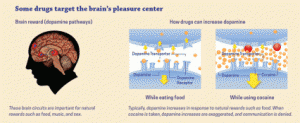
    To start to understand a craving, we need to look first at how drugs work in the brain. According to the National Institute on Drug Abuse (NIDA), experts used to think that a specific chemical neurotransmitter (dopamine) produced by drugs creates an extreme feeling of well-being. However, the reality is that the way drugs work in the brain is a little more complicated than that.

    Today, scientists now think dopamine has more to do with getting us to repeat pleasurable activities (reinforcement) than with producing pleasure directly. Large surges of dopamine “teach” the brain to seek drugs … while other, healthier activities such as exercise, creative pursuits, relationships, or even sex, get sidelined.

    The Definition of  a Craving

    So, what is a craving, exactly?

    Well, take away the drug-of-choice…and the need to feel pleasure still exists.  Our natural ability to feel pleasure can take some time to return as the brain returns to normal function. This is why people often feel the following in the first few months of addiction recovery:

    • depressed
    • flat
    • lacking motivation
    • lifeless

    The technical term for this is “anhedonia”. For some drugs – like meth, cocaine, heroin, or painkillers – it can take months or years for the brain’s chemistry to return to normal. And the amount of time it takes for the brain to return to homeostasis after a period of addiction will vary by individual.

    What’s important to know is that most of us are physically unable to enjoy things that were previously pleasurable. And naturally, we consciously and subconsciously seek out pleasure…to make life fun! This is why drug craving is natural outcome of drug use: it is a physical or psychological urge for your drug-of-choice.

    A craving is a deep yearning for the effect of your drug-of-choice.

    Triggers

    A craving can come out of the blue. It can also be”triggered”. Indeed, most cravings are usually prompted by a trigger. Triggers include external stimuli such as:

    • Certain people
    • Places
    • Situations
    • Smells
    • Other external stimuli

    Triggering situations affect the area of the brain called “amygdala”. When a triggering situation occurs, the amygdala sends signals to the other parts of the brain reminding you of your drug-of-choice. The amygdala regulates functions such as memory and learning, so you are in the company of a person, or in a certain situation that somehow reminds you of your previous addictive behavior… reaching for drugs again is a program running in your brain. The trigger sets of a pattern of decision making that can spiral you into an unconscious decision to use.

    During this process, you may even experience sensations such as shaking, cramps, anxiety attacks, nervousness… etc. A craving sensation can literally nearly take control over a person. However, you can stay in control by knowing the brain science behind them.

    Cravings occur as the result of powerful memories linked to substance abuse. When a trigger occurs, the amygdala lights up and in a moment, you can nearly feel the pleasure of your drug-of-choice. But cravings come and go. They do not last.

    They key to coping with cravings is to anticipate triggers and learn to avoid them. A craving may never go away compltely…the learned “reflex” can last a long time, even in people who haven’t used drugs in many years. Like riding a bike, the brain remembers. Cues that are linked with drug use can trigger uncontrollable cravings whenever you experience the cue, even if the drug itself is not available. However, you can stay in control of a craving and learn to ride it like a wave.

    Are Cravings Normal in Recovery?

    Yes.

    Almost every addict in recovery experiences craving. In fact, cravings are a very common and normal part of addiction recovery. The urge to take your drug-of-choice is rooted in brain chemistry.

    Again, they key is to be aware that they happen. When cravings appear out of nowhere they tend to take us by suprise. And if they come out of the blue, a craving can be sudden and very unpleasant. Indeed, the sudden and impulsive nature of cravings are one of the key factors for relapse.

    Therefore, it’s highly recommended that you ask for help when they strike. This because you’re working with long term memory association in the brain. A trigger can not be “deleted” as easily as people think. So, because cravings act as “automatic” and unconcious desire,s it’s best that you seek help from mental health professionals in order to manage them.

    A counselor, psychotherapist, social worker, or addiction doctor can help you to plan for cravings and teach you tools and strategies for managing them.

    Experiencing cravings and looking for ways to get rid of them? The next section offers you ideas aabout how to manage a craving and what to do when they appear.

    • Are your thoughts preoccupied with your drug-of-choice?
    • Can you literally taste your drug-of-choice on your tongue?
    • Do you experience a strong desire to see old friends?

    Do not worry, these are all normal.

    What you do next is key!

    What Do The Experts Say?

    Ph.D. Adi Jaffe defines cravings as programmed responses to environmental signals that have been connected to drug use through experience. His advice is that when you have a craving, recognize it for what it is. If the experience is overwhelming, make sure there’s someone you can talk to about it (a therapist, partner, parent, or 12 step sponsor). As time passes your cravings will become less and less frequent, though without specific treatment, their intensity will likely not go away. Like he says, cravings are a part of the reality of addiction – knowing what to do with them is a key to success.

    Randy Lindel, Facilitator at SMART Recovery says:

    “Everyone who’s engaged in addictive behavior will experience uncomfortable cravings (“I want it badly”) and urges (“I have to do it now”).”

    Again, this experts notes tha they are normal. And fortunately, h reminds us, they always pass with time. At the outset of recovery, they can be pretty intense, but each one will subside if you can wait it out and have a plan for relapse prevention. Cravings and urges will decrease in strength and frequency over time. You can make this happen by adopting some coping strategies that work best for you.

    3 Ways to Cope: How To Work with Cravings

    1. Learn your personal triggers.

    Being aware about the things that are associated with your addiction past is the first step towards learning how to take control of them. Most people are not aware about which things signal a craving. This is one of the main tricks of cravings. If they are not consciously recognized and registered they tend to act as automatic occurrences forcing your attention on using.

    Cravings may present themselves in any form, but the key thing is learning to recognize your personal triggers. When you are able to detect your personal triggers, you can avoid them. In fact, many professional recommend that you list alternatives to avoid certain people, places, smells or situations which can bring up old, unhealthy habits.

    2. Find a new brain circuit to reinforce pleasure. Or, occupy your mind.

    It’s vital as you identify triggers, you also look for other activities to replace drug use. The brain is re-programmable. So, here are some ideas for what you can do when cravings strike:

    • Ask for guidance and help from a trained treatment professional.
    • Change your routine.
    • Distract yourself: Read a book, see a movie, or talk to a friend.
    • Do something spontaneously from your bucket list.
    • Go out for a walk or exercise for 20 minutes.
    • Practice mindfulness meditation.

    3. Actively create a safe, healthy and drug-free environment.

    We are creatures that hunt for reward. The need to satisfy your cravings and/or desires is based on availability. When a drug-of-choice is completely unavailable, we are forced to shift our attention elsewhere. Know this about your own human nature and bring health into your environment.

    In sum, eliminate all the possible triggers from the place you live and the places you go and the people you hang out will at least make you feel safe. Take responsibility for what you surround yourself in. Then, adjust your lifestyle accordingly.

    Professional Help

    There are many professionals and treatment methods developed to help people deal with cravings and prevent relapse . You can seek professional help from the following:

    • Addiction counselors or psychotherapists (APA find a counselor)
    • Addiction specialist doctors, or MD (ABAM find a doctor)
    • Licensed clinical social workers
    • Hotlines such as SAMHSA’s National Helpline – 1-800-662-HELP.

    Mental health providers can engage you in the following treatment modalities:

    • 12-Step meeting facilitation
    • Cognitive Behavioral Therapy (CBT)
    • Individual Therapy or Group Counseling
    • Mindfulness techniques

    Your Questions

    We hope this article offers practical guidance and some useful ideas about how to get through cravings in addiction recovery. In case you still have a question or want to share a personal experience… please feel free to use the comments section below. We try to answer all real-life comments personally and promptly, or refer you to an expert in case we do not know the answer.

    Reference Sources: Alternatives In Treatment: What Are Drug Cravings and How Do They Impact an Addict’s Life?
    Psychology Today: Craving: When the brain remembers drug use
    Addiction Blog: How does a heroin craving feel?
    Recovery: Cravings Symptoms, Treatments and Relapse Prevention
    A Road To Recovery Rehab: Understanding Cravings and How it Helps Recovery
    Addiction Blog: Coping with urges and cravings
    Addiction Blog: Coping with drug and alcohol cravings: A skills list

    View the original article at

  • Let’s Get Real: How To Handle the Tough Stuff in Recovery Without Using

    Let’s Get Real: How To Handle the Tough Stuff in Recovery Without Using

    Of course, people had good reason to think that I couldn’t handle upsetting news. Every time a hardship, breakup, or something unsettling happened, I wound up in the psych ward, detox, ER, or a bloody, tear-filled mess.

    When I was drinking, I was the girl who took pulls of rail vodka right from the bottle. I took it straight, no chaser. Others looked at me with a mixture of surprise and disgust. Girls were supposed to mix their vodka with fruit juice or soda. Girls weren’t supposed to out-drink the men or keep straight razors in their wallet for chopping up fat lines. Fellow drunks patted me on the back. I was one of them. I embraced my heavy drinking as a point of pride, wore it like a badge of honor.

    But the point of this isn’t to share my war stories or act like I was the most bad ass alcoholic or junkie to ever haunt the planet. Rather, I want to share how I still prefer to apply the “straight, no chaser” motto to other areas of my life. I prefer when loved ones are straightforward, blunt, and honest with me about tough stuff and hardship rather than trying to gloss over the truth or protect me from pain. Even though I have been in recovery for years, some of my loved ones have continued to worry that I will relapse upon hearing bad or heartbreaking news, as though I was some sort of wounded dove with the word “fragile” stamped on my forehead.

    Of course, they had good reason to think that I couldn’t handle upsetting news. Every time a hardship, breakup, or something unsettling in my life happened, I wound up in the psych ward, detox, ER, or a bloody, tear-filled mess. I categorized people as either “normies” or “addicts and crazies” because it was easier than embracing the messy complexity of human beings. In my mind I was broken. Normal people went to the gym, spa, or the mall when they were troubled. But those options didn’t work quickly enough to soothe my mercurial temperament and smooth my edges. I labeled myself as a crazy addict, so I went straight to the liquor store or to the organic grocery store (ironically this was where my dealers were, standing outside with signs reading: “needs money, anything helps”).

    If you’re someone who struggles with addiction, you understand this self-destructive pattern. It’s hard to deal with “life on life’s terms,” as they say in the program. When stressful life events happen, we often turn to our familiar coping mechanisms. In fact, the National Institute of Drug Abuse found that up to 60 percent of people relapse within their first year of recovery. 

    There is a constellation of reasons that people relapse. Studies have found that being exposed to stresses that originally caused someone to excessively drink or use drugs is a major trigger for relapse. Another study found that patients with alcohol and opioid dependence were most likely to relapse when they had a family history of substance use and high number of relapses, used maladaptive coping strategies, and also had “undesirable life events.”

    I can relate as I had my share of undesirable life events this past year. Even though I’ve been clean for a few years, I still felt a massive urge to use after hearing about the death of my god-daughter and, on a less serious note, a heartbreaking romantic let-down.

    These events were handled very differently. The morning after my god-daughter died, my mom called and told me the tragic news. She wanted to make sure I heard it from her directly rather than passively finding out about the death on social media. Although this was devastating news, I appreciated that she was direct and real with me.

    What really triggered my cravings was ambiguity and a romantic disappointment. Although we broke up a few years ago after I relapsed, I still consider my ex one of my best friends. We text every single day and I even stayed with him for five days when I was visiting Portland in December. He let me sleep in his bed while he slept on the couch. Wrapping myself in his blankets, I was comforted by his familiar smell of Camel cigarettes and Old Spice. Although the visit was platonic, there were moments when I felt a possible rekindling of our romantic relationship.

    He paid for all my meals, opened doors to restaurants, and even took me to the Oregon Museum of Mental Health in Salem where I researched an essay. Okay, maybe going to a museum of mental health isn’t exactly a hot date, but the fact that he was willing to take me felt positive. He also talked about taking a road trip together in his new BMW coupe, laughing at how when we had been together he drove a Buick and we barely made ends meet. I reminded myself that my intention for this visit was to make amends in person for spinning him in my addictive chaotic orbit and leaving him in the wreckage of our relationship. Yet I still got my hopes up that we would get back together and I wrote him a long letter proclaiming my feelings for him.

    He never responded. He faded away from me, and his texts became infrequent and vague. He said that he was busy and stressed with work. Finally, he admitted to our mutual friend that he had a girlfriend but was afraid to tell me because I was “constantly on the verge of suicide” and he was worried about relapse.

    I was crushed, but at the same time I sort of understood his perspective. He knew the story of my old self. I had shown him in the past that I couldn’t handle such rejection or disappointment.

    So how do we deal with the tough stuff in recovery? Amanda Decker, a Licensed Addiction Counselor (LAC) and Licensed Professional Counselor (LPC) in Fargo, North Dakota, explained: “There will be growing pains throughout the ebb and flow of recovery. It’s hard knowing how to deal with life without drugs or alcohol but it’s helpful to remember that perspective shifts over time. It also helps to develop hobbies and interests. When people in recovery can embrace these things, drugs and alcohol become white noise in the background.”

    Decker suggested developing a “pre-emptive” relapse prevention plan by thinking about how to handle life stressors without alcohol or drugs. If we are in the position of telling difficult or uncomfortable news to a family member or friend who is in recovery, Decker advises: “As an addiction counselor, I’ve had to tell my group about a fellow group member who has overdosed. The first thing I did was to be direct and be present with my group members who were struggling in that moment. There will be a lot of grief and sadness that we have to learn to cope with.”

    The truth is that hardship, tragedy, and disappointment are parts of life that we have to learn how to come to terms with in recovery. We have to start embracing and seeing the shades of wellness and addiction rather than labeling things “normal” or “crazy.” It’s hard to tell a different story about ourselves, it’s even harder to break the story that others have about us. But I have faith in myself and I have faith in you, my fellow humans in recovery. For we are resilient, brave survivors, not fragile wounded doves.

    View the original article at thefix.com

  • Can Exercise Prevent Cocaine Relapse?

    Can Exercise Prevent Cocaine Relapse?

    Researchers used animals to model the effects of exercise on addictive behaviors for a new study.

    According to researchers, the possibility of a cocaine relapse can be reduced with exercise.

    The discovery comes thanks to research at the University of Buffalo led by Panyotis Thanos.

    “Cocaine addiction is often characterized by cycles of recovery and relapse, with stress and negative emotions, often caused by withdrawal itself, among the major causes of relapse,” said senior scientist Thanos.

    In the study, Thanos and his team used animals to model the effects of exercise on addictive behaviors.

    To this end, he and his team observed that test subjects who did regular aerobic exercise (one hour on a treadmill five times a week) were less likely to exhibit “stress-induced cocaine-seeking behaviors.” Not only were they more likely to be drug-free, they also changed the way they responded to stress, both behaviorally and physiologically.

    Cocaine addiction causes these behavioral and physiological shifts in response to stress. Thanos’ research found that physical exercise can change the mesolimbic dopamine pathways in the brain. These pathways are the same ones that cocaine acts on, creating the rewarding feeling that makes cocaine so addictive.

    Exercise can also help boost mood and cut down on the hormones responsible for stress, which could keep those mental formations that tempt relapse at bay.

    There are also the other known benefits to aerobic exercise, including the prevention of heart disease, diabetes, and arthritis, that make regular aerobic exercise worthwhile.

    “Our results suggest that regular aerobic exercise could be a useful strategy for relapse prevention, as part of a comprehensive treatment program for recovering cocaine abusers,” explained Thanos. “Further research is necessary to see if these results also hold true for other addictive drugs.”

    The use of exercise has helped at least one person: country superstar Tim McGraw. He previously used alcohol to help with pre-show jitters, but in his recovery, replaced that with a long run instead.

    “The ritual now is to run,” McGraw explained. “Me and a few of the guys in the band—I do my meet and greet and right after the meet and greet, we take off and run for 4 or 5 miles. It is literally timed so I run straight into the dressing room, get ready and hit the stage.”

    View the original article at thefix.com

  • Sex, Money, and Power in Recovery

    Sex, Money, and Power in Recovery

    What are the things you can’t live without in a relationship? Those are your needs. And what are the things you’d like but could live without? Those are wants.

    Romance and Finance. Two of the toughest things to manage in recovery—and the most likely to lead to a relapse. While someone with addiction can stay abstinent from drugs and alcohol, we must learn to moderate when it comes to love and money. This is a tall order for a group of “all or nothing” people. So what do we need to know to make sex, money and power work out more Hollywood ending and less tabloid headline? I spoke with three experts who offer their wisdom and tools for understanding and solving the riddle.

    Psychotherapist, Sex Addiction, and Financial Disorders Expert Debra Kaplan points out that underlying attachment issues surface a few years into sobriety from drugs and/or alcohol, and when they do, romance and finance become all the more difficult. ”Attachment is the process by which we gain our knowledge of self— we know who we are because it has been reflected back to us by a co-regulating other,” she explains. Most people with substance use disorders suffer from some ruptures in attachment— a bond that may not have been consistent throughout our developmental process. When this process goes awry, we may become insecure about our self-worth. Kaplan says we must understand that sex and money are “stand-ins for self-esteem and self-worth.” This is why so many people who start in one 12-step program like NA or AA also end up in DA (Debtors Anonymous) and SLAA (Sex and Love Addicts Anonymous)—many times when they’ve been brought to their knees by these issues. So this this is a question of both living sober and relapse prevention.

    According to a 2016 Ameriprise study, “Approximately 31% of all couples clash over their finances at least once a month.” We all know this is a leading cause of divorce. Sex and money are tied like Christian Gray’s shoelaces: tightly. As Kaplan says, “When there are financial troubles, the bedroom is the canary in the mine.” Her years as a successful Wall Street trader and her work as a psychotherapist make her uniquely qualified to acknowledge the connections and disconnections between sex, money and power.

    All of the experts I spoke to agree: the first key to success in love and money is negotiation. There is no question that a power differential exists in romantic relationships. Just as we create contracts in business, we create contracts with one another. Would you sign a business contract without knowing what was important to you? And yet so many of us in sobriety will rush into relationships because of our insecurities. One pitfall Kaplan warns against is the tendency to blend money early in a relationship by buying or leasing property together too soon. Kaplan says, “Ask yourself, do I know how my partner operates when it comes to money and work?”

    These conversations are scary but in order to have successful relationships, we need to develop some negotiation skills. The truth is we are communicating all the time every day whether we speak or not. Kaplan says: “There are two levels of negotiation; spoken agreements and silent arrangements.” From the outset, even in the early stages of dating, we must acknowledge what Kaplan calls “relational currency.” She defines this as “My worth, what I’m bringing to the table, what we expect from each other.” It can be anything from youth or beauty to social access or financial wealth. This currency plays into the negotiations we are making silently, even with ourselves. For example: Well, he’s not making as much money as me, but he’s ten years younger and considerably better looking.

    Dr. Pat Allen, a Certified Addiction Specialist and Transactional Analyst and author of the recovery tome Getting To I Do, agrees: “Ninety percent of all communication is nonverbal,” she says. One of her five tools for negotiation is a marvelous way to bring that nonverbal communication into conversation. The script she suggests is: “I sense by the look on your face you’re upset, yes or no? What can I do?” Or, for a man: “I think by the look on your face you’re upset, yes or no? What can I do?” The languaging, Allen says, varies from gender to gender. Generally, the feminine “feels” and the masculine “thinks.” This tool brings the issue to the floor and allows it to be dealt with rather than festering in a dark corner and becoming a resentment.

    Allen explains her point of view: “Einstein said ‘everything is energy’ and we are both yin and yang, this is physics. Men have yang bodies but yin souls, women have yin bodies but a yang soul.” So there is a built-in duality in all of us to consider in relationships and in negotiating. People—even pansexual people— play different roles in relationships, not necessarily based on gender, but on the choice between masculine and feminine principles. They may not be static, but we usually have one that is more prevalent. So, Allen says, “Before you even go on a date, know which role you want to play.”

    Kaplan echoed the importance of self-examination, saying that the key in early stages is, “Know thyself.” Know what your needs and wants are and the difference between the two. What are the things you can’t live without in a relationship? Those are your needs. And what are the things you’d like but could live without? Those are wants.

    According to Allen, a quick way to determine which role you are playing is to ask yourself— “Do you want to get laid or paid?” The masculine wants to get “laid” and picks with his eyes. The feminine wants to get “paid” and picks with her ears.

    Once you know what role you want to play, the trick is negotiating the contract of the relationship. “Ask for help!” Kaplan says. Her work with couples involves uncovering some of the underlying beliefs about self, sex, and money in order to make conscious decisions. This is important considering the underlying attachment disturbances that may be triggered. Her book, For Love and Money: Exploring Sexual and Financial Betrayal in Relationships also has an inventory that can be helpful in identifying patterns. Allen says that couples should negotiate every three months for the first year, then once a year, or whenever any large issue arises.

    Dawn Cartwright is a renowned Tantra teacher who received her degree in psychology from the University of California, Davis, and has had extensive training in Tantra, Yoga, Sexuality, Bioenergetics, Meditation, and Expressionistic Movement & Art. When it comes to negotiating, she too brings it back to self-responsibility. “When I can keep myself regulated and stay in an emotionally available state even when I need to say no, that gives the person I’m involved with a lot more freedom to be my ally, rather than my therapist. I have to make sure that I’ve had enough sleep, eaten well, I’ve got some friends. I need to look at how many hours I’m working and make sure that I develop a well-rounded life so that when my partner and I come together it’s about being partners and it’s not about being rescued.”

    Cartwright suggests setting aside a specific time to solve problems and talk budget, “Create a chart of all the things that need to get done but only talk about that once a week during a family meeting— even if it’s just the two of you, so those things don’t bleed over into your romantic sexual connection.”

    It’s easy to get complacent at any stage of a relationship. Cartwright suggests: “We can continue to let every date be the first date.” She recommends a process she calls pleasure mapping. “Maybe we take some nights where we don’t actually have intercourse but we explore and experiment, what are some places on your body that you’d really love to be touched? Do we like massage there or feather kisses here? Do we want to hear sweet words? What is our pleasure map? When we do that we’re actually creating a greater bond with our partner and releasing more neurochemicals and we’re not falling into habits that are just highlighting certain parts of the brain over and over again. Each person has their needs and we negotiate. But we stay in the game. We stay in the yes and.”

    With tools like these, you are on your way to that happy ending! I know what you’re thinking, but I didn’t mean it like that. Or did I?

    View the original article at thefix.com

  • Potential Treatment To Prevent Relapse Shows Promise

    Potential Treatment To Prevent Relapse Shows Promise

    Researchers only tested the treatment mechanism out on morphine though they are interested in seeing if it works on other drugs.

    The journal Addiction Biology published research from scientists at the University of Bath which offers a new mechanism for preventing drug-addiction relapses.

    According to Medical Xpress, the Bath scientists collaborated with colleagues from RenaSci and University of Surrey to use an animal model in order to study specific behaviors of rats and mice that sought out morphine after being exposed to environmental cues associated with the drug.

    The scientists then withheld morphine from the rats and mice and then reintroduced the environmental cues. The rodents then lapsed into drug-seeking behaviors. The premise set, the scientists then tested the effect of a brain neurotransmitter blocker called acetylcholine.

    Acetylcholine is crucial to the memory process. Using the blocker on a specific acetylcholine receptor on the rats and mice, the researchers observed that the blocker drug, called methyllycaconitine, or MLA, did not block the rodents from searching for morphine, but did prevent them from ingesting it.

    Moving forward with that information, the researchers honed in on a part of the brain vital for memory, the ventral hippocampus. The venal hippocampus is linked with emotional memory, crucial in the functions of addiction and relapse.

    Relapse is a pervasive reality for those with an addiction to drugs or alcohol. While studies present differing statistics on relapse rates, Science Daily reports that “the majority of addicts return to drug-taking within 12 months of quitting.”

    Triggers for relapse are numerous and range from physical cues such as drug paraphernalia to emotional cues such as a painful setback. The study shows that MLA—at least in animal models—works to prevent relapsing even when exposed to those environmental cues.

    Medical Xpress quotes Professor Sue Wonnacott, from the University of Bath’s Department of Biology & Biochemistry, as saying, “More work needs to be done to uncover the brain mechanisms involved, but it raises the prospect of erasing long-term drug-associated memories that underpin addiction and the propensity to relapse.”

    Dr. Chris Bailey from the University of Bath’s Department of Pharmacy & Pharmacology looked forward to more research which could reveal if MLA blocks relapse for other drug addictions besides morphine.

    He said, “We already have evidence, in the same animal model, that it is effective against the more potent opioid, heroin. If MLA has similar effects against other drugs of abuse such as cocaine it would be even more encouraging.”

    Research is being done on relapse prevention using other methods for other drugs, as well.

    This year, a promising study published in Neuropsychopharmapsychology (also done on animals), found that they were able to reduce relapse rates with a drug used to treat diabetes and obesity, called extendin-4. No adverse reactions were found, and research continues to move forward.

    View the original article at thefix.com