Tag: sex

  • The Ugly Side of Dating in 12-Step Programs

    The Ugly Side of Dating in 12-Step Programs

    When someone acts perfectly, their best selves, when that’s what they present to us, we often fall for it. I wasn’t special or not special. I was typical.

    Recently I was in a relationship with a guy I met in the program. We’d been together about four months, on again-off again. Really twice on, twice off.

    The first breakup wasn’t pretty — we’d had an argument one evening and when we parted he wasn’t happy. I’d say he was disappointed, but it was more than that. But after years of working my AA program, my “people pleaser” was quick to reassure him we were “good.” In fact, while the argument wasn’t really that bad and could have even been food for growth, his anger had frightened me. I’m eleven years sober, he had four years. I thought the recipe was for love, not disaster.

    The truth is: I’d been on the fence about him since we met.

    On our first date, he told me that he’d threatened to kill someone during a relapse. This left me feeling unsettled, but when I told my friends and therapist, I learned it was apparently really, really bad. I thought well, it was a relapse, not the type of thing he would do sober. I remembered him also telling me of a breakup that had happened when he was still using. Maybe all of his negative behavior was when he was using. I’d been through this before with sober men, and it was altogether confusing. An ex had gotten physical with a few women before I knew him, and I assumed it was while he was drinking. I learned at the end of our relationship that it was actually during a dry period. 

    I sound so judgmental. I guess we all have to be, to some extent, while we’re choosing who and who not to date. But apparently I’m not judgmental enough. I ended up dating the man who’d threatened someone’s life, and now here we were, post-fight, all my protective feelings swirling around inside me. I hate it when people say they were a hot mess, because it implies that they are or were hot, which is a little too narcissistic for my taste, so let’s just say I was a mess. (Not that I’m completely free of narcissism, but I choose to believe in the good in myself and focus on my character defects one at a time, rather than bundling them together.) 

    I’d like to say I was fine, but really I wasn’t fine. I was going to act like I was, though, to maintain the status quo. In other words, I’d said everything was okay, so I’d act like it was. Acting as if is a skill I learned fairly early in sobriety, and it had served me well.

    The morning after the fight I awoke to a long Facebook messenger message, really a few long messages from him, clustered together. This was the guy I was dating exclusively, and sleeping with, and basically in a “sober” relationship with. His messages were angry and spiteful. I’d thought all was okay enough to at least be civil to one another, but no such luck. And I felt sick about it. 

    I can’t remember if we spoke after the messages, but I don’t think we did. I was livid and hurt, an ugly combination of emotions. I broke up with him. Over messenger. The way we loved, we died.

    The Resurrection

    Until he started love-bombing me. I call it “The Resurrection.” It started with things he was going to give me, restaurants he wanted to take me to. He gifted me with a very personal family heirloom… and on and on. After about a month, I caved. Our second-round first date was at a park near my home. When this guy was on, he was on. We ended up kissing at my place, just kissing, and I was falling in love like I never had with him before. When someone acts perfectly, their best selves, when that’s what they present to us, we often fall for it. I wasn’t special or not special. I was typical. 

    The love affair lasted about two days, and then the old him reappeared: not listening well, an underlying frustration, a continuation of great and comforting sex (that’s where the connection stemmed from). All in all, except for the sex, nothing very exciting. Except I’m leaving out my behavior in the whole episode. Knowing I didn’t feel as strongly about him as he did about me, I should have ended it the first time around.

    Then the second time, about a month in, we went to a couple of galleries and walked around on a Friday night when everyone in New York City, like us, was mulling around for free. I wasn’t in a very good mood; my insecurity and self-hatred were getting the best of me. We had an argument — again, not so bad — but he got too angry for the situation.

    I woke up the next morning, upset and out of sorts, and called my sponsor, as I had a few times during our courtship. I asked her if I should keep my date with him that night. For the third time, she suggested I take a break from seeing him, but I didn’t listen. Suggestions are just that, I told myself, and at 11 years sober, who was I to have to listen to my sponsor.

    I went over to his place around six that evening. We took a taxi to a restaurant we liked, and the whole ride there was awkward, with short bursts of forced conversation. It got worse at the restaurant and culminated in me telling him I didn’t have the same feelings for him that he had for me. Read: My Part. I shouldn’t have gone in the first place, should have broken up with him the night before (as I didn’t hesitate to mention during what I now realize was a fight from the minute I set foot in his apartment).

    But then his anger moved in, like a dark cloud.

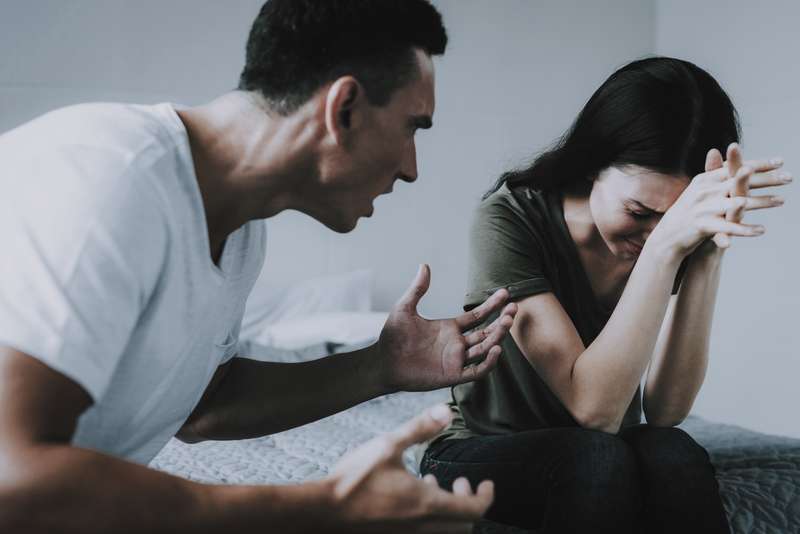
    “I’m breaking up with you, bitch,” he said and slammed his hand on the table. He started to walk out, which I feared would leave me stranded, far from home, with no means of getting back to my warm apartment and my sweet cat. At times of high stress, I, like so many others, go to the worst place, a place of abandonment and rejection. And as much as he really might have been rejecting me, I knew in my heart I had left the relationship months ago.

    I ended up begging him to let me ride home with him — that feeling of being stranded, scared, and alone that reminds me of all the reasons I drank and drugged — and we ended up sharing a taxi back to his apartment so I could take the subway the rest of the way home. During the 45-minute ride he alternated between yelling at me and saying he wasn’t going to be mean to me any longer, an agreement he broke countless times during the drive. He spewed hate at me while I mainly stayed silent and looked out the window. And then he said the most danger-filled and threatening thing anyone’s ever said to me: “if you think this is bad, try pouring alcohol and coke on it.”

    The moral? I should have left sort-of-well-enough-alone. After I knew who he was, I never should have gone back and dated him the second time. Or, if I am honest with myself, the first. I’m glad I got out before something really awful happened, though I remain worried that he might stalk me. I don’t know if that’s his style, but he did tell me that I had reason to be terrified of him. He said there are only a few people in the city who he hates, and they are scared of him.

    I’m dating again and it’s hard. I’ve had difficult breakups, in and out of sobriety, but this has to be the worst. It’s an all-time low; the one that leaves you with the most vile taste in your mouth. I don’t even know if I want to publish this, for fear he might read it, for fear you might. I’m going to go with HP on this one — pray like there’s no tomorrow, pray to be of service, to learn what HP has brought me in offering me this experience which I have embraced and then, finally, un-embraced, and to affirm that whatever happens, I’ll be taken care of.


    View the original article at thefix.com

  • Sober Romance: Why We Act Like Teenagers When It Comes to Relationships

    Sober Romance: Why We Act Like Teenagers When It Comes to Relationships

    So many people rush into relationships in early recovery. This may be related to neurochemistry: we’re suddenly deprived of the substances that made us feel good and we need to find a substitute.

    I’ve spent the last six and a half years of recovery wondering why I have been so emotionally immature when it comes to romantic relationships. Why have I sulked over communicating my needs? Why have I formed such insecure attachments that I wonder when I’ll see the person again before they have even left? Why have I felt so crazed and simultaneously flummoxed at my behavior? Reflecting on my relationships during my recovery, I can describe them in one word: disaster. But they’ve also been a blessing.

    When I found recovery, relationships were the last thing on my mind; I could barely function. I spent most days struggling to sufficiently caffeinate myself to get out of my apartment and to a meeting. For the first few months, I lugged my 300-pound body around wondering where this elusive pink fluffy cloud was, because it certainly wasn’t on my radar.

    As time progressed, my body began to recover: my liver regenerated—which is quite remarkable considering the quantity of cocaine I snorted and the four bottles of wine I drank each day—my depression lifted enough that I was able to function, and I lost weight. I was hardly experiencing the promises, but I could see that my life had improved. The fact I no longer felt compelled to drink was a miracle in itself.

    Sufficiently recovered—or so I naively thought—I looked for romantic distraction in the rooms. A smile from someone at the break would elicit a rush of feel-good hormones. I wonder if they like me? would play through my mind (well, that’s the PG version I’m willing to share, but you get the picture). Needless to say, this didn’t end well.

    I ignored the guidance to stay single for a year after finding recovery, because in my mind I was thinking: I’m a 32-year-old woman. Why shouldn’t I date? I’m an adult! Off I went and dated, just like every other person in the room because—let’s face it—few people actually adhere to that rule!

    And so I chose some lovely chaps from that swimming pool of dysfunction, Narcotics Anonymous. Promises that they’d treat me right, and that they really liked me, were exactly that: just promises. Even though I expressed my desire for a relationship over just messing around, my experience was that once these guys got what they wanted, they were off. Wondering what was wrong with me—and playing the victim role really well—I’d move on to the next dude.

    I couldn’t see until much later in my recovery why I was so terrible at picking a suitable partner. I was blind to my part in these encounters and all of the emotional baggage I brought to them. I’d often act like a teenager: sulking, gaslighting, and holding the person emotionally hostage. I was incapable of adequately and maturely communicating my needs, or of listening and hearing theirs.

    It took several years of recovery to unpack my insecurities around attachment and the trauma I had suffered that made forming a healthy attachment nearly impossible. I can’t imagine many people would want a relationship with a needy, insecure, obsessive woman. And that wasn’t helped by my choices: people who were completely avoidant. It was never going to work.

    Keen to explore why we act this way in early recovery, I asked recovery scientist Austin Brown about it. He explained that we have to look at our inclination to use external objects, or people, to provide instant changes in mood—just like we experienced with drugs. Also, Austin says, many of the social developmental benchmarks we pass from childhood to adulthood are slowed by active use.

    “The early stages of romance offer a thrill and an escape,” he goes on. “In fact, they operate on many of the same pleasure pathways as our substances used to. One interesting phenomenon I have noted in clinical work is the almost overwhelming desire to get into a relationship that occurs when people initially get into recovery. To me, this is likely a neurochemistry issue; a starvation of the stuff that makes us feel good. So, we act on it, having neither the maturity or the self-awareness that is required for a complex adult human relationship.”

    Explaining why we act so immaturely in relationships, Austin says, “If we started using as teens, emotionally we are still there those first few months. This is a well-known facet of the disorder. But we want—and therefore think we are ready for—a relationship, often before we even get out of treatment, have a stable job, or even have a place to live. Entering into any relationship under those conditions is statistically unlikely to succeed.”

    About our inability to communicate, Austin says, “At a more scientific level we are talking about the ability to identify AND verbalize our emotional states. Often all we know are ‘want’ and ‘relief’ when we come into recovery. Those are woefully short-sighted emotional states when it comes to equitable human relationships and partnerships. It’s like bringing a juice box to a gunfight.”

    The upside is that if we work hard to grow in recovery, we can mature fairly quickly. “I usually calculate about a year to six months of growth per every month of recovery. If we started using 12 years ago, it takes us at least a year to emotionally resemble our peers. Might even take two, depending on how hard we work at it,” he says.

    Even though we think we might be ready for a relationship after we’ve achieved a few weeks of recovery, Austin says, we might want to be cautious. “Unfortunately, early recovery relationships slow our emotional maturation as well, just like substances,” he says. “If someone else can give us a sense of relief, why do all the hard work to achieve emotional growth? Early-recovery relationships prolong our process of healing and can often throw our recovery off disastrously, sometimes even to the point of a return to use and even death. So, it is quite serious business, and yet no one really talks about it in any tangible or helpful way.”

    “Personally,” he goes on to say, “I have seen relationships in early recovery ruin more lives than substances themselves. Why relational health isn’t the central focus of early recovery support is frankly beyond me.”

    View the original article at thefix.com

  • Sex, Money, and Power in Recovery

    Sex, Money, and Power in Recovery

    What are the things you can’t live without in a relationship? Those are your needs. And what are the things you’d like but could live without? Those are wants.

    Romance and Finance. Two of the toughest things to manage in recovery—and the most likely to lead to a relapse. While someone with addiction can stay abstinent from drugs and alcohol, we must learn to moderate when it comes to love and money. This is a tall order for a group of “all or nothing” people. So what do we need to know to make sex, money and power work out more Hollywood ending and less tabloid headline? I spoke with three experts who offer their wisdom and tools for understanding and solving the riddle.

    Psychotherapist, Sex Addiction, and Financial Disorders Expert Debra Kaplan points out that underlying attachment issues surface a few years into sobriety from drugs and/or alcohol, and when they do, romance and finance become all the more difficult. ”Attachment is the process by which we gain our knowledge of self— we know who we are because it has been reflected back to us by a co-regulating other,” she explains. Most people with substance use disorders suffer from some ruptures in attachment— a bond that may not have been consistent throughout our developmental process. When this process goes awry, we may become insecure about our self-worth. Kaplan says we must understand that sex and money are “stand-ins for self-esteem and self-worth.” This is why so many people who start in one 12-step program like NA or AA also end up in DA (Debtors Anonymous) and SLAA (Sex and Love Addicts Anonymous)—many times when they’ve been brought to their knees by these issues. So this this is a question of both living sober and relapse prevention.

    According to a 2016 Ameriprise study, “Approximately 31% of all couples clash over their finances at least once a month.” We all know this is a leading cause of divorce. Sex and money are tied like Christian Gray’s shoelaces: tightly. As Kaplan says, “When there are financial troubles, the bedroom is the canary in the mine.” Her years as a successful Wall Street trader and her work as a psychotherapist make her uniquely qualified to acknowledge the connections and disconnections between sex, money and power.

    All of the experts I spoke to agree: the first key to success in love and money is negotiation. There is no question that a power differential exists in romantic relationships. Just as we create contracts in business, we create contracts with one another. Would you sign a business contract without knowing what was important to you? And yet so many of us in sobriety will rush into relationships because of our insecurities. One pitfall Kaplan warns against is the tendency to blend money early in a relationship by buying or leasing property together too soon. Kaplan says, “Ask yourself, do I know how my partner operates when it comes to money and work?”

    These conversations are scary but in order to have successful relationships, we need to develop some negotiation skills. The truth is we are communicating all the time every day whether we speak or not. Kaplan says: “There are two levels of negotiation; spoken agreements and silent arrangements.” From the outset, even in the early stages of dating, we must acknowledge what Kaplan calls “relational currency.” She defines this as “My worth, what I’m bringing to the table, what we expect from each other.” It can be anything from youth or beauty to social access or financial wealth. This currency plays into the negotiations we are making silently, even with ourselves. For example: Well, he’s not making as much money as me, but he’s ten years younger and considerably better looking.

    Dr. Pat Allen, a Certified Addiction Specialist and Transactional Analyst and author of the recovery tome Getting To I Do, agrees: “Ninety percent of all communication is nonverbal,” she says. One of her five tools for negotiation is a marvelous way to bring that nonverbal communication into conversation. The script she suggests is: “I sense by the look on your face you’re upset, yes or no? What can I do?” Or, for a man: “I think by the look on your face you’re upset, yes or no? What can I do?” The languaging, Allen says, varies from gender to gender. Generally, the feminine “feels” and the masculine “thinks.” This tool brings the issue to the floor and allows it to be dealt with rather than festering in a dark corner and becoming a resentment.

    Allen explains her point of view: “Einstein said ‘everything is energy’ and we are both yin and yang, this is physics. Men have yang bodies but yin souls, women have yin bodies but a yang soul.” So there is a built-in duality in all of us to consider in relationships and in negotiating. People—even pansexual people— play different roles in relationships, not necessarily based on gender, but on the choice between masculine and feminine principles. They may not be static, but we usually have one that is more prevalent. So, Allen says, “Before you even go on a date, know which role you want to play.”

    Kaplan echoed the importance of self-examination, saying that the key in early stages is, “Know thyself.” Know what your needs and wants are and the difference between the two. What are the things you can’t live without in a relationship? Those are your needs. And what are the things you’d like but could live without? Those are wants.

    According to Allen, a quick way to determine which role you are playing is to ask yourself— “Do you want to get laid or paid?” The masculine wants to get “laid” and picks with his eyes. The feminine wants to get “paid” and picks with her ears.

    Once you know what role you want to play, the trick is negotiating the contract of the relationship. “Ask for help!” Kaplan says. Her work with couples involves uncovering some of the underlying beliefs about self, sex, and money in order to make conscious decisions. This is important considering the underlying attachment disturbances that may be triggered. Her book, For Love and Money: Exploring Sexual and Financial Betrayal in Relationships also has an inventory that can be helpful in identifying patterns. Allen says that couples should negotiate every three months for the first year, then once a year, or whenever any large issue arises.

    Dawn Cartwright is a renowned Tantra teacher who received her degree in psychology from the University of California, Davis, and has had extensive training in Tantra, Yoga, Sexuality, Bioenergetics, Meditation, and Expressionistic Movement & Art. When it comes to negotiating, she too brings it back to self-responsibility. “When I can keep myself regulated and stay in an emotionally available state even when I need to say no, that gives the person I’m involved with a lot more freedom to be my ally, rather than my therapist. I have to make sure that I’ve had enough sleep, eaten well, I’ve got some friends. I need to look at how many hours I’m working and make sure that I develop a well-rounded life so that when my partner and I come together it’s about being partners and it’s not about being rescued.”

    Cartwright suggests setting aside a specific time to solve problems and talk budget, “Create a chart of all the things that need to get done but only talk about that once a week during a family meeting— even if it’s just the two of you, so those things don’t bleed over into your romantic sexual connection.”

    It’s easy to get complacent at any stage of a relationship. Cartwright suggests: “We can continue to let every date be the first date.” She recommends a process she calls pleasure mapping. “Maybe we take some nights where we don’t actually have intercourse but we explore and experiment, what are some places on your body that you’d really love to be touched? Do we like massage there or feather kisses here? Do we want to hear sweet words? What is our pleasure map? When we do that we’re actually creating a greater bond with our partner and releasing more neurochemicals and we’re not falling into habits that are just highlighting certain parts of the brain over and over again. Each person has their needs and we negotiate. But we stay in the game. We stay in the yes and.”

    With tools like these, you are on your way to that happy ending! I know what you’re thinking, but I didn’t mean it like that. Or did I?

    View the original article at thefix.com

  • My Life with Phil

    My Life with Phil

    If anyone could relate to loneliness, abandonment, depression, it was Phil. We got each other. 

    If my cat could talk, he’d say “You’re so fucking crazy.” Also, feed me, asshole. And not that gluten and grain-free slimy shit. Meow Mix from the corner bodega, where you’ll often spend seven dollars on an activated charcoal latte paired with a fifty cent Camel Light loosie, which I judge your embarrassing fat ass for. You’re actually insane. I’ll kill you.

    Phil, that’s his name, has tried to kill me before. He’s a very dramatic attention-seeker. Anxious, needy, moody. Damaged goods. I’ve got similar symptoms because, according to several psychiatrists, I’m bipolar II and, according to me, crazy. Phil’s been through a lot, and admittedly, I am partially to blame.

    Oh, and Phil is a pyromaniac. Though I can be and have been terrible, I’m pretty sure I’ve never deserved to die via apartment fire—puking under the bed would’ve been more reasonable— but Phil takes his feline frustrations to the extreme.

    The first time Phil turned the gas stove on, I thought, maybe his back paw had innocently hit the knob on his way up. But that was my brain on drugs. Despite being perpetually overweight, he’s not clumsy. He’s light on his feet; a decent ballerina in a past life. This was intentional. This happened more than once. This was really testing what my problematic as-a-result-of-anxiety-and-amphetamines pulse could handle.

    Redundant scenario: Phil would just LOVE greeting me when I entered my apartment at 7-ish AM by standing perfectly still over a flaming stove burner in taxidermy pose, staring right into my bewildered AKA tweaked-out eyes, and then maniacally meowing with the subtext: I’m seconds from plopping my fat ass on this flame if you don’t get your shit together. I dare you to abandon me for a day or two once more to get as high as Mount Everest and fuck everything at an open 24-hours bathhouse in Chelsea.

    Phil’s penchant for pyromania emerged circa 2013, when I was at my most mentally ill and near-ish-death-ness. But I was growing tired of perspiring out regret, poppers and lube, anyway. And Phil was just offering me tough, traumatic love! Okay, maybe he was just miserable living with mentally fucked, miserable me, and into the idea of both of us dying in a local news-making manner. Maybe Phil was doing us both a favor. End us.

    “Suicide kitty.” That’s what my ex-roommate, Messy Mark*, called him because of Phil’s impressive rabid flying squirrel-like antics. I inherited Phil from messy Mark. Pre-Phil, I hated cats and the only cat I tolerated was the dead one I had to dissect in Anatomy class in high school. But when the formaldehyde wore off and his thighs developed mold, my teacher discarded him and I received a D+ on my report card, which made my hating-on-cats restart. It was a short-lived although intimate relationship. I never even knew his name.

    Phil was already named Phil when Mark brought him home to our janky South Williamsburg apartment in the summer of 2009. Mark had been sober for like, a month, and he told me, with his enchanting albeit decaying-inside eyes, that a cat would keep him sober. I told him I hate cats, they scratch everything, and I knew I’d end up having to take care of the cat, so please God, no. Taking care of Mark was already my pro-bono job. I did my best! Well, the best that I, a party animal (spirit animal: a cat in perma-heat) who proudly has never blacked out, could at the time. (Note: We were in our early twenties and fresh out of college, living it up in a pre-Starbucks/Wholefoods Williamsburg and convincingly adopting the PBR-chugging, Patti Smith-worshipping hipster ways. You know, when kombucha was still a thing.)

    Mark, on the other hand, was the drink-to-blackout type. He was an all American twink-next-door type. Charming, cute, book smart. His book cover was colorful and playful, concealing the tattered pages and its painful Comic Sans font. He’d invite himself to my friends’ house parties, because he had no friends of his own, which should have been a WARNING: DON’T BE ROOMMATES sign, and I’d warn/beg my friends to not fall for this troubled trick, because he wouldn’t remember anything in the morning and then I’d have to clean up his mess, including the sometimes charcoal-latte-colored puke. But alas, Mark’s blue eyes and bubble butt was a fuckable force. He’d also sleep with guys I thought I was dating, but I’d forgive him. I was a battered tabby cat to his primped-and-polished persian. We, oops, hooked up a few times too. This wasn’t something I initiated… initially. I knew there’d be trouble post-orgasms. But when your never-not-wasted roomie wakes you up via aggressive seduction, well, I was too tired to object.

    Anyway, despite my cat concerns, I came home one day to find Phil crazily rolling around on the Ikea carpet in catnip. My fury segued into an “Aw, it’s fine” when Mark looked up at me with a genuine, heart-tugging smile. I was touched! Perhaps that purring Swamp Thing-y thing on the rug would cure Mark, because 12-step meetings sure as shit weren’t enough. And I’d be free and maybe even happy. Ha!

    I was a spineless, clueless enabler. I didn’t understand why Mark couldn’t hold his liquor like a normal early twenty-something millennial. And I didn’t want Mark to die, so I’d do whatever to help. I didn’t want him to ever punch me in the face again when I forced his inebriated ass to look into the mirror at his sadness. I didn’t want to have to drag him through glass after he collapsed into our Ikea cabinet post-bar, as Phil screeched and judged from atop of the fridge. I didn’t want to wake up to a sea of is-this-real-life texts like the time he was in Dunkin’ Donuts and had just pissed his pants after escaping from the ER—apparently he had passed out at the bar the night before and someone normal called 911. This someone also called Mark’s mom, which I realized because of a devastating voicemail, in which she wondered if her son was alive. Not fun. Heartbreaking.

    Phil was damaged goods himself, and, as expected, it’d be me, the professional plant killer, responsible for getting him back on track. He was an army brat, and had two unstable homes before being dropped off at a ASPCA in Virginia, where he lived in a cage for a year. Apparently no one wanted a middle-aged, jittery, ordinary tabby cat. I guess the bloody bald spots from Phil’s habit of biting out his fur and furiously scratching himself like a meth addict weren’t so appealing. (Meanwhile, Mark cruelly took Phil off of his anxiety meds because he’d rather save money for happy hour.) Phil’s coat of fur looked like my shredded, smelly Harley Davidson (reminder: I lived in Williamsburg) thrift t-shirts. He was so death-door-y thin, like me at the time (because, drugs), his meow was/still is so grating and loud. It’s nearly as demonic as the iPhone default alarm. And his moniker at the shelter was “alien kitty” because of his macadamia nut head paired with green, extraterrestrial eyes. Anyway, Mark and his manipulative victim ways convinced his Virginia-based friend—his only other friend—to drive Phil to Brooklyn; a non-refundable gift.

    While Mark did calm down and get sober for a bit post-cat adoption, he didn’t miraculously develop thoughtfulness or anything. He’d attend evening 12-step meetings after his 9-5 job and then go to sober people Chipotle hangouts. HE WAS SO HAPPY! And I’d never ever see him. I’d been replaced. And I think I was subconsciously jealous of his healing. As a freelance writer, I worked from home, so it was just me and Phil. I took care of him. Not like it’s difficult—food, litter, cuddles, oh my!—but this wasn’t my goddamn cat! Mark would lock his bedroom door at night, so I’d allow Phil’s manic ass to sleep with me and claw at my scalp.

    And so, I fell in love with Phil; Mark fell in love with a recovering meth addict. Two months later, Mark casually told me he was moving in with this boyfriend and that I had to find another roommate within two weeks. NBD. But I could keep Phil, because his boyfriend was allegedly allergic to cats. I don’t know why, but I started to ugly cry. (Well, my ex-therapist told me I was, yawn, in love with Mark and I’m scared of intimacy and abandonment etc etc fuck off etc.) It wasn’t until Mark finally “got better” and didn’t need me anymore that I acknowledged and confronted my own issues.

    Just kidding. I’d little-by-little distract the pain with sex, drugs and rock bottoms.

    Another roommate moved in for a year or two, but then we were bought out of the rent stabilized decrepit apartment for 40k. So, Phil and I moved to a shit but rent stabilized studio apartment on the other side of the Williamsburg bridge in Lower East Side—I signed the lease during what I now understand to have been a manic high, believing that I clearly needed to live alone; to take care of just myself, Phil and my plants. I was so psychotically positive! (I blame my psychiatrist for adding another mood stabilizer.) Living alone would inspire me to get a fantastic full time job, and then I’d be able to afford the studio on my own once the 40k ran out!

    Didn’t happen. What did happen was Phil putting up with my unraveling as a result of eternal loneliness with no future, except funerals, in sight. I’m very dark. Phil forgave me, probably, when I’d lock him in the bathroom during a Grindr quickie. He plopped on my chest when I was coming down; he dived off my chest when I convulsed and howled in fetal position because of anxiety/panic attacks. If anyone could relate to loneliness, abandonment, depression, it was Phil. We got each other. Phil’s still with me.

    I haven’t seen my ex-BFF since he left me, but he’ll text me like, every five months, informing me of things like how he now lives in a forest or that his boyfriend he ditched me for died of a drug overdose. Mostly, he brings up memories. “Remember that time when ___?” I never remember. I don’t want to remember. My responses are mostly an emoji or two. I’ve intentionally disconnected. His most recent text to me wasn’t a ‘sup. It was a handful of sexually explicit photos, featuring his dick. Ew. If he was ever my real friend, he would’ve remembered that I’m an ass guy. “Are you high?” was my response. He wrote no. I didn’t even care if he was lying, his top talent. I blocked him. I mourned him years ago. I’m all about protection these days. I’ve got some friends, a long-term boyfriend, and a drug-free, inconsistent zest for life.

    Today, I’m sometimes very happy. I’m sometimes going under those dark, depression waves. The bipolar isn’t going anywhere. Unless I’m traveling outside of America, I barely leave my house.

    And I still have major anxiety. So does Phil, but we’re in this thing together. We’re a lot better, we’ve grown up. He gets me out of bed and gives me a purpose. Feeding him his healthy grain and gluten-free food reminds me to take my meds. We take care of each other! We need each other!

    Meanwhile, this triggers my morbid mind. He’s 73 in cat years. Phil’s cremated remains will be in a jar on my Buddhist altar soon enough. It was ME who was supposed to be rotting in a coffin by now, not Phil! But at least it’s been years since I last truly worried about Phil killing me… killing us. (Just kidding—I remove the stove knobs when I’m not in the apartment because, anxiety.)

    Just a month ago, I was convinced Phil was dying. It’s a gnarly image that involved scattered around my apartment puddles of puke, heavy breathing, and him hiding from me in the litter box. I didn’t want to remember him like this: lethargic and not wanting anything to do with me for two full days. This wasn’t like him. He’s a cuddle monster in the mornings. And here I was, imagining a life without him. My first pet. Would I replace him? Could I? He’s the only one who, through it all, never left me. He’s tried, but only a handful of times. (He attempted to jump out of the window after sitting on a flame, but it wasn’t open wide enough for his fat ass.)

    He’s back to normal-ish for now. I’m trying to appreciate our time together. So many memories. I try to think of only the best memories, but sometimes I’ll look at Phil and I’ll remember Mark, but only for a moment, then I shut that shit down. I’ve let Mark go.

    I couldn’t save Mark. Neither could Phil. But we saved each other.

    If Phil could read this, he’d eject a hairball because of my cheesiness. He’d roll his alien kitty eyes. And if Phil could talk, he’d say “You’re welcome for saving your life, bitch.” And then go back to sleep.

    View the original article at thefix.com

  • Dating While (Newly) Sober

    Dating While (Newly) Sober

    When my sponsor told me about the suggestion to not date for a year, that I should just concentrate on getting sober, I said: “I’m a really good multi-tasker.”

    I thought that when I got sober, I’d get into the best shape of my life, start going to the gym all the time, train for a triathlon, become super successful and meet the man of my dreams. Basically, my version of what advertising says is the perfect life. I wasn’t thinking along the lines of what some people say: the gift of sobriety IS sobriety. Boring. I mean, I was and I wasn’t; I mostly just wanted to stop being miserable. I did a 90 and 90, got a sponsor, joined a gym, took a class in my career of choice, slept a lot, and met a guy.

    When my sponsor told me about the suggestion to not date for a year, that I should just concentrate on getting sober, I said: “I’m a really good multi-tasker,” and “I can get sober and date at the same time.” Luckily for me, she didn’t say it was a rule, because there are no rules in the Big Book of Alcoholics Anonymous. Nowhere in the Big Book does it say: “no dating allowed in the first year.” It just talked about some people prefer a little more pepper in their sex life or whatever (page 69) and who are we to tell people what spices to proverbially cook with?

    So thank god for that because in my first 90 days, I met a guy. He was a friend of a friend and when we met, he told me that he was going through a big transition in his life.

    “What kind of a transition?” I asked, while thinking Oh my God! We have so much in common! We’re both going through transitions! As if a relationship could be built on that alone. Or even a marriage, because I thought that now that I had opened the book of sobriety, everything would change in the blink of an eye. It would be like I just woke up to a new life. That’s how it happens, right? I mean, don’t you kinda hear that all the time? The person’s life was shit and then they got sober and now they’re in this awesome marriage/job/house/car/babies and it all like happened in a year or maybe two? I’m smart and attractive. That shit should happen for me too! I can make that happen. I. CAN. MAKE. THAT. HAPPEN. Higher power who?

    So, when I asked the guy what kind of transition, he said poetically, “It’s like my house was taken away so now I have no house, but at least I can see the moon.” And I was like “Wow, coooooool. I totally love the moon.”

    For our first date, we went on a bike ride along the river, had lunch where I did not order a glass of wine (the first time that has ever happened) and ordered a coffee instead. I didn’t tell him that I was newly sober. I just told him I didn’t drink, and he said that was cool and he’s thought that maybe he should quite drinking too (uh oh); that he meditates and when he meditates, he feels super clear and drinking gets in the way of that (uh yeah). Then he walked me home and I remember feeling very sensitive and insecure. It was like I was eight years old again with a crush on a boy at school and I forgot how to walk my bike. Or talk. I felt awkward. Which is why, at 16, drinking and boys went hand in hand. Less feeling. More yay.

    When I got home, I realized there was no way I could date right now. I knew that if I was rejected or even felt rejected, it would probably cause me to drink. I didn’t have the emotional tools. I talked to my sponsor about it and then called him up and said, “I really like you, but I’m going through something right now where I need to take a year off of dating. I hope you understand.” And he said, “Wow. I should probably do that, too.” Turns out he was going through a divorce and was in no place to be in a relationship or be the man of my dreams/dysfunction right now.

    For the rest of the year, I concentrated on going to meetings, fellowship, making new AA friends, eating cookies and milk, binge watching Netflix at night, and it was the most awesome/horrible year of my life. I highly recommend it. I gained 10 or 20 pounds which was weird. Dudes can go through a rough time and get fat and grow a beard and still be considered likeable — but as a woman, it’s harder to hide behind a beard and 50 pounds and be cool. But a girl can dream.

    So, a year later, guess who I ran into? No-house-moon dude. And yay! I was like a year sober so totally awesome and fixed, right? It. Was. On. We went on a few dates, and I honestly can’t remember if we had sex. It was only seven years ago and I know we did sexy things but I cannot for the life of me remember. I don’t think we did, because we would have needed to have the talk and well, let’s just say that the time I chose to have the talk was not a good time to have it. Take it from me when I say DO NOT ATTEMPT TO HAVE THE TALK WHEN HIS HEAD IS BETWEEN YOUR LEGS. That should be in the Big Book. It’s a real buzz kill for one and all. And our relationship (if you can call it that) ended shortly thereafter which was okay because he was seriously still mourning the loss of his ten-year marriage.

    So that’s my take on dating in the first year. I do know a couple people who hooked up in their first year of sobriety and 30 years later are still married. That might happen to you. I knew that wasn’t going to happen for me. It wasn’t until year two that I met the man of my dreams AKA qualifier who really brought me to my knees (not in a good way) and into Sex and Love Addicts Anonymous which is like the nicest thing a guy can do. Kidding. But not in a way because Girrrrrrrl, I needed some of that SLAA in my life. Since then, I’ve moved to a place that I am happy to call home, am “healthy” dating and more will be revealed. But the best thing is that I like myself – dare I say love myself? I love my friends, my career, and my life and I don’t expect a man or any person or thing to save me. Because I don’t need saving any more. Thank god. Thank HP. Thank program. And thank you.

    View the original article at thefix.com

  • Men… I’ve Always Been Obsessed With Them

    Men… I’ve Always Been Obsessed With Them

    It’s not him, it’s the version of him I’d chosen to focus on, ignoring all the bad behavior which followed, as I have way too many times.

    “Addicted to Love” is a great song––it’s also a not-so-great running theme in my life. Last week, at 62 ½, it dawned on me that there’s never been a time––nary a day of my life––when I haven’t had, first a boy, then a man, front and center in my brain. Attempting to add up the hours––the real estate––and what I might’ve done with both had I been more focused on me––rather than them––is depressing as hell. 

    I can remember being a little girl of not quite 8, chasing 10-year-old Andy Helfman––all day, all summer long––for at least three years running. I eventually caught him and got the chaste kiss I sought, and the satisfaction of discovering he liked me, too. Returning to the city from the Catskills, there was Roy. I picked him on the first day of school; in June he asked me out. I fell for Paul when I was barely 12. I harbored that love for years until he returned it, in his fashion––breaking my heart and hymen. There was Lenny––unrequited; with Randy, I came to wish it was unrequited; Vinny #1, and then Vinny # 2––both mine for the having, and both exceedingly inappropriate.

    I sound insanely fickle. And yet, I was fairly easy on the fickle, heavy on the insane. These were not short impetuous crushes. I harbored all of them well past their expiration dates, either until I got them or until the next one took hold, oft with some heart-breaking overlap.

    Looking back––how much of my quest was about the conquest? The chase. Winning. Ownership. Not to amass bounty, but to capture––love. To fill a hole, to prove my worth––which I could never seem to do with the people I deemed most important, including my rarely-considered self. I never thought of it in those terms––yet now––it’s impossible for me not to see the pattern.

    How many times have I given my time, attention, and power to a guy who either didn’t ask for it, didn’t appreciate it, or used it more as a means to control rather than love.

    I followed one boyfriend to the college of his choice, and another, post-degree, to the city of his––in both cases putting aside my own desires. I married the second one, knowing he was a volatile alcoholic. But, he was my volatile alcoholic. I waitressed, putting my career on hold, so he could… sleep. So what if there were holes in the walls behind every picture? You couldn’t see them, so I could pretend they weren’t there. I spent the majority of our years together obsessing… about how to get away from him.

    It took falling in love with someone else to manage it.

    My second marriage grew from a years-long professional friendship. The romance was built on mutual respect, affection, and ultimately, love. In my mid-thirties, almost immediately, I shifted my focus from my career to managing his and to starting a family. It was my choice, my great privilege and pleasure. For a decade, as his star ascended, our kids blossomed and thrived. When his up came crashing down, it took our love with it. We spent the next 10 years struggling over what once was, trying like hell to get it back––unsuccessfully. Graciously, the kids continued to bloom––magnificently.

    As a middle-aged single mom, without a career or a man, I obsessively struggled to find both. My long-starved creative passions swiftly found their voice and vision, and have met with some success. The money and the manhunt have been an exhausting, heartbreaking, ego-crushing exercise in futility. In spite of all the years, and lessons learned, I’m struggling to find my way with both. I’m still giving men who don’t deserve it––and sometimes don’t even know it––my time, energy, and my power. And, there’s always a man––and a way to stalk him.

    Back in the day, I did it with the phone: I’d call the object of my desire, hear his voice, or,sometimes hell-forbid, his parent’s voice, and hang up. I graduated to the walk-by––finding any excuse to pass his house, or where he hung out, in hopes of catching a glimpse––a smile––or a moment of his time. What a waste of mine.

    Facebook, Twitter and, Instagram took my occasional insanity and turned it into an ongoing opportunity to “check-in” on the latest object of my obsession affection.

    Dating apps are an even bigger nightmare, with distance offered at any given moment. Twenty-three miles? Hey! Where the hell are you?

    Finally, two weeks ago, I freed myself from the now daily insanity. Julian, my latest (mind) fuck, doesn’t utilize social media (talk about insanity). I had no way to monitor him other than to glimpse What’s App to see when he’d last been on. Why exactly? What did I gain by such behavior? Heartache. I knew when he was communicating, I also knew it wasn’t with me.

    I tried weaning myself from looking, but just as it was with pot 17 years ago, I had to quit cold turkey. I’ve stuck to it for 14 days, and it’s working. As each day passes with zero connection, he fades from my mind, and perhaps more importantly, from my heart. With distance, the rose lenses are clearing their hue––less obstructing my view. I’ve come to appreciate that I’d been romanticizing him, focusing on the alchemy of the connection, whilst ignoring the harsh cruelty of the abrupt disconnection. It’s not him, it’s the version of him I’d chosen to focus on, ignoring all the bad behavior which followed, as I have way too many times.

    For the first time in memory, there’s no man in my head. I’ve stepped away from the swipe. That leaves a lot of time and space to think about worthy people, ambitions, and causes––and maybe, at last, to include myself as one of them.

    View the original article at thefix.com

  • Neil Strauss' Evolution: From Pick-Up Artist to Relationship Expert

    Neil Strauss' Evolution: From Pick-Up Artist to Relationship Expert

    “Your relationship success has nothing to do with your partner, it’s really all about you and working on yourself…Until you do that you’ll always fall in love with the same kind of person.”

    Neil Strauss has an enviable list of accomplishments. A nine time best-selling author, he got his start as a music critic writing for The New York Times and Rolling Stone; he has toured with and written about heavy metal bands, and penned books with some of the greatest rock stars. He’s written about how to survive in a post-apocalyptic world from a survivalist’s point of few, harboring skills such as flying a plane, delivering a baby, and fashioning a knife out of a credit card.

    Strauss’ The Game: Penetrating The Secret Society of Pick Up Artists, is one of the top two most shoplifted pieces of literature from Barnes and Noble. The other one? The Bible. Both are similar in appearance and in length: hardcover leather with gold embossed titles on the cover.

    Even though it’s been over a decade since its debut, The Game, which many view as the holy grail on how to seduce and lure women into the bedroom, was recently released in its 11th hardcover edition. To Game fans, Strauss is somewhat of a Messiah. He delves into the elusive PUA (Pick Up Artist) scene and morphs from geek to the ultimate ladies’ man. He goes undercover, adopting the name “Style,” and by making adjustments and using certain puzzling techniques that verge on reverse psychology, he discovers that suddenly he can have any woman he wants. He explains lingo including terms such as peacocking: to wear something flashy and unusual in a crowded venue to get a romantic prospect’s attention; sarging: to go out to look for willing participants to try PUA moves on; kino: touching your object of desire sporadically during a conversation to establish a connection and build trust; and closing: sealing the deal and ending things with a kiss and/or a trip to the bedroom.

    Eventually Strauss left the PUA community, but not empty-handed. He began teaching others how to wine and dine women by starting “StyleLife Academy,” which made him an unexpected celebrity and hero to many men. His admirers also included an unlikely group: the FBI. The Game was required reading for agents. Few details are known other than Strauss was personally invited to train them in an undisclosed location. He applied the same techniques he honed for picking up women to teach FBI agents how to open a conversation and gain the trust of suspects, with the ultimate goal of closing: luring confessions out of the bad guys.

    One cannot play the game forever, so where does the hero go next? When it came time for the sequel, Strauss went in a radically different direction.

    The Truth: An Uncomfortable Book About Relationships is the exact opposite of a dating guide; it’s about Strauss’ journey from to player to monogamous man. His painfully honest candor is refreshing and as the title states, it’s an uncomfortable book. Some of the most brilliant work comes from pushing the limits of our comfort zones, and Strauss shares all, revealing details of his adventures into the world of polyamory, orgies and open relationships. On the occasion of The Truth’s re-release in paperback several weeks ago—with a new subtitle: An Eye-Opening Odyssey Through Love Addiction, Sex Addiction, and Extraordinary Relationships—we had the opportunity to talk to Strauss about emotional health, healthy relationships, and who he hopes his book will appeal to.

    “You write a book and you never know who the audience is, men who are struggling with intimacy and relationship issues in general, and women too.” Strauss tells The Fix.

    The Truth details how life has changed for the author post Game. After years of playing the field, he’s met the right girl at the wrong time. When she discovers that he’s had a fling with one of her friends, he checks into treatment for sex addiction in hopes to better understand himself and to save their relationship. He quickly comes to realize that what he experienced during his childhood has a lot more to do with the way he’s wired than he had thought. He accepts that he will have to make peace with his past, a realization that resonates with many individuals, whether they’re in recovery or not.

    “Whatever issue someone is experiencing, whether it’s sex addiction or something else, you have to get to the core of it. We all have core wounds that take place in our first 17 years. Those imperfections get passed on and whatever label you want to put on it doesn’t matter, you just have to fix it.”

    Few authors are recognized beyond their words on a page, but whether or not he intended on it, Strauss has become a guru in the topics of life, seduction and love. It’s no longer about how to get the girl; with the massive success he’s had, there are now men and women enrolled in Stylelife Academy. He’s gone beyond instructing others how to be the ultimate PUA. It’s about guiding others to live their lives to the fullest.

    “I think I’m fortunate. I love learning about people and new things. I found something that changes my life and solves my problems [and] I want to share that,” he says of the journey that has led him to where he is today: a settled down family man with a beautiful wife and son.

    So what comes after The Truth? Stauss has no plans to stop sharing what he’s learned with others. He’s preparing to lead a workshop called The H.A.V.E.: The Human Anti-Virus Experience, a three day intensive workshop where he’ll meet and teach those who want to do some serious work on themselves.

    “If everyone took a course between high school and college, the world would be a much more comfortable place. Emotional health needs to be taken as seriously as physical health. There needs to be something for people to take to de-program everything they were taught growing up and all of their false beliefs. I couldn’t find one out there that didn’t seem dark or culty so I created one.” He’ll share what’s he learned over the years, and bring in the very instructors who guided him on his path to self-realization.

    It’s easy to get distracted when speaking with an author who has such an array of experiences, and has the kind of life that so many only dream of. After a conversation with Strauss, it’s clear why he was awarded “The greatest pick up artist who ever lived.” The charisma is there and he’s filled with sincerity. Of course there are so many questions I want to ask him, but before my time with him is up, he leads me back to The Truth, and leaves me with valuable advice:

    “There are a lot of bad single-sided myths about relationships in our culture. Your relationship success has nothing to do with your partner, it’s really all about you and working on yourself. You can’t accept your partner as they are unless you work on yourself. Until you do that you’ll always fall in love with the same kind of person.”

    When asked what the future holds, Strauss told us he’s far from finished: “I have so many books I want to write. I want to keep telling amazing and better stories.”

    The Truth: An Uncomfortable Book About Relationships is now available in paperback. For more information on what Neil Strauss is up to, how you can attend The H.A.V.E. and learn other survival skills, go to www.neilstrauss.com.

    View the original article at thefix.com