Category: En

  • Ditch Your Device for a Day on UK Unplugging Day 2021

    Ditch Your Device for a Day on UK Unplugging Day 2021

    UK Unplugging Day takes place this year on Sunday 27th June and we’re encouraging everyone to join in! UK Unplugging Day is the one day in the year where everyone can join together to take part in a 24 hour digital detox.

    During the past year it’s no wonder that all our time on devices increased exponentially. A surge in screen time during lockdown saw people in the UK spend 40% of their day watching TV and online video services, according to a study of the nation’s media habits in the pandemic. And even before the pandemic, both adults and children said they felt they spent too much time on their devices, particularly their smartphones. 54% of US. teens, in a study in 2018, said they spend too much time on their phones, with two-thirds of parents expressing concern over their teen’s screen time. And in the UK, 62% of polled adults have said they ‘hate’ how much time they spend on their phone.

    So, UK Unplugging Day is a chance to reset your relationship with your devices, giving you some time and space to step back and think about how you’d like to better use them going forward. It’s on a Sunday, so that should make it a little bit easier to manage and we’re encouraging everyone nation-wide to take part – so you won’t be alone.

    Why take part in UK Unplugging Day?

    There’s a tonne of evidence pointing to how excess time on screens is impacting our physical and our mental health. We know, for example that the blue-light emanating from our digital devices causes sleep disruption. We know that simply having our smartphone nearby when we’re trying to focus and concentrate can actually reduce our IQ.

    But it’s what we’re missing out on when we spend the majority of our day on a screen that we want to shine a spotlight on, particularly the time we miss out on being outside in nature, and the time we miss focusing on our relationships.

    Ditch Your Device for a Day on UK Unplugging Day 2021
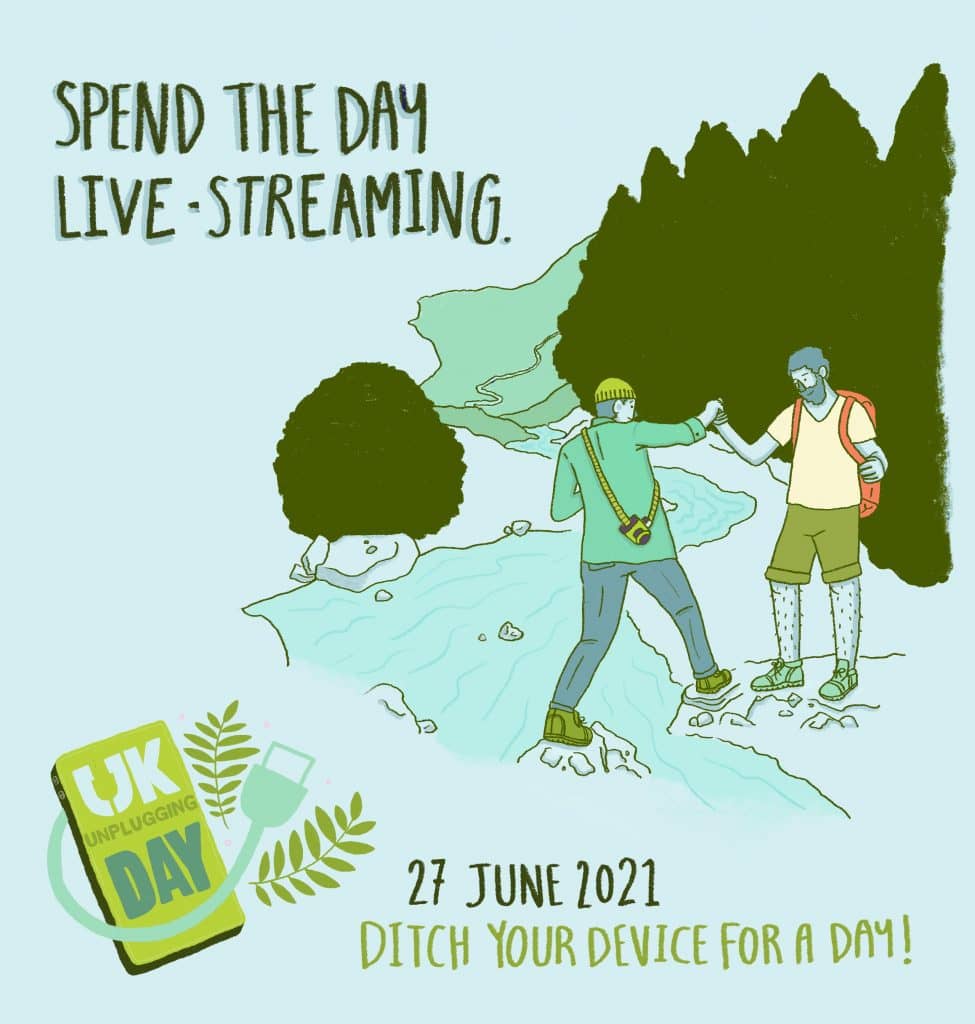
    Spend the day live-streaming on UK Unplugging Day, 27 June 2021

    We’re passionate believers in the restorative power of getting out in nature and it has been part of our manifesto since our founding in 2014. Time in a green space has been shown to lower stress, blood pressure and heart rate, while also lifting our mood and boosting our mental health. Research from 2019 showed that just 20 minutes a day spent in a park — even if you don’t do any exercise — is enough to improve your well-being.

    Ditch Your Device for a Day on UK Unplugging Day 2021
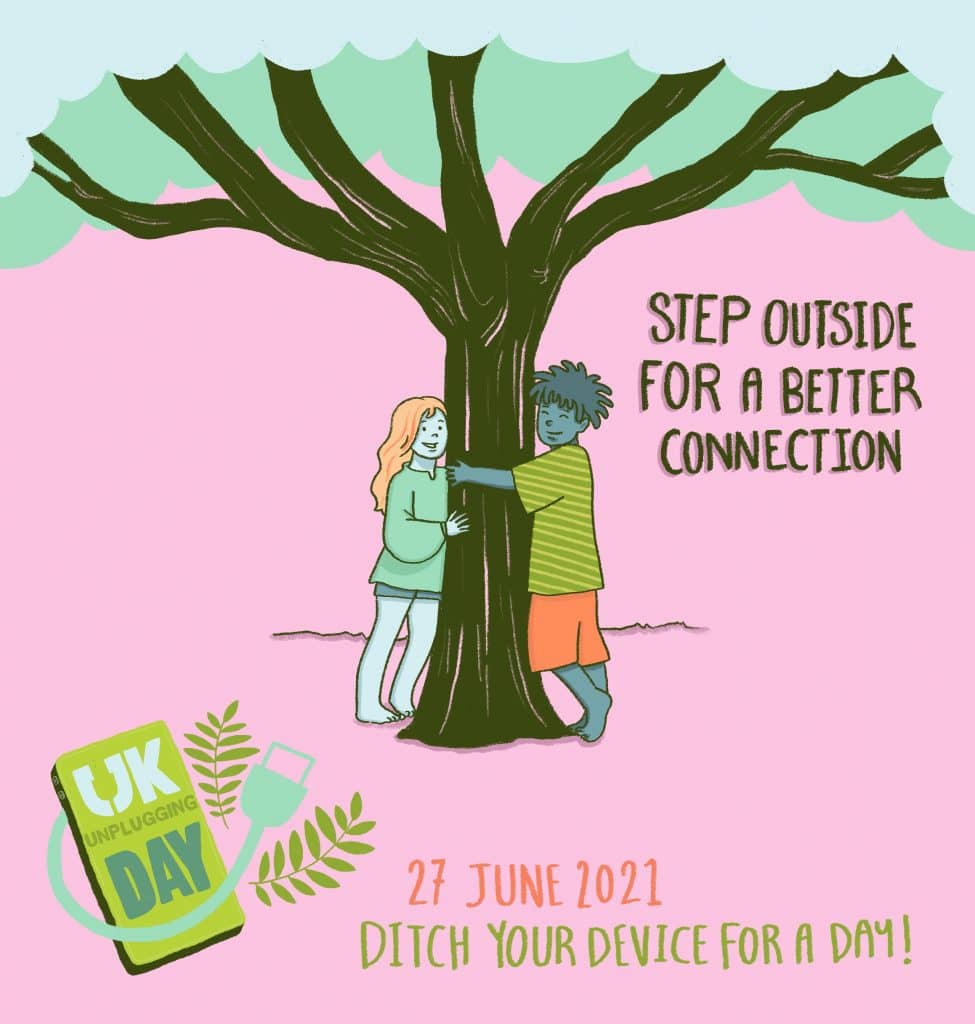
    Step outside for a better connection on UK Unplugging Day, 27 June 2021

    And our relationships are another thing that we could be focusing more on, when we spend more time off screens. More than half of UK adults (54%) in 2018 admitted that connected devices interrupted face-to-face conversations with friends and family. One study found that more than 17% of adults phub others (snub them by looking at their phone) with almost 32% of people complaining that they themselves are ‘phubbed‘ two to three times a day.

    While it might not seem like a big deal when you pick up your phone when your partner, friend, or child is talking, research suggests that the habit of phubbing may be really hurting your relationships and your own mental health.

    Ditch Your Device for a Day on UK Unplugging Day 2021
    Devote the day to organic search on UK Unplugging Day, 27 June 2021

    So, we think taking part in UK Unplugging Day this coming Sunday will benefit you in more ways than you might expect. It’s not just about taking time off screens, it’s also about boosting your mood and mental health and investing in your closest relationships.

    If you’re worried about the FOMO – well, the fact that it’s a national day might help as there are going to be thousands of others going offscreen and giving it a go. Why not get your friends and family to take part too? By switching off on Sunday 27th June, you’ll be joining a growing global community of people who’ve found that regular, scheduled, time off screen benefits their physical and mental health, and indeed every aspect of their lives. Join in and tell us beforehand if you plan to using #UKUnpluggingDay on social media. Have fun!

    View the original article at itstimetologoff.com

  • What Happened to Our Screen Habits in the Pandemic?

    What Happened to Our Screen Habits in the Pandemic?

    Our screen habits have changed dramatically over the pandemic. During the first lockdown the Australian National Network saw an increase of 70-80% on adult screen time,. Ofcom found UK adults spent 40% of their time watching digital video (let alone the time they spent on answering emails, or even sleeping). Despite these incredible numbers, the shift in screen habits caused by COVID-19 has affected us each differently. Some were forced to work or learn from home, others had to continue to work as normal in order to support our communities.

    We relish a dig into screen time research at Time To Log Off so we wanted to examine the particular impact that the pandemic has had on our screen usage. Here are some interesting findings on the impact coronavirus has had on us and our screens.

    What Happened to Our Screen Habits in the Pandemic?

    Kids screen time didn’t go up as much

    According to one study, children’s screen usage rose by around 60% during the pandemic. The American Academy of Paediatrics found in 2019 that children aged 13-18 were spending 6.5 hrs online a day and those aged 8-12 spent 4.5 hrs a day, so the additional time in 2020 made a huge difference.

    For many of those children the additional time spent on screens has been as a result of remote schooling, with education and socialisation necessarily taking place online. This even continues today, with 375,000 UK children currently off school due to coronavirus infections.

    Interestingly, the general trend with children and young people appears to suggest that the increase in their screen time was lower than that of the average adult. Perhaps suggesting that they have been able to find other outlets. Or simply underlining the reality that their previous screen time use was so high it wasn’t dramatically increased by a global pandemic.

    Working from home

    What Happened to Our Screen Habits in the Pandemic?

    Like children, many adults were also being forced to work remotely. Adult screen time was therefore also increased, with many reaching up to 11 hrs a day. Adult social options were also confined largely to screen-based activities. And many adults found themselves not only working eight hour days online, but then also spending a further two or three more hours on screen-based activities to ‘unwind’.

    This trend was clearly understandable, and even now continuing due to a widespread anxiety at the relaxation of COVID rules after so long. But we do recommend adults get back outside and meeting friends and family in person, as much and as soon as possible.

    Screen time differences by gender weren’t significant (but the impact was)

    One factor which did not impact changes in screen habits during the pandemic was gender. Men, women and non-binary people all increased their screen usage at similar rates. But that doesn’t mean that the effects of excess screen time were experienced equally. Women were more likely to report depressive symptoms than other genders. Nearly half of all participants in one survey reported symptoms of depression which rose to well over 50% in women.

    What Happened to Our Screen Habits in the Pandemic?

    The general trend across the last year is that all of our screen habits have increased as (by necessity) we spent more and more time online. For children and young people the rate of increase was somewhat reduced, perhaps due to their already high levels of screen time. For different genders it has had a different impact on mental health. For all, though, it has been momentous.

    View the original article at itstimetologoff.com

  • The Latest In Digital Detox Research

    The Latest In Digital Detox Research

    As we emerge from – what we hope will be – the final lockdown in the UK, we can gain a new perspective on just how much our lives have changed over the last 15 months. In particular, we want to review how our tech habits have changed, and what impacts these changes have had on our overall wellbeing.

    New Research Interrogates the Link Between Higher Screen Time and Depression

    A new study has undermined previous studies on the impact of tech habits on mental health by suggesting that the data gathered for these is flawed. The study argues that any study wherein the participants have self-reported their screen time and habits is likely to be inaccurate, as this method of data-gathering is unreliable. And, earlier this year, Mark Zuckerberg himself claimed that there was no conclusive research linking excessive screen time with worsening mental health.

    However, whilst the data for some studies may be biased, there is still evidence and reason to believe that increased screen time results in reduced mental wellbeing. Not only do other independent studies still maintain that excessive technology use is bad for your mental health, but our understanding of why this may be the case is increasing too.

    Cyberpyschology – an emerging field studying the effect of our interaction with technology on our brains – is not just about analysing trends between internet use and mental health. It is about trying to explain the psychological implications of our technological habits, and how exactly these could give way to mental health conditions. In light of Zuckerberg’s rejection of the hypothesis that heightened social media use could negatively effect mental health, psychologist Jean Twenge argued that there was still evidence indicating a link between the surge in social media and smartphone use, and in mental health conditions experienced by young people.

    For example, over lockdown many of us experienced Zoom burnout: a phenomenon which Stanford researchers confirmed and explained. From the unnatural overexposure to videos of ourselves throughout the day, to the loss of mobility due to having to be sat a desk during a call, it was clear to see how different aspects of the digital platform could have negative impacts on our health. In a similar way, we can see how our digital habits may be effecting our health by evaluating how we feel when we use our devices – for example, by considering what social media does to our self esteem, or how gaming is affecting our posture and mobility.

    So, despite the lack of clarity surrounding whether technology causes mental health conditions, we can still conclude that it takes a toll on our wellbeing. And if it makes logical sense to us that certain experiences linked to our technology use could place us under stress, then we should take necessary precautions to protect our health.

    Excessive Screen Time Linked to Obesity

    Even if the more evidence is needed to link increased screen time to a decline in mental wellbeing, the negative effect of our tech habits on our physical health is undeniable. Our vision, posture and physical fitness have all been found to suffer as a result of excessive screen time.

    Most recently, a study on 9 to 10 year olds in the US found that spending longer on screens throughout the day was associated with a higher BMI. The researchers recorded the screen time of the children, and then measured their BMI a year later. This illustrates the unhealthy buildup of harmful tech habits.

    This study was conducted pre-pandemic. However, had the research been done whilst social restrictions were imposed, it may have yielded even more dramatic results. With sporting and social activities cancelled, and children’s education conducted online, young people’s screen time has rocketed since the pandemic began.

    Excessive screen time is actually defined by the study as only over two hours of usage a day. This may come as a shock; I’m sure many of us are guilty of spending far more than that daily, and know of children who are too. In fact, the latest statistics from USwitch tell us that the average UK adult spends almost half of their day on screens.

    Our Sleep Suffered from our Pandemic Tech Habits

    Confined to our homes and unable to see family and friends, we relied on technology a whole lot more throughout the pandemic. In fact, our tendency to use tech in the hours preceding our bedtime increased, and this wreaked havoc on our sleep schedules.

    An Italian study showed that increased screen time before bed resulted in reduced sleep quality. Participants were found to go to bed later, and to then suffer from exacerbated insomnia symptoms. The consequent reduction in the hours of sleep they got meant they found it harder to get up in the morning.

    This is unsurprising. Research has shown before that blue light disrupts our natural sleep cycles, so when we use backlit screens in the evening, we are making it more difficult for ourselves to wind down and prepare to sleep.

    The Latest In Digital Detox Research

    A Digital Detox Following a Digital Year

    With the benefit of retrospect, we can see how dramatically our tech habits have changed since before the pandemic, and not necessarily for good. Whilst we can be grateful that technology was there to keep us connected whilst under social restrictions, we now need to reevaluate our relationships with our devices.

    Research continues to illustrate the negative impacts tech can have on our health if we are not careful with our usage patterns. Therefore, we encourage you to take a digital detox. You will likely see positive changes to your wellbeing, and this past year and a half has shown us more than anything how important it is to protect both our physical and mental health.

    The Latest In Digital Detox Research

    For more about how to untangle our relationship with tech, pre-order ‘My Brain has Too Many Tabs Open‘, out in the US and UK on 21st September.

    View the original article at itstimetologoff.com

  • The Best Digital Detox Advice We’ve Ever Received

    The Best Digital Detox Advice We’ve Ever Received

    We are living in a world drowning in too much information. Everywhere you turn there are experts who can advise on the minutiae of every decision you make, especially regarding your health and wellness. It is no wonder that so many articles have been written in the last year about being us being overwhelmed, by mental health, work issues, parenting concerns and more. Your digital health need not be another area where you are struggling to choose between conflicting advice, constantly worried that you are not doing the ‘right thing’. So, we have taken all of that stress away and condensed six seasons of our podcast down to give you the inside track on the best digital detox advice we have ever received.

    Cal Newport
    The Best Digital Detox Advice We’ve Ever Received

    Cal Newport is a heavyweight in the world of digital detox advice. He is an associate Professor of Computer Science at Georgetown University in Washington DC and the author of six books about work and productivity, including the bestselling ‘Deep Work’. He knows what he is talking about. He also walks the talk too, having no social media and maintaining most of his life offline. We were very excited to talk to him about his advice and it boiled down to:

    • Take at least 30 days offline before you start to rebuild your digital life
    • Start by figuring out what you care about and then, working backwards, choose which digital tools help you do that, and only use those.
    • Divide your work and home life, e.g. do not do work or have work emails on your phone.
    Thomas Brag
    The Best Digital Detox Advice We’ve Ever Received

    Thomas Brag on the other hand comes at this issue from a completely different perspective as a content creator on YouTube, one of the founder of the Yes Theory channel (over 6 million subscribers). Yet, he was influenced by the work of Cal Newport and took a 30 day sabbatical from social media. His advice was to:

    • Take a period of digital detox and completely unplug.
    • Make your time, on social media in particular more active. Engage, rather than sitting back.

    Andrew Cotter

    The Best Digital Detox Advice We’ve Ever Received

    Our final piece of advice comes from our first episode of the new Season 6 where, if you listen to the end you might be able to hear some canine contributors too. Andrew Cotter is a sports broadcaster who shot to international fame during lockdown due to turning his skills to hilarious commentary on the antics of his two labradors: Olive and Mabel. The videos have been watched over 800 million times. However, he too is aware of the conflicting positives and negatives brought by social media fame as well as the digital world more generally. In speaking to Tanya Goodin, our founder, Andrew Cotter’s advice was to:

    • Try to only focus on positive interactions online.
    • When the negative outweighs the positive, log off.

    Hopefully these top tips from our most esteemed guests (Olive and Mabel, we’re looking at you) will help you find a good balance in your digital life, but if not, or you are looking for more top tips, our podcast: It’s Complicated is always a good place to start.

    View the original article at itstimetologoff.com

  • Kids Already Coping With Mental Disorders Spiral as Pandemic Topples Vital Support Systems

    When states and communities fail to provide children the services they need to live at home, kids can deteriorate and even wind up in jail.

    A bag of Doritos, that’s all Princess wanted.

    Her mom calls her Princess, but her real name is Lindsey. She’s 17 and lives with her mom, Sandra, a nurse, outside Atlanta. On May 17, 2020, a Sunday, Lindsey decided she didn’t want breakfast; she wanted Doritos. So she left home and walked to Family Dollar, taking her pants off on the way, while her mom followed on foot, talking to the police on her phone as they went.

    Lindsey has autism. It can be hard for her to communicate and navigate social situations. She thrives on routine and gets special help at school. Or got help, before the coronavirus pandemic closed schools and forced tens of millions of children to stay home. Sandra said that’s when their living hell started.

    “It’s like her brain was wired,” she said. “She’d just put on her jacket, and she’s out the door. And I’m chasing her.”

    On May 17, Sandra chased her all the way to Family Dollar. Hours later, Lindsey was in jail, charged with assaulting her mom. (KHN and NPR are not using the family’s last name.)

    Lindsey is one of almost 3 million children in the U.S. who have a serious emotional or behavioral health condition. When the pandemic forced schools and doctors’ offices to close last spring, it also cut children off from the trained teachers and therapists who understand their needs.

    As a result, many, like Lindsey, spiraled into emergency rooms and even police custody. Federal data shows a nationwide surge of kids in mental health crisis during the pandemic — a surge that’s further taxing an already overstretched safety net.

    ‘Take Her’

    Even after schools closed, Lindsey continued to wake up early, get dressed and wait for the bus. When she realized it had stopped coming, Sandra said, her daughter just started walking out of the house, wandering, a few times a week.

    In those situations, Sandra did what many families in crisis report they’ve had to do since the pandemic began: race through the short list of places she could call for help.

    First, her state’s mental health crisis hotline. But they often put Sandra on hold.

    “This is ridiculous,” she said of the wait. “It’s supposed to be a crisis team. But I’m on hold for 40, 50 minutes. And by the time you get on the phone, [the crisis] is done!”

    Then there’s the local hospital’s emergency room, but Sandra said she had taken Lindsey there for previous crises and been told there isn’t much they can do.

    That’s why, on May 17, when Lindsey walked to Family Dollar in just a red T-shirt and underwear to get that bag of Doritos, Sandra called the last option on her list: the police.

    Sandra arrived at the store before the police and paid for the chips. According to Sandra and police records, when an officer approached, Lindsey grew agitated and hit her mom on the back, hard.

    Sandra said she explained to the officer: “‘She’s autistic. You know, I’m OK. I’m a nurse. I just need to take her home and give her her medication.’”

    Lindsey takes a mood stabilizer, but because she left home before breakfast, she hadn’t taken it that morning. The officer asked if Sandra wanted to take her to the nearest hospital.

    The hospital wouldn’t be able to help Lindsey, Sandra said. It hadn’t before. “They already told me, ‘Ma’am, there’s nothing we can do.’ They just check her labs, it’s fine, and they ship her back home. There’s nothing [the hospital] can do,” she recalled telling the officer.

    Sandra asked if the police could drive her daughter home so the teen could take her medication, but the officer said no, they couldn’t. The only other thing they could do, the officer said, was take Lindsey to jail for hitting her mom.

    “I’ve tried everything,” Sandra said, exasperated. She paced the parking lot, feeling hopeless, sad and out of options. Finally, in tears, she told the officers, “Take her.”

    Lindsey does not like to be touched and fought back when authorities tried to handcuff her. Several officers wrestled her to the ground. At that point, Sandra protested and said an officer threatened to arrest her, too, if she didn’t back away. Lindsey was taken to jail, where she spent much of the night until Sandra was able to post bail.

    Clayton County Solicitor-General Charles Brooks denied that Sandra was threatened with arrest and said that while Lindsey’s case is still pending, his office “is working to ensure that the resolution in this matter involves a plan for medication compliance and not punitive action.”

    Sandra isn’t alone in her experience. Multiple families interviewed for this story reported similar experiences of calling in the police when a child was in crisis because caretakers didn’t feel they had any other option.

    ‘The Whole System Is Really Grinding to a Halt’

    Roughly 6% of U.S. children ages 6 through 17 are living with serious emotional or behavioral difficulties, including children with autism, severe anxiety, depression and trauma-related mental health conditions.

    Many of these children depend on schools for access to vital therapies. When schools and doctors’ offices stopped providing in-person services last spring, kids were untethered from the people and supports they rely on.

    “The lack of in-person services is really detrimental,” said Dr. Susan Duffy, a pediatrician and professor of emergency medicine at Brown University.

    Marjorie, a mother in Florida, said her 15-year-old son has suffered during these disruptions. He has attention deficit hyperactivity disorder and oppositional defiant disorder, a condition marked by frequent and persistent hostility. Little things — like being asked to do schoolwork — can send him into a rage, leading to holes punched in walls, broken doors and violent threats. (Marjorie asked that we not use the family’s last name or her son’s first name to protect her son’s privacy and future prospects.)

    The pandemic has shifted both school and her son’s therapy sessions online. But Marjorie said virtual therapy isn’t working because her son doesn’t focus well during sessions and tries to watch TV instead. Lately, she has simply been canceling them.

    “I was paying for appointments and there was no therapeutic value,” Marjorie said.

    The issues cut across socioeconomic lines — affecting families with private insurance, like Marjorie, as well as those who receive coverage through Medicaid, a federal-state program that provides health insurance to low-income people and those with disabilities.

    In the first few months of the pandemic, between March and May, children on Medicaid received 44% fewer outpatient mental health services — including therapy and in-home support — compared to the same time period in 2019, according to the Centers for Medicare & Medicaid Services. That’s even after accounting for increased telehealth appointments.

    And while the nation’s ERs have seen a decline in overall visits, there was a relative increase in mental health visits for kids in 2020 compared with 2019.

    The Centers for Disease Control and Prevention found that, from April to October last year, hospitals across the U.S. saw a 24% increase in the proportion of mental health emergency visits for children ages 5 to 11, and a 31% increase for children ages 12 to 17.

    “Proportionally, the number of mental health visits is far more significant than it has been in the past,” said Duffy. “Not only are we seeing more children, more children are being admitted” to inpatient care.

    That’s because there are fewer outpatient services now available to children, she said, and because the conditions of the children showing up at ERs “are more serious.”

    This crisis is not only making life harder for these kids and their families, but it’s also stressing the entire health care system.

    Child and adolescent psychiatrists working in hospitals around the country said children are increasingly “boarding” in emergency departments for days, waiting for inpatient admission to a regular hospital or psychiatric hospital.

    Before the pandemic, there was already a shortage of inpatient psychiatric beds for children, said Dr. Christopher Bellonci, a child psychiatrist at Judge Baker Children’s Center in Boston. That shortage has only gotten worse as hospitals cut capacity to allow for more physical distancing within psychiatric units.

    “The whole system is really grinding to a halt at a time when we have unprecedented need,” Bellonci said.

    ‘A Signal That the Rest of Your System Doesn’t Work’

    Psychiatrists on the front lines share the frustrations of parents struggling to find help for their children.

    Part of the problem is there have never been enough psychiatrists and therapists trained to work with children, intervening in the early stages of their illness, said Dr. Jennifer Havens, a child psychiatrist at New York University.

    “Tons of people showing up in emergency rooms in bad shape is a signal that the rest of your system doesn’t work,” she said.

    Too often, Havens said, services aren’t available until children are older — and in crisis. “Often for people who don’t have access to services, we wait until they’re too big to be managed.”

    While the pandemic has made life harder for Marjorie and her son in Florida, she said it has always been difficult to find the support and care he needs. Last fall, he needed a psychiatric evaluation, but the nearest specialist who would accept her commercial insurance was 100 miles away, in Alabama.

    “Even when you have the money or you have the insurance, it is still a travesty,” Marjorie said. “You cannot get help for these kids.”

    Parents are frustrated, and so are psychiatrists on the front lines. Dr. C.J. Glawe, who leads the psychiatric crisis department at Nationwide Children’s Hospital in Columbus, Ohio, said that once a child is stabilized after a crisis it can be hard to explain to parents that they may not be able to find follow-up care anywhere near their home.

    “Especially when I can clearly tell you I know exactly what you need, I just can’t give it to you,” Glawe said. “It’s demoralizing.”

    When states and communities fail to provide children the services they need to live at home, kids can deteriorate and even wind up in jail, like Lindsey. At that point, Glawe said, the cost and level of care required will be even higher, whether that’s hospitalization or long stays in residential treatment facilities.

    That’s exactly the scenario Sandra, Lindsey’s mom, is hoping to avoid for her Princess.

    “For me, as a nurse and as a provider, that will be the last thing for my daughter,” she said. “It’s like [state and local leaders] leave it to the school and the parent to deal with, and they don’t care. And that’s the problem. It’s sad because, if I’m not here …”

    Her voice trailed off as tears welled.

    “She didn’t ask to have autism.”

    To help families like Sandra’s and Marjorie’s, advocates said, all levels of government need to invest in creating a mental health system that’s accessible to anyone who needs it.

    But given that many states have seen their revenues drop due to the pandemic, there’s a concern services will instead be cut — at a time when the need has never been greater.


    This story is part of a reporting partnership that includes NPR, Illinois Public Media and Kaiser Health News.

    View the original article at thefix.com
  • 4 Biggest Mistakes People Make When They Try To Log Off

    4 Biggest Mistakes People Make When They Try To Log Off

    Trying to log off can be hard. However, there are certain habits you may be subconsciously keeping which could be making it even harder. Here are the biggest mistakes people make when trying to log off:

    They keep their phone in sight and accessible

    Trying to stay off your phone whilst having it in reach is rather like trying to eat healthily when there is a chocolate bar lying right in front of you. Constantly keeping your tech nearby is not going to promote any healthy habits; you are going to be distracted. Having your phone so close by makes it so much easier to give in to the temptation of aimlessly checking it.

    Try instead placing your tech in a drawer or – even better – in a separate room. At the very least, place your phone face down when you are not using it, to prevent your wandering eye from trying to glimpse notifications.

    4 Biggest Mistakes People Make When They Try To Log Off
    Remove your phone from your space when not using it: out of sight, out of mind.

    They keep push notifications on unnecessarily

    Like a moth to a flame, nothing tempts us to go on our tech quite like seeing it lit up with notifications. Turn these off. They will only distract you and make you want to unnecessarily log on, as well as evoking FOMO.

    If you are concerned that you will miss important notifications, for example phone calls, you can customise your notification settings. For example, you could fine-tune them so that your phone still alerts you to calls but not to Instagram likes, or email notifications. That way you can minimise temptation whilst also being free of any anxiety that may accompany the idea of not being reachable by phone.

    They don’t try to find replacements

    There are some instances where we rely on our screens to fill a gap; for example, the commute to work. Our tech gives us something to do and, in trying to cut out technology from certain aspects of their lives, many people make the mistake of not substituting it with anything else.

    Nothing is going to make you reach for your phone like boredom will. If you are trying to cut down your screen-time, make sure to equip yourself with an alternative, such as a book, a project or exercise, to fill the gap. You will find that by keeping boredom at bay, you will experience fewer urges to check your phone.

    They are too harsh on themselves

    In an increasingly digital world, it is a big ask of oneself to go ‘cold-turkey’ and log off. Instead, be realistic with yourself and set small personal goals. These should challenge you, but not make you feel uncomfortable. The more you try to restrict yourself, the more likely you will succumb to temptation. It is far healthier and better for you in the long run to establish a good balance with tech, than to repeatedly fail to adjust your screen-time because your aims are too ambitious.

    Enjoy the time you log off

    There are probably digital activities you really enjoy and don’t want to cut out, such as talking to friends online or watching a certain TV show. Do not feel that you have to deprive yourself of these. Instead, set yourself realistic time limits to ensure you are using your tech responsibly and maintaining a good digital-life balance.

    View the original article at itstimetologoff.com

  • Digital Burnout: How to Deal

    Digital Burnout: How to Deal

    In 2021 we work, relax, learn and connect with loved ones, all through the same medium, it’s no wonder that we are all experiencing digital burnout to some degree, especially after nearly a year of lockdowns. We have featured digital burnout before, but never in the setting of a pandemic

    What is digital burnout?

    ‘Burnout’ is a psychological term that refers to the state of mental, emotional and physical exhaustion caused by prolonged and excessive stress. Digital burnout is classed as a specific type of burnout that is triggered by the prolonged and excessive use of digital devices.

    In the last year we have spent more time online and in the digital space than ever before. Ofcom has found that, in the UK at least, adults are now spending 40% of their time watching TV and online video – that doesn’t even include the time we spend working. So it comes as no surprise that in a recent Gallup poll it was found that 75% of respondents said they’re experiencing digital fatigue. Digital burnout is on the rise.

    Here are some pandemic-tailored-tips to help you overcome your digital burnout and rebalance your relationship with technology.

    Log off

    Our first suggestion is pretty self-explanatory- log off! We know it can be easier said than done but if you are experiencing digital burnout then it should be your first step. If you were experiencing burnout from work you would take it seriously, so make sure you prioritise your physical and mental health as it relates to digital burnout too. If you are working remotely and cannot take a day off, then at least take the weekend.

    Unplug all your devices and spend the whole weekend, 5pm Friday until 9am Monday offline. Even that little amount of time will make a huge difference. If you can afford to take longer by all means do- perhaps a week or even 10 days. Each extra day that you allow yourself for recovery will enable you to reduce that fatigue and burnout and recover faster.

    Get outside

    Digital Burnout: How to Deal

    Part of the problem associated with digital burnout in this pandemic age is that we are not only spending hours more time on our devices, we are also spending hours less time outside, rarely leaving our houses except for essentials. Before the pandemic, we naturally went outside regularly, to commute, to meet friends, or for exercise. Now many of those reasons have been taken away, so we are holed up inside. This has a huge impact and will worsen any symptoms of digital burnout significantly. So, our advice is to get outside. The mental health benefits of going outside are innumerable. Even 20 mins outside each day will aid your recovery no end.

    Find analogue alternatives

    One of the reasons that digital burnout has reached such a peak during this pandemic is that the analogue alternatives that used to fill our time are gone. We can no longer meet up with friends so we need to video-call them to spend that quality time. We can no longer work in an office so all our time is spent on similar Zoom calls to attend meetings remotely. Some of these cannot be reduced if we want to continue to function effectively, such as working remotely. However, in all other aspects of our lives there are analogue alternatives and implementing them will make a huge difference. You could try catching up with your friends ‘old-school-style’ over the phone instead of on video-call. Or maybe knitting instead of watching TV tonight. There are many ways to reduce your dependence on screens, and thereby hopefully your burnout, even in a pandemic.

    Digital Burnout: How to Deal

    Set boundaries

    For the past year we have been living in a far less boundaried world. Our colleagues have been able to see into our homes, our bedrooms have become offices and we have run our entire lives through one or two devices. It’s time to set some boundaries and reinstitute the natural order of things.

    In small homes especially it will be difficult to find physical spaces which you can differentiate from others in order to make home offices but in all homes boundaries can be set around time. For example, “I will turn off my phone at 7pm every night“. At the beginning, when you are in the worst phase of burnout it will serve you better to institute strict rules with little flexibility and harsh timelines, these can change over time but at the beginning they will help you recover whilst you are moving on.

    These tips will help you to recover from digital burnout and fatigue whilst you maintain a work-life balance. Remember the single best thing you can do, is log off.

    View the original article at itstimetologoff.com

  • How to Find Digital Detox Moments in Every Day

    How to Find Digital Detox Moments in Every Day

    In recent years, and particularly in 2021, we are struggling more and more to find digital detox moments in our day. A YouGov poll found that more than half of respondents admitted to their screen time going up in lockdown, and that makes sense. We now use our phones to work, learn, connect, relax and even to simply distract from the reality of our new normal. We are checking our smartphone every 12 minutes and 34% of us check it within 5 minutes of getting up in the morning.

    It is no wonder that our attention spans have decreased and we are no longer able to give our work and our lives the same undivided focus we used to. We need those digital detox moments in order to be able to function at the same level- our tech habits are denying us much needed downtime to maintain our ability for deep-thinking. So, we have put together some tips to help you rediscover those digital detox moments which used to be more easily found, before our world moved on screen.

    Get outside
    How to Find Digital Detox Moments in Every Day

    As we featured in another recent article on things to do instead of scrolling on your phone, one of the best things you can do to recenter yourself is go outside. According to Harvard going outside improves happiness, concentration, healing and, more obviously, fitness. Our devices were not designed for use alfresco so it is much harder to get distracted by social media or never-ending news notifications. One way to increase the effectiveness of this strategy is to leave your phone at home. Without it you won’t have the crutch of music, a podcast or the occasional check for emails- you will have to focus on the world around you. If you choose to go outside without your devices regularly you can integrate it into your routine and gain back those invaluable digital detox moments on a regular basis.

    Link digital detox to your routine

    It is very difficult to stick to new resolutions, there is so much going on in our lives that we struggle to remember and implement them regularly. One way to get around this is to tie your digital detox moments to habits that you already engage in. You could tie it to brushing your teeth morning and night, eating, walking your dog or any other habit that you complete without fail daily. That way you will remember it and be able to stick to it.

    How to Find Digital Detox Moments in Every Day
    Cheat code: If you are struggling to get started on a mindful practice why not use an app such as HeadSpace to help you get in the zone?
    Commit

    When it comes down to it, the most important step of your journey to regaining your digital detox moments is to commit. There will always be things you can do instead of taking some time to be mindful! So, you need to reexamine your attitude to digital detox and prioritise it the same way you prioritise food and exercise. Our mental and brain health is just as important as the physical so value it in the same way mentally. Once you have made this shift to seeing digital detox moments as a non-negotiable, it should be easier to incorporate them into your day-to-day.

    View the original article at itstimetologoff.com

  • Dealing With Digital Addiction

    Dealing With Digital Addiction

    There is no clear quantitative definition of digital addiction. However, many of us will recognise symptoms of digital addiction in ourselves: for example, excessive and even compulsive use of social media. These all-too-familiar symptoms will likely have been heightened during lockdown, as the restrictions and cold weather leave us feeling that we have little option for connection and entertainment beyond what our tech offers us.

    These are challenging times, and with work, education and socialisation all moved to online spaces, digital addiction is neither unexpected nor something to be ashamed of. However, it is crucial for our wellbeing that we establish a healthy relationship with tech, and a good digital-life balance.

    If you think you may be addicted to your technology, there are steps you can take to rebuild and rebalance your relationship with tech.

    1. Reflect on your digital habits

    Self-awareness is the first step towards tackling your digital addiction. Identify the largest consumers of your time – for example, certain social media sites or games – and think about what causes these excessive usage patterns. Interrogating the thought process behind the times you reach for your phone will help you think more critically about whether you actually want and need to go on your phone, and whether it is good for you.

    2. Find other ways to deal with these triggers

    Continuing with the theme of self-awareness, knowing how to deal with the triggers that cause you to spend large amounts of time on screens will help you rely less on your tech. Whatever sets this off – be it an emotion, environment, or even just the time of day – can be satisfied with analogue alternatives. Find offline hobbies that can distract you and give yourself a purpose, to prevent you from resorting to your tech.

    3. Set yourself limits

    Setting screen-time limits is an excellent quantitative goal which will count as a significant step towards curing your digital addiction. The nature of the limits set is up to you, and will vary person to person. When setting them, it is important to be strict with yourself but not overly harsh. These limits should not deprive you of activities you enjoy, such as watching TV or socialising with friends; they should simply ensure that you are maintaining a good digital-life balance.

    Dealing With Digital Addiction
    You don’t have to stop doing the things you enjoy; just ensure that you have a healthy balance.

    4. Prioritise using technology to socialise

    Long hours spent with nothing but our phone can lead to feelings of isolation and loneliness. However, technology is not inherently a bad thing, and in many cases enriches our lives – especially at the moment, when we are relying on online spaces to maintain contact with friends and family. Do not feel that you have to sacrifice these moments now that you are more conscious of your screen-time. Instead, prioritise usage that simulates real life connections, rather than gaming or aimlessly scrolling through social media alone.

    5. Join an online support group

    Technology can have positive effects and enable us to feel more connected to other people. Online peer support groups have been found to help people establish healthier digital usage patterns. Sharing your struggles and journey with others can help your self-evaluation.

    Most importantly, it will allow you to recognise that you are not alone. Digital addiction is something many people struggle with, but by following these tips you will be able to ensure you are getting the most out of your tech.

    View the original article at itstimetologoff.com

  • Five Things To Do Instead of Scrolling on Your Phone

    Five Things To Do Instead of Scrolling on Your Phone

    A lot of us began the year with good intentions and new resolutions such as: “I am going to spend less time on my phone this year”, “I am going to leave my phone behind when I go for walks” or “I am going to find something to do instead of scrolling” but how many of us have been able to stick to it? Over 25% of Brits in a YouGov poll stated that they wanted to use their phone less in 2021. Over 50% of children also said that they wanted their parents to use their phone less this year, (20% more than those who wanted their parents to quit smoking!) So clearly the success of our digital detoxing is important to all generations!

    One of the biggest difficulties we face when we start a digital detox, or make the resolution to log off more, is what to do with all that time. It is hard to put your phone down and find things to do instead of scrolling when that used to take up hours of your day. So, here are five things that you can do to help you stay offline today.

    #1 Write a letter

    The art of letter-writing is somewhat out of fashion but that doesn’t mean that people don’t want to receive them- most people will be overjoyed to find something other than bills in their post! Why not choose a friend or a family member and write them a letter today? It doesn’t have to be long or about anything important, you could tell them about your walk, say thank you for a gift or remind them of their importance to you. Letter-writing is a lovely way to get offline whilst still connecting with loved ones (especially as they only way to communicate for months has been through screens).

    Five Things To Do Instead of Scrolling on Your Phone
    #2 Plan to see a friend

    Another thing you could do to connect with your friends instead of scrolling on your phone is to plan to meet up. During lockdown that could be challenging, but the plan doesn’t have to be for next week. You could plan a holiday you want to take together, a trip to a sporting event, your first night out once the clubs open or a pamper session; it is important to have things to look forward to right now. If you are lucky enough to be able to meet up you could plan a walk or bike ride near your home, you will be amazed the difference company makes.

    #3 Write down some goals

    This year we have already written quite a few pieces about goals, our top tips for resolutions and even more ways to help you put your phone down. In both we talked about the importance of goal setting as a way to frame your resolutions. If you want to log off why not tie that to another goal? Perhaps you want to get fitter this year, learn a language or get back into crafting? Whatever task you choose, tying it to logging off can make it easier to stick to, so write down your goal today and try to carve out time to focus on it, and away from your screen, regularly.

    Five Things To Do Instead of Scrolling on Your Phone
    #4 Clear out your ‘junk drawer’

    Most of us have a ‘junk drawer’ whether that be a drawer, wardrobe, spare room or attic and a lot of us have had sorting it out on our ‘To-Do’ List for at least a few months. So, why not tackle it today? Put down your phone right now, get some bags ready and clear it out. We can promise you it will be incredibly satisfying. It will also likely take up a significant amount of time offline and give you the chance to get active. What’s not to love?

    #5 Go outside
    Five Things To Do Instead of Scrolling on Your Phone

    On the theme of getting active, another great way to stop yourself from scrolling on your phone is to get outside. Phones were not designed for the natural world so it is harder to use them outside anyway. The mental health charity Mind says that going outside has innumerable physical and mental health benefits. So, just by going outside you could lower your blood pressure, decrease your stress and even help with moderate depression. Win-win-win!

    Just five ideas of alternative ways to spend your time instead of scrolling. Let us know if you have any other favourite ideas so we can share them too.

    View the original article at itstimetologoff.com