Category: Addiction News

  • Blackouts and Memory Gaps: How Alcohol and Trauma Affect the Brain

    Blackouts and Memory Gaps: How Alcohol and Trauma Affect the Brain

    Dissociation is most common in trauma that involves a betrayal of trust. This is a survival mechanism that protects our need for social support.

    Sober October has ended and now (hopefully sober) November begins. Fall brings the annual three-fold challenge: Thanksgiving, Christmas and New Year’s. This year, the midterm elections have created a fourth stressor and some of us are barely muddling through. Recent events have been especially terrifying—mass shootings, pipe bombs, a new report of catastrophic climate change, and the ongoing nightmare that is the Justice Department’s current mandate.

    Recently, Senator Chuck Grassley (R-Iowa) called for an investigation into allegations made by Julie Swetnick—one of the brave women who accused Brett Kavanaugh of sexual misconduct. Unbelievably, Grassley ordered the FBI to open a criminal investigation—into Swetnick.

    Grassley said that Swetnick’s sworn affidavit was not true. Was this just his opinion? It wasn’t based on FBI reports because he and fellow Republicans would not allow the feds to thoroughly investigate her claims against Kavanaugh—nor anyone else’s.

    “During the years 1981–82,” Swetnick said in her sworn statement, “I became aware of efforts by Mark Judge, Brett Kavanaugh and others to spike the punch at house parties I attended.” She also stated, “In approximately 1982, I became the victim of one of these gang or train rapes where Mark Judge and Brett Kavanaugh were present.” Swetnick said she’d seen Kavanaugh drink excessively at these parties and described him as a mean drunk.

    CBS News video:

    The Brett Kavanaugh Hearing

    In late September, Kavanaugh accuser Dr. Christine Blasey Ford went before the U.S. Senate during Kavanaugh’s SCOTUS confirmation process. There were times during her testimony that I felt sick to my stomach. It was as if she were telling my story. Dr. Ford stated that some of her memories were seared into her mind. She also acknowledged that she wasn’t able to recall every detail from that day. But who remembers every detail of any event?

    It was reassuring when Senator Patrick Leahy (D-Vermont) acknowledged this:

    “Ford has at times been criticized for what she doesn’t remember from 36 years ago. But we have numerous experts, including a study by the U.S. Army Military Police School of Behavioral Sciences Education, that lapses of memory are wholly consistent with severe trauma and stressful assault.”

    But the Republicans were not interested in further investigation and, despite the #MeToo and #TimesUp movements and all of the highly publicized Harvey Weinstein and Bill Cosby survivors, much of the country remains obtuse when it comes to the shared traits of traumatized women: remembering some things but not others, and not telling anyone what happened to them for decades.

    Ford’s assault happened at a party when she was 15, in 1982. When I was 13 I was gang-raped by classmates at an outdoor gathering. Ford tried to forget what happened. So did I. She didn’t want to think about the worst night of her life. Neither did I. It took both of us decades to tell anyone. Ford said: “I convinced myself that because Brett did not rape me, I should just move on and just pretend that it didn’t happen.” Confused and freaked out, I, too, decided to pretend my rape didn’t happen and believed that would “erase” it.

    Ford told the committee: “I tried to yell for help. When I did, Brett [Kavanaugh] put his hand over my mouth to stop me from yelling. This is what terrified me the most, and has had the most lasting impact on my life. It was hard for me to breathe…. Both Brett and [his friend Mark Judge] were drunkenly laughing during the attack.”

    Through much of the hearing I was shaking and sobbing, wiping my eyes so I could see. The identification triggered the sensation that I was reliving my experiences. When she said her mouth was covered, it felt as if mine was, too. I felt like I couldn’t breathe. The laughter from the boys that hurt me is burned into my memory. When I went public with my story in January 2012, I wrote: “[My friend] grabbed me, clamped his hand over my mouth….I tried to scream but it came out muffled. They laughed. I gagged.”

    I became so upset watching the live video that I almost called a close friend. I stopped myself because I knew she’d say, “Stop watching it!” Inspired by Ford’s bravery, I felt a sisterhood during this historical moment. It felt like my duty to bear witness.

    During the hearing, Senator Feinstein addressed Ford: “You were very clear about the attack. Being pushed into the room, you say you don’t know quite by whom, but that it was Brett Kavanaugh that covered your mouth to prevent you from screaming, and then you escaped. How are you so sure that it was he?”

    Ford responded: “The same way that I’m sure that I’m talking to you right now. It’s just basic memory functions. And also just the level of norepinephrine and epinephrine in the brain that, sort of, as you know, encodes—that neurotransmitter encodes memories into the hippocampus. And so, the trauma-related experience, then, is kind of locked there, whereas other details kind of drift.”

    Alcohol Blackouts

    The second half of the Senate hearing was shocking. Who but an alcoholic would mention beer nearly 30 times in a job interview? This was to determine if Kavanaugh was right for a lifetime position on the highest court. He whimpered, cried and lashed out. Did baby need his bottle? When Sen. Klobuchar asked if Kav ever had a blackout, he responded, “Have you?” Twice.

    Video clip of that part of the Kavanaugh Hearing:

    A few days after the Kavanaugh hearing, still feeling wrecked, I reached out to neuroscientist Apryl Pooley, PhD, an expert on the brain and memory and the author of Fortitude: A PTSD Memoir, which documents her road to healing from rape, child abuse, PTSD, and addiction.

    Both Dr. Pooley and I were blackout drinkers. We discussed how unpredictable alcohol is. In my teen years, I blacked out if I drank too much too quickly or hadn’t eaten. But in the last few years of rum and cocaine, I could go into a blackout after one gulp, or I could guzzle 5-6 drinks and feel totally sober. Pooley said her experiences were similar.

    But both of us found it difficult to believe that Kavanaugh was telling the truth at the hearing. It’s possible he didn’t know that he blacked out, but that is highly unlikely. After many of my drunken binges, friends would refer to things I’d said or done that I had no memory of. When I asked them if everybody knew I was that drunk, they’d say no. “You seemed normal, maybe a little high.”

    Pooley said, “I’d be walking around and having conversations. People wouldn’t know if I was blacked out. When someone is blacked out, it means their blood alcohol level is so high that it’s impairing that part of their hippocampus, that part of your brain that encodes those memories.”

    She said that everything you’re doing and seeing may or may not be getting stored in your brain. I asked her about being in and out of consciousness. Sometimes I could remember a snippet of an evening. Chatting with a friend at a bar, but then I had no idea how I got home.

    “That’s called a fragmentary blackout,” she said, “or a brownout. That happens when you are blacked out for a while and then come out of it. That can mean that you’d metabolized some of the alcohol, enough of it to regain that function.”

    She also said that some people might think a blackout means passed out or unconscious, which can also look like you’d just fallen asleep.

    Blackouts from Trauma

    According to Pooley, Ford was correct when she spoke about how the brain and memories work. Ford stated that a “neurotransmitter encodes memories into the hippocampus” which explains that trauma-related experience can be “locked in” whereas other details can “drift.”

    Pooley expanded on that: “When recalling memories of trauma, they can pop into your head if you’re triggered, or when asked about a detail.”

    That reminded me of every episode of Law & Order: SVU. Olivia Benson always asks a traumatized victim specific questions: What did they look like? What were they wearing? Can you remember anything unusual? A logo on a hat, shirt or vehicle? The sound of their voice? What they said?

    “Right!” said Pooley. “Those questions can trigger a flashback. The survivor may remember details about the event but not be able to verbalize them. To an outsider, this may look like they don’t remember or are lying. If the survivor was dissociated at the time of the assault, when they remember it later they may seem surprised or confused at their own memory.

    “If survivors feel unsafe when questioned, they may not be able to use their pre-frontal cortex to understand the questions and retrieve certain memories. That’s because their brain was focused on survival. If triggered, they may experience emotional and sensory memories that are as intense as the trauma itself.”

    Aha! That’s why I was shaking and crying while watching the Kavanaugh hearing. And for days afterward. The PTSD had caused my body to react by reliving what happened to me.

    Research backs up Ford and Pooley’s explanations. Memories may be fragmented and certain details missing.

    “But,” Pooley said, “what the survivor does recall is incredibly accurate. Sometimes you hear the term ‘repressed memories,’ which is probably more accurately referring to memories that were stored during dissociation. Dissociation is a survival reflex that can occur when escape is—or seems to be— impossible. A threat may be perceived by the brain as inescapable because of a physical barrier.”

    Ford was afraid she was going to die when she described Kavanaugh’s hand over her mouth. In my case, dissociation happened when I was pinned by five guys. I’d tried to break free. I floated up to the trees and watched. I could see what the boys were doing to me but it took on a surreal quality. It served as a buffer. I was literally scared out of my mind and my body.

    “A threat can also be perceived by a psychological barrier,” said Pooley. “Dissociation is most common in trauma that involves a betrayal of trust. This is a survival mechanism that protects our need for social support. When the trusted individual betrays you, this is a social threat and social threats are real threats.”

    Ford and I both experienced that. She’d gone to what she expected to be a friendly party with people she knew. I thought the guy who tricked me was my friend. He said he wanted my advice about his girlfriend. Flattered, I practically skipped over. That’s when he clamped his hand over my mouth and threw me to the ground and the other boys surrounded me and held me down.

    Pooley explained: “Many people believe that life-threatening trauma only refers to threats to physical safety—like the presence of a weapon—but humans need social support for survival. So, social threats like bullying, ostracization, or anything that threatens social standing can be interpreted by the brain as life-threatening. If abuse or assault is perpetrated by a trusted individual, not only is the event traumatic, but the social threat of losing the sense of safety from that person [or people] is traumatic as well.”

    If trauma leads to dissociation, Pooley said, that can lead to amnesia. Traumatic amnesia is so common that it’s even included in the diagnostic criteria for PTSD.

    “When all or part of the traumatic experience cannot be remembered,” said Pooley, “the risk for developing PTSD greatly increases.

    Throughout the hearing, and frankly, throughout these past few years, I’ve often felt an overwhelming temptation to get high. My mind and body are so wound up that I crave some kind of relief. Rum and cocaine still hover in my mind, pretending to offer salvation. Thankfully my years in recovery have taught me not to listen to my head when it’s trying to get me high, not to keep secrets, and to make time to meditate, keep a journal, draw, hug my dog, and most importantly, remember to breathe.

    If you are shaken by the Kavanaugh Hearing, and especially if it has kicked up flashbacks, there is help. The same is true for anyone who is scared about the midterm election or having panic attacks and high anxiety.

    You can reach out to RAINN, the nation’s largest sexual violence organization. Their website is RAINN.org or you can call their hotline 24/7 at 800-656-HOPE. For any kind of mental health help including addiction, PTSD, or thoughts of harming yourself please visit the National Alliance on Mental Health’s list of hotline resources.


    View the original article at thefix.com

  • How Much Do College Students Know About Heavy Drinking & Blackouts?

    How Much Do College Students Know About Heavy Drinking & Blackouts?

    A new study revealed that a lot of students are unaware of the consequences of risky drinking.

    With some statistics showing that nearly half of all college students who drink alcohol regularly also experience a memory blackout, researchers have launched a series of studies to determine exactly what this demographic understands about alcohol and blackouts, as well as the toll that it takes on their health.

    Their research underscored that while students are aware that hard drinking can lead to blackouts, they were unclear about how to avoid them. They were also unclear about the difference between a full blackout and a “brownout” (a shorter period of fuzzy memory).

    The researchers hoped to use the information gleaned from their studies to provide more detailed information to students about the risks of high-volume drinking.

    The research, published in the October 2018 edition of Psychology of Addictive Behaviors, was drawn from single-gender focus groups comprised of 50 students (28 women and 22 men) from four-year colleges and universities in the Providence, Rhode Island area.

    The researchers analyzed the data and composed three reports, the first of which looked at students’ understanding of the cause of blackouts.

    As Science Daily noted, the students were aware that drinking large quantities of liquor or drinking very quickly could produce a blackout; however, they were less aware of other factors—including mixing drugs with alcohol, gender and genetics—which could be contributing factors.

    The second study looked at how students viewed the experience of blackouts. The results showed a mixed reaction, with many reporting them as “scary” or “embarrassing,” with others describing them as “exciting.”

    External factors, such as friends’ perceptions of blackouts, who they were with at the time of the blackout, and what happened during the blackout, were also determining factors in how the experience was recalled.

    The third report sought to determine if the students understood the exact nature of a blackout. Most respondents described a blackout experience as a period of heavy drinking, though a blackout is defined as a period of complete memory loss lasting one hour or more. Shorter periods of memory loss were described as “brownouts.”

    Forty-nine percent of college students surveyed reported experiencing both blackouts and brownouts in the past month, while 32% only had brownouts and just 5% reported only blackouts.

    Respondents also claimed that brownouts were less troubling than full blackouts, which study co-author Kate Carey from the Center for Alcohol and Addiction Studies at Brown’s School of Public Health noted as “discounting the earlier signs of memory loss, suggesting that they weren’t serving as red flags or even yellow flags.”

    Carey and her fellow researchers hope to use the information culled from the study to create education modules for alcohol prevention programs that target high-volume, high-speed drinking or other behaviors that could lead to blackouts.

    These behaviors include “pre-gaming”—in which alcohol is consumed prior to an event where more alcohol will be available—drinking games or “chugging” were all cited as behaviors that could lead to blackouts.

    Reframing how students view these experiences as outside the norm could also serve as helpful prevention, Carey noted.

    View the original article at thefix.com

  • Francis Ford Coppola Enters The Cannabis Business

    Francis Ford Coppola Enters The Cannabis Business

    Coppola is launching a “cannabis lifestyle brand” in partnership with a sustainable cannabis farm in the Emerald Triangle.

    Francis Ford Coppola is best known as the director of the Godfather series and Apocalypse Now. But in recent years, Coppola has launched a lucrative wine business and also owns hotels in Italy, Guatemala, Belize and Argentina.

    Now, Coppola is getting into the cannabis business, which is shaping up to be a big growth industry. As Forbes reports, Coppola’s new cannabis business is called Sána Company LLC, and it will be independent from his Family Coppola enterprises. Sana is a sanskrit term for marijuana.

    In a statement, the company announced that it wants to “give life to a progressive vision for pioneering the highest-quality, sun-grown cannabis products through sustainable farming.”

    Coppola is launching The Grower’s Series, which he’s calling a “cannabis lifestyle brand.” The company is working in conjunction with Humboldt Brothers, a cannabis farm located in the Emerald Triangle, “the Napa Valley of cannabis.”

    As the famed director declared in a statement, “Wine and cannabis are two ancient and bounteous gifts of Mother Nature, linked by great care, terroir [a Northern California fog that gives cannabis a special flavor] and temperateness. Expertise making one applies to the other. As with growing grapes, location matters, and The Grower’s Series reflects California agricultural expertise creating a true blend of art and science.”

    Coppola’s Grower’s Series will include sativa, indica and hybrid strains that will come in one-gram packages that are shaped like wine bottles. Each package will go for $99, complete with a pipe and rolling papers.

    Corey Beck, an executive at Coppola Winery, told The Drinks Business, “This is another avenue we’ve created for a tasting experience. We need to be able to market to our consumers, wherever they may be. If they are in a dispensary, they can see that bottle and it may resonate with them the next time they see that bottle when they’re in a Safeway or Kroger.”

    The Herb Somm, another cannabis lifestyle brand, will help promote The Grower’s Series. Like Coppola, Somm founder Jamie Evans worked in the wine industry.

    Evans told Forbes, “I think it’s incredible to see such an iconic family get into the space. There are so many synergies that exist between the two industries, especially in Northern California. The more support we can get from leaders like Francis Ford Coppola, the closer we get to breaking the stigma of cannabis nationwide.”

    View the original article at thefix.com

  • Get Rid of Drug Cravings Once and for All

    Get Rid of Drug Cravings Once and for All

    ARTICLE SUMMARY: There is no way to completely eliminate drug cravings. However, you can learn to live with them…and get through them. This article reviews why cravings occur and offers three practical ideas on how to cope.

    ESTIMATED READING TIME: 5-10 minutes.

    TABLE OF CONTENTS:

    Drugs and Pleasure

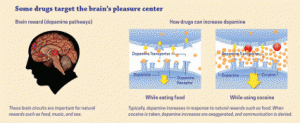
    To start to understand a craving, we need to look first at how drugs work in the brain. According to the National Institute on Drug Abuse (NIDA), experts used to think that a specific chemical neurotransmitter (dopamine) produced by drugs creates an extreme feeling of well-being. However, the reality is that the way drugs work in the brain is a little more complicated than that.

    Today, scientists now think dopamine has more to do with getting us to repeat pleasurable activities (reinforcement) than with producing pleasure directly. Large surges of dopamine “teach” the brain to seek drugs … while other, healthier activities such as exercise, creative pursuits, relationships, or even sex, get sidelined.

    The Definition of  a Craving

    So, what is a craving, exactly?

    Well, take away the drug-of-choice…and the need to feel pleasure still exists.  Our natural ability to feel pleasure can take some time to return as the brain returns to normal function. This is why people often feel the following in the first few months of addiction recovery:

    • depressed
    • flat
    • lacking motivation
    • lifeless

    The technical term for this is “anhedonia”. For some drugs – like meth, cocaine, heroin, or painkillers – it can take months or years for the brain’s chemistry to return to normal. And the amount of time it takes for the brain to return to homeostasis after a period of addiction will vary by individual.

    What’s important to know is that most of us are physically unable to enjoy things that were previously pleasurable. And naturally, we consciously and subconsciously seek out pleasure…to make life fun! This is why drug craving is natural outcome of drug use: it is a physical or psychological urge for your drug-of-choice.

    A craving is a deep yearning for the effect of your drug-of-choice.

    Triggers

    A craving can come out of the blue. It can also be”triggered”. Indeed, most cravings are usually prompted by a trigger. Triggers include external stimuli such as:

    • Certain people
    • Places
    • Situations
    • Smells
    • Other external stimuli

    Triggering situations affect the area of the brain called “amygdala”. When a triggering situation occurs, the amygdala sends signals to the other parts of the brain reminding you of your drug-of-choice. The amygdala regulates functions such as memory and learning, so you are in the company of a person, or in a certain situation that somehow reminds you of your previous addictive behavior… reaching for drugs again is a program running in your brain. The trigger sets of a pattern of decision making that can spiral you into an unconscious decision to use.

    During this process, you may even experience sensations such as shaking, cramps, anxiety attacks, nervousness… etc. A craving sensation can literally nearly take control over a person. However, you can stay in control by knowing the brain science behind them.

    Cravings occur as the result of powerful memories linked to substance abuse. When a trigger occurs, the amygdala lights up and in a moment, you can nearly feel the pleasure of your drug-of-choice. But cravings come and go. They do not last.

    They key to coping with cravings is to anticipate triggers and learn to avoid them. A craving may never go away compltely…the learned “reflex” can last a long time, even in people who haven’t used drugs in many years. Like riding a bike, the brain remembers. Cues that are linked with drug use can trigger uncontrollable cravings whenever you experience the cue, even if the drug itself is not available. However, you can stay in control of a craving and learn to ride it like a wave.

    Are Cravings Normal in Recovery?

    Yes.

    Almost every addict in recovery experiences craving. In fact, cravings are a very common and normal part of addiction recovery. The urge to take your drug-of-choice is rooted in brain chemistry.

    Again, they key is to be aware that they happen. When cravings appear out of nowhere they tend to take us by suprise. And if they come out of the blue, a craving can be sudden and very unpleasant. Indeed, the sudden and impulsive nature of cravings are one of the key factors for relapse.

    Therefore, it’s highly recommended that you ask for help when they strike. This because you’re working with long term memory association in the brain. A trigger can not be “deleted” as easily as people think. So, because cravings act as “automatic” and unconcious desire,s it’s best that you seek help from mental health professionals in order to manage them.

    A counselor, psychotherapist, social worker, or addiction doctor can help you to plan for cravings and teach you tools and strategies for managing them.

    Experiencing cravings and looking for ways to get rid of them? The next section offers you ideas aabout how to manage a craving and what to do when they appear.

    • Are your thoughts preoccupied with your drug-of-choice?
    • Can you literally taste your drug-of-choice on your tongue?
    • Do you experience a strong desire to see old friends?

    Do not worry, these are all normal.

    What you do next is key!

    What Do The Experts Say?

    Ph.D. Adi Jaffe defines cravings as programmed responses to environmental signals that have been connected to drug use through experience. His advice is that when you have a craving, recognize it for what it is. If the experience is overwhelming, make sure there’s someone you can talk to about it (a therapist, partner, parent, or 12 step sponsor). As time passes your cravings will become less and less frequent, though without specific treatment, their intensity will likely not go away. Like he says, cravings are a part of the reality of addiction – knowing what to do with them is a key to success.

    Randy Lindel, Facilitator at SMART Recovery says:

    “Everyone who’s engaged in addictive behavior will experience uncomfortable cravings (“I want it badly”) and urges (“I have to do it now”).”

    Again, this experts notes tha they are normal. And fortunately, h reminds us, they always pass with time. At the outset of recovery, they can be pretty intense, but each one will subside if you can wait it out and have a plan for relapse prevention. Cravings and urges will decrease in strength and frequency over time. You can make this happen by adopting some coping strategies that work best for you.

    3 Ways to Cope: How To Work with Cravings

    1. Learn your personal triggers.

    Being aware about the things that are associated with your addiction past is the first step towards learning how to take control of them. Most people are not aware about which things signal a craving. This is one of the main tricks of cravings. If they are not consciously recognized and registered they tend to act as automatic occurrences forcing your attention on using.

    Cravings may present themselves in any form, but the key thing is learning to recognize your personal triggers. When you are able to detect your personal triggers, you can avoid them. In fact, many professional recommend that you list alternatives to avoid certain people, places, smells or situations which can bring up old, unhealthy habits.

    2. Find a new brain circuit to reinforce pleasure. Or, occupy your mind.

    It’s vital as you identify triggers, you also look for other activities to replace drug use. The brain is re-programmable. So, here are some ideas for what you can do when cravings strike:

    • Ask for guidance and help from a trained treatment professional.
    • Change your routine.
    • Distract yourself: Read a book, see a movie, or talk to a friend.
    • Do something spontaneously from your bucket list.
    • Go out for a walk or exercise for 20 minutes.
    • Practice mindfulness meditation.

    3. Actively create a safe, healthy and drug-free environment.

    We are creatures that hunt for reward. The need to satisfy your cravings and/or desires is based on availability. When a drug-of-choice is completely unavailable, we are forced to shift our attention elsewhere. Know this about your own human nature and bring health into your environment.

    In sum, eliminate all the possible triggers from the place you live and the places you go and the people you hang out will at least make you feel safe. Take responsibility for what you surround yourself in. Then, adjust your lifestyle accordingly.

    Professional Help

    There are many professionals and treatment methods developed to help people deal with cravings and prevent relapse . You can seek professional help from the following:

    • Addiction counselors or psychotherapists (APA find a counselor)
    • Addiction specialist doctors, or MD (ABAM find a doctor)
    • Licensed clinical social workers
    • Hotlines such as SAMHSA’s National Helpline – 1-800-662-HELP.

    Mental health providers can engage you in the following treatment modalities:

    • 12-Step meeting facilitation
    • Cognitive Behavioral Therapy (CBT)
    • Individual Therapy or Group Counseling
    • Mindfulness techniques

    Your Questions

    We hope this article offers practical guidance and some useful ideas about how to get through cravings in addiction recovery. In case you still have a question or want to share a personal experience… please feel free to use the comments section below. We try to answer all real-life comments personally and promptly, or refer you to an expert in case we do not know the answer.

    Reference Sources: Alternatives In Treatment: What Are Drug Cravings and How Do They Impact an Addict’s Life?
    Psychology Today: Craving: When the brain remembers drug use
    Addiction Blog: How does a heroin craving feel?
    Recovery: Cravings Symptoms, Treatments and Relapse Prevention
    A Road To Recovery Rehab: Understanding Cravings and How it Helps Recovery
    Addiction Blog: Coping with urges and cravings
    Addiction Blog: Coping with drug and alcohol cravings: A skills list

    View the original article at

  • How to Help a Spice Addict

    How to Help a Spice Addict

    ARTICLE OVERVIEW: Research into Spice and its ingredients is only beginning. However, we do know it’s a heavily addictive drug with both short and long term effects to your health. Withdrawal can also occur. This article gives you background into the physical and mental effects of Spice, and offers suggestions for where to seek help.

    ESTIMATED READING TIME: 10 minutes.

    Table of Contents:

    Spice Effects

    The herbal mixture “Spice” is a blend of both naturally dried plant material and synthetic sprayed cannabinoids. It’s advertised as a “healthy” marijuana substitute, which is anything but the truth. In fact, the chemicals found in Spice mixes have become a great concern in the medical field.

    According to NIDA for Teens, people who have had bad reactions to Spice report symptoms like:

    • fast heart rate
    • feeling anxious or nervous
    • feeling confused
    • hallucinations
    • increased blood pressure
    • lowered blood flow to the heart
    • paranoia
    • suicidal thoughts
    • throwing up
    • violent behavior

    In a few cases, smoking Spice has caused heart attacks and death. You can find more facts about the effects of Spice on the National Institute on Drug Abuse NIDA website. The unpredictable dangers of Spice use have been outlined by NIDA here and in the following infographic.

    What Addiction Really Is

    According to the National Institute on Drug Abuse, addiction is a state when you no longer are taking a drug for the sake of feeling good. Rather, you’re taking it as a means of feeling normal. Further, addiction occurs when:

    You continue to use a drug despite several negative consequences in your life.

    But how does one make such a transition?

    It begins the first time you take Spice. For a good amount of people, the high it gives you is a good feeling. Therefore, you want more of it. But, the more you take, the more your body adapts itself to the chemical compounds found within synthetic cannabis. This is known as a drug dependence. When you become dependent on Spice, you experience withdrawal when you lower doses or quit.

    Over time, you need to smoke more Spice to get high. This is known as “tolerance”. When you’ve built a tolerance, you need more of Spice in order to feel its effects. This leads you to taking more and your body adapting further. Combined, this cycle eventually leads to compulsive behavior. It looks like this:

    • Smoke Spice.
    • Feel good.
    • Repeat.

    Dependence vs. Addiction

    There’s a keen difference between addiction and dependence which should be understood.

    An addiction is when drug use becomes compulsive even when it’s brought upon harmful consequences. People who are addicted to Spice have the inability to stop using it, despite negative effects to health, home, work, or school obligations.

    Drug dependence can reinforce addiction. This is when the body adapts to the drug because chemicals are often present in the system. If Spice were suddenly taken away, withdrawal occurs.

    So, how can you tell whether you dependent or addicted to Spice?

    Signs and symptoms of addiction aren’t always visible or immediately obvious. There are a few questions you can ask yourself in order to find out.

    • Have you ever tried to quit Spice without having success?
    • Do you find yourself craving to use Spice?
    • Are your responsibilities at risk due to your Spice use?
    • Have you continued to use Spice despite it causing problems in your relationships (i.e. significant other, family, friends)?
    • Do you find yourself in risky behavior due to the fact that you use Spice?
    • Has your use of Spice affected previous activities you used to enjoy?
    • Do you spend a large amount of time thinking about, obtaining, or using Spice?

    If you’ve answered yes to one or more of the above questions, we suggest that you seek a professional diagnosis. It’s possible that you’re facing an addiction. And professional intervention can help!

    Denial

    Denial is a defense mechanism. People struggling with Spice often deny that they have a problem as a way of rationalizing their use and to avoid change. Denial is actually an inability to look at what’s really going on…seeing yourself as a “failure” is a difficult step to take.

    So, how can you help a loved one break through denial?

    First, understand a little bit more about where denial comes from. It’s common for people facing addiction to feel a deep shame of themselves. Both young people and adults don’t like to admit they’ve failed at self-control. Furthermore, many of us who deal with a drug problem want a good life…and have a difficult time when we don’t achieve it. This is why humans often use denial as a means of justifying behaviors.

    When you’re in the early steps of helping anyone addicted to Spice, the first thing you’ll want to do is show support. Though it may not break through denial, it’ll lay the foundation of you showing care and acceptance for the person you care about. Here is a list of tips when it comes to helping someone look at denial:

    • Attempt not to approach when they’re high on Spice.
    • Be specific about what you talk about – bring up specific incidents which they’re aware of as a means of triggering memory.
    • Discuss areas in which their drug use is having negative effects on other loved ones and, more specifically, their aspirations (careers, commitments, etc.)
    • Keep in touch regular on the issues and any new issues to arise.

    Additionally, there’s a chance mental health concerns are concurrent with denial, including depression and anxiety. This is especially true for Spice addicts, as synthetic cannabinoids have plenty of psychoactive properties which disturb thought and emotion. Therefore, when you look to address denial, you need to be very careful. Depending on the individual, you might be walking on thin ice and any wrong move can send the addict further into a drug hole.

    It shouldn’t come as a surprise if your loved one continues to deny their addiction. This is common when it comes to compulsive drug use. It’s important to have a level of patience when dealing with these matters. And sometimes, in order to really break denial, you must go to further lengths.

    Intervention Basics

    Addicts generally don’t reach out until they’ve hit a point of despair through an incident or accident related to their addiction. As a family member, you want to do all you can as a means of avoiding this. The most efficient way to do so is through an intervention.

    An intervention is considered to be one of the following:

    1. A clinical or professionally arranged sit down discussion.
    2. A close friend opening up for the first time about previously undiscussed behavior.
    3. Work colleagues sitting together to talk for the first time about their concerns.

    There is a risk involved in confronting an addict through such means. If you poorly plan or manage the intervention, it can result in:

    • Bitterness
    • Hostility
    • Resentment
    • Violence

    With that in mind, here are some suggestions for early and effective intervention. If you’re looking for a professional interventionist, you can search the Association for Intervention Specialists, AIS Directory. Here are some basic guidelines.

    1. Carefully Choose Who Will Attend. Spice has many psychological and emotional side effects. Therefore, you’ll want to be keen on who is present during the intervention period. You want to create the right dynamic. Not everyone is capable of this.

    2. Get Some Advice Before You Begin. Go to an addiction counselor or professional who has experience in conducting interventions before you attempt to talk about the problem with your loved one. These professionals can inform you of the important points to cover and how to go about conversation throughout the intervention.

    3. Plan Communication in Advance. Accusations don’t work. Rather, you want to help a loved one understand their problem and give them aid in recovery. Therefore, the way you communicate is vital. Some people have difficulty with this as they might’ve been harmed through the individual’s addiction. It’s important to keep specific in why you’re holding the intervention, emphasize on your love and support, and don’t exaggerate your emotions.

    4. Be Prepared for Anything. There’s no telling how a person will react to an intervention. Some individuals will understand while others will retaliate. Consider the mindset of the person struggling with addiction and the time in which you choose to conduct the intervention. You should prepare yourself as much as possible for any reaction they may give and develop a comprehension of how to handle it properly.

    5. Follow Through. The intervention is only the first step towards recovery. Make you follow through, go through intake with a rehab clinic, and become a part of the recovery process. Family counseling can be incredible helpful and can change your family dynamic for the better!

    Help During Detox

    Luckily, when it comes to Spice, detoxing generally isn’t as painful as it is when it comes to other drugs, such as opioids or alcohol. This is because there’s less of a physical dependence in comparison to a psychological one.

    Still, Spice withdrawal can present a similar pattern. Common physical symptoms brought upon by Spice detox include:

    • Agitation and irritability
    • Cravings
    • Depression
    • Extreme sweating
    • Headache
    • Insomnia
    • Loss of appetite
    • Mood swings
    • Uncontrollable vomiting, nausea, and diarrhea

    Although withdrawal from Spice has not been fully defined, some symptom relief has been reported with benzodiazepines and the atypical antipsychotic, quetiapin. Further, when looking to help someone who’s going through the detox process, you’ll want to be keen on the danger of dehydration. Make sure the person recovering gets plenty of water taken in small amounts. This will ensure the body to stabilize back to its normal chemical functioning.

    However, a bigger concern loved ones will have when handling Spice withdrawals is that of mental health. Since Spice is primarily a psychological substance, the biggest issues with it pertain to that of the mind. Though these are apparent throughout detox, they truly peak during treatment.

    Help During Treatment

    Addiction treatment is most effective when it’s a combination of medications and talk therapy. In fact, a variety of psychotherapy options are available. The purpose of talk therapy is to help former drug users to adjust back to day-to-day functions without the need for their drug-of-choice. This is done through teaching people how to handle emotions and behaviors while attempting to reduce cravings. On top of this, medications help people stable mood. This is why antidepressants may be prescribed in the first 3-6 months of treatment.

    Psychotherapies generally last anywhere from three to six months and sometimes upwards to a year, depending on the level of addiction. There are a variety of things you can do in order to ensure your loved one gets the best out of treatment.

    Be Present at Family Therapy Sessions. People facing addiction usually go through group therapy and individual counseling on their own in rehab. However, when it comes to the participation of loved one, family therapy is the most efficient. The goal of these therapies is to figure out the underlying cause of the drug addiction while working towards rebuilding relationships. This is also a good moment to work out any personal complications that may have arose during your loved one’s addiction.

    Promote General Good Healt. Besides therapies and medications, many family and friends look into healthy living as a means of helping their loved one. These can be anything from exercise and yoga to meditation and creating art. By influencing these hobbies, you’re showing your support through a new means.

    Always Be There. Treatment is difficult and, more often than not, people going through it will feel guilt, shame, and remorse. Not only must they push through all sorts of therapies but they must also keep down the itch of cravings and focus on a new life ahead. As a person of support, it’s vital you’re always there for them. Showing this can make a huge difference and motivate your loved one.

    The Number of Current Users

    One thing that can give you some sense of relief is that you are not alone. While synthetic marijuana is still very new, statistics about how many people are currently affected by Spice are tracked by government and health agencies.

    • In 2010, 11,406 people were rushed to the ER due to associations with Spice. 77.5% of them were male and 22.5% were female. 75% were between the ages of 12 and 29.
    • In 2016, the Monitoring the Future Study found that 3.7% of high school seniors had taken Spice at least once in the prior year.

    From these statistics, NIDA found that Spice is the #2 most used drug after marijuana on the illicit market for young people. And of those using it, most are young males.

    Where to Find Help

    You have a variety of options at your disposal when looking for help for a loved one. These include:

    • Addiction doctors (Find an ABAM specialist)
    • Psychotherapists or counselors (Find an APA psychologist member near you)
    • Psychiatrists (Find an ABA psychiatrist near you)
    • Social Workers (Your state’s Department of Health and Social Services)
    • Substance Abuse and Mental Health Services Association’s (SAMHSA) National Hotline 1-800-622-HELP (4357)
    • You family physician

    How to Support a Friend

    If you’re a friend of someone who’s addicted to Spice, you might want to read through the information about for families. Know that it’s important you help them separate from the crowd of people who are using. And you can list facts to present to your friend about your concerns. Other than that, there’s really not too much that you can do.

    Once out of treatment, relapse will remain a possibility. A high percentage of people relapse due to being in the wrong environment. In this way, the most important thing for you to do is offer any motivation towards a sober lifestyle. Support good habits and you’ll be super helpful to your friend!

    Your Questions

    We hope to have answered your main questions about helping someone seek help. But we know that you may still have something to ask.

    If you have any further questions about how to help a Spice addict, we invite you to ask them in the comments below. If you have any advice to give for people currently trying to help a Spice addict, we’d also love to hear from you. We try to provide a personal response to each comment and get back to you promptly.

    View the original article at

  • A New Addiction Intervention Book: INTERVIEW with Dr. Louise Stanger

    A New Addiction Intervention Book: INTERVIEW with Dr. Louise Stanger

    Addiction and Families

    Addiction affects an estimated one in three American families. So, how do these families get help? Some struggle along on their own. Other families seek help directly treatment providers: detox clinics, psychotherapists, addiction treatment centers, or addiction counselors. Still other families are just lost.

    Still, there is one group of professionals that bridge the gap between families and treatment…

    Interventionists.

    In the next decades, behavioral healthcare professionals will need to increasingly both identify and refer families coping with substance use disorders to treatment. And interventionists practicing solid principles taken from social work and family systems theory may hold the key to our collective progress.

    A Book That Can Help

    A new book called, “The Definitive Guide to Addiction Intervention: A Collective Strategy” introduces clinicians to best practices in addiction interventions. It literally bridges the gap between the theory and practice of successful intervention. Today, we speak with the originator of this strategy, Dr. Louise Stanger.

    Dr. Stanger has developed and refined her invitational method of interventions over decades of working with families. She has performed thousands of family interventions throughout the United States and abroad. And we’re pleased to have her here for a digital interview!

    ADDICTION BLOG: What was your inspiration for writing this book?

    DR. LOUISE STANGER: After growing up in a family with substance abuse and writing about many of these stories in my memoir and in the public sphere, I started to think about what message I’d like to leave for future generations of social workers in this space.

    I maintain that it is very important for the future generations of social workers, psychologists, marriage and family counselors, alcohol and other the drug counselors, doctors, nurses, etc. to not just read one book about one person’s methodology, but to be able to learn a variety of different strategies. Questions like where strategies come from, what is the evidence behind intervention strategies, how have these strategies developed and changed, etc. to inform the reader and open their eyes to the broader scope of intervention and its modalities. As such, I like to think of these strategies as “invitations to change.” The idea is to provide a textbook at your disposal to learn and teach from.

    The truth is that 155 people die from opioids every day – it’s a global crisis, and we need new ways to train professionals across many levels in schools and in practice to help people and their families.

    ADDICTION BLOG: What do you think is the most important message that clinicians can “take home” after a reading?

    DR. LOUISE STANGER: The most important message is that change is possible.

    The key to this, which is talked about in the book, is CIS or Collective Intervention Strategies. This means that in order for an intervention to be successful, a collective team of family members, friends, colleagues, associates, business partners, managers and co-workers must be assembled to bring change in a person’s life, which is the intervention part of it. And finally, strategies, in that nothing is set in stone, we adapt to the unique needs of each individual.

    As a whole, Collective Intervention Strategies is a powerful model for inviting change that readers can take home.

    ADDICTION BLOG: How do most people or families get help for addiction?

    DR. LOUISE STANGER: How do they get help? That’s a great question.

    Talking with and connecting with professionals that are trained in process addictions, substance abuse, chronic pain, etc. You can also get help. Addiction is always bigger than the families, so it’s always best to seek out professional help from a mental health clinic, substance abuse clinic, or clinicians. Help is available. Families don’t have to do it alone. Not alone. For example, they can do 12-step. But when their hearts are breaking, they call.

    ADDICTION BLOG: Do you find that people misunderstand the field of mental health treatment and/or the work that you do? Do you find professionals even have a bit of trouble when it comes to certain areas of your work?

    DR. LOUISE STANGER: I think people by far don’t understand how substance abuse and mental health interface and work hand in hand. They don’t understand the duality or triality of what happens. The two are not mutually exclusive, and as such, must both be assessed (along with any other influencers) to get the best possible picture of the person and begin to build a comprehensive treatment plan.

    For instance, I appreciate the ASAM definition of addiction – it’s a disease of the brain and causes changes in brain chemistry. As such, people are afraid to address the complexity of humans and all the aspects. Therefore, when helping a family or a loved one, it’s very important to understand and learn about that particular individual, you must do a retrospective – bio, psycho, and social – to understand how to help and what kinds of treatment will fit their life.

    As for the professional sphere, there are many people who claim they are pros but have not been properly trained. I don’t think a 5 day training makes one an interventionist. Sometimes it feels like the Wild, Wild West out there. I think there needs to be more education and schooling, professional classes and programs that illustrate intervention as a real treatment option. We need it in our undergraduate, graduate and doctoral programs, across fields of work including counseling, nursing, pre-med, etc. to build it out as a field of study.

    ADDICTION BLOG: How do you hope this book will impact the field of substance use disorder treatment? Where do you hope to see treatment advance within the coming years?

    DR. LOUISE STANGER: My hope is that this book is adopted by both training centers, colleges and universities and hospitals, behavioral health care treatment centers, the legal system centers, senior living centers, doctors, Nurses, Funeral Directors, etc.

    This book takes a deep dive and discusses clinical and reverse interventions, which can be performed in a variety of milieus, shedding light on aspects of intervention that aren’t always talked about in trainings and certification programs. I hope professionals will hire and cultivate staff trained in the strategies talked about in the book, so that knowledge, standards and practices are a part of their tool box.

    In coming years, we are going to see more telephone and internet-based treatment options, the use of AI and other technological advances. Though nothing will replace relationships, we will have higher standards based on improved educational qualifications and higher standards of accreditation for treatment centers – all good things for behavioral health care. The ongoing opioid epidemic will spur change by demanding robust and low cost treatment options to address this issue.

    We will also address ethical issues. For example, the hiring of professionals for treatment centers will need to address marijuana legalization. Questions will arise: do treatment centers have progressive abstinence? Or a firm baseline? Can hired professionals use one substance over another? The ethics of these questions will come to fruition as the issues play out over the next couple of years.

    ADDICTION BLOG: Would you offer a bit of insight for our readers as to how they can best handle trauma and addiction in their family? What are some of the best steps they can take themselves if facing a drug or alcohol problem within the home?

    DR. LOUISE STANGER: The first step is to define trauma as an overwhelming experience that cannot be integrated and one that elicits multiple defenses and dysregulates the person. Or, it can be described as a stress that causes physical or emotional harm that you cannot remove yourself from.

    Then, we may unpack the etiology of the trauma, which may be objective or subjective. Objective trauma is what took place i.e. I fell off a ladder, I was told I was no good, I would never amount to anything, my father was emotionally abusive, I was in a car accident, etc. Subjective trauma is how the person perceives what took place and the emotional aftershocks. This can come from adverse childhood experiences, and the effects of trauma is cumulative over time.

    Once this is understood, seeking out and talking with trained professionals who can put you on the path to recovery is integral to the process.

    Professionals must ask: how can we help clients who experience trauma and then substance abuse/addiction rise to their best possible selves? Also, it is important to give treatment recommendations to other family members so they too can be the best they are. This is a holistic approach to treating a wounded person, and it always comes back around to CIS or Collective Intervention Strategies as the best approach.

    Folks may also consider visiting a 12-Step group such as Alcoholics Anonymous, Al-anon, Narcotics anonymous, etc. And of course there is me in my own independent practice. I always tell my clients that help is just a phone call away.

    ADDICTION BLOG: Through the process of writing, did you learn any important lessons or come across information that you weren’t expecting?

    DR. LOUISE STANGER: I didn’t have any big surprises. I found it humbling that with all the research and time working on this book, I circled back to the one truth that has been consistent in my work – it is imperative to meet the client where they are at. It’s about understanding who they are, where they come from, their family dynamics, traumas, and their place in the world.

    The best theory in the world won’t take into account this human element. With unique people, a multitude of cultures, gender expressions and the changes in our genetic diversity, we must embrace difference as a teacher. That way, you can help plan a strategy that meets their unique needs.

    ADDICTION BLOG: Are there any future projects you’re currently working on and/or have in mind? What kind of impact are you hoping to leave on the mental health world with the addition of this book?

    DR. LOUISE STANGER: I continue to write public blogs – openly discussing the major topics in the behavioral health field. One thing I will wrestle with through public discourse, presentations, trainings and daily practice is ethics in the digital age. Specifically with marijuana legalization, how will this affect the workforce? There will be a multitude of implications and I’m excited to dive in and explore with my practice, clients and continued commitment to service of the behavioral health industry.

    Finally, my hope is that this book is adopted my many universities and schools across the globe. I’m excited about the e-platform, which will make it a living source of knowledge for professionals to keep up to date and relevant for future generations. Also, I hope that whatever my next writing venture is – whether it’s a book, a collection of blogs, or more thought pieces – that it will seep into the mainstream and become a larger public discourse than we’ve seen related to these topics. A wider audience would help ease the stigma of substance abuse and mental health in the public sphere.

    ADDICTION BLOG: Do you have some inspiration you can leave for our readers who are currently handling addiction for themselves or a loved one?

    DR. LOUISE STANGER: Keep doing what you’re doing. As I put in my memoir, keep falling up, which means that stumbles, detours and falls are part of the human experience, so long as you’re out there living and moving forward.

    I strive to look for strengths and goodness in people so everyone may rise to their best possible selves. I hope that readers and those out there struggling with these kinds of issues will do the same. Help is just a phone call away and hope is possible. Dig deeper, think harder, look further, rise stronger.

    ADDICTION BLOG: Do you have anything else you’d like to add?

    DR. LOUISE STANGER: Thank you for the opportunity to be a part of your blog. I appreciated working with you as an editor. Your contributions are immeasurable.

    In closing, I want people to know every day they are inviting people to change, help is available, solutions are possible.

    View the original article at

  • Is It Hard To Quit Adderall?

    Is It Hard To Quit Adderall?

    ARTICLE SUMMARY: Yes, it can be hard to quit Adderall. Physical changes to brain function occur when you take Adderall daily. So, drug dependence makes quitting hard. Increased tolerance and brain chemistry also make it difficult to quit. This article reviews the main obstacles to quitting and how you can quit safely.

    ESTIMATED READING TIME: 5-10 minutes.

    TABLE OF CONTENTS

    Why Quitting is Hard

    Adderall is a psychoactive drug, which means that it changes brain chemistry. When you stop using it after a few weeks or more, your body goes through an adjustment period. This is because Adderall can cause both physical and psychological dependence. These are the main reasons it can be hard to stop using on your own.

    Because of the potentially intense and dangerous withdrawal symptoms, it is highly recommended that you seek medical help and supervision when you quit taking Adderall.

    Continue reading for more on safety protocols when quitting Adderall. We’ll discuss in detail the safety concerns and possible side effects. Then, we invite your comments and/or experiences in the section at the end. In fact, we try to respond personally and promptly to your real life questions.

    Addictiveness

    Adderall is faily addictive, especially when used to get high. Adderall – a mixture of amphetamine salts -is considered a schedule II drug under the Controlled Substance Act (CSA), which describes this drug as:

    • Substance with high potential for abuse.
    • Substance with no current accepted medical use in treatment in the U.S.
    • Substance which can lead to severe psychological or physical dependence.

    Still, high school and university students who have easy access to Adderall take it as a study enhancer. Other professionals use Adderall for work performance. There have also been reports of stimulant abuse by individuals seeking weight loss, enhanced energy, sleep postponement (student “cramming”, long-distance driving), improved athletic performance, or simply enhancement of recreational social activities.

    Are these people at risk addiction?

    Yes.

    NIDA reports that PET scans of the brain show that Adderall can be just as addictive as crack or cocaine.

    Adderall can induce a pleasurable high.

    Brain Changes

    In short, Adderall is difficult to quit because of its effects on the brain. Stimulants increase the activity of brain chemicals called neurotransmitters. In particular, the neurotransmitters dopamine and norepinephrine are stimulated by Adderall. Dopamine is involved with pleasure and rewarding behaviors. Norepinephrine affects blood vessels, blood pressure and heart rate, blood sugar, and breathing.

    This study explains how Adderall works:

    1. Adderall inhibits the reuptake of dopamine in nerve synapses.
    2. Adderall stimulates additional production of dopamine.

    According to the National Institute on Drug Abuse, prescription stimulants like Adderall can affect key pleasure centers within the brain. While people who are taking Adderall for ADHD usually do not experience a high, for others Adderall can cause an intensified euphoria. After a pattern of use, a compulsion to use can occur and a loss of control happens very quickly.

    The desire to reach that same pleasure point stimulates you to increase the amounts with each dose. As you lose your ability to experience any pleasure, you might attempt to stop, but unfortunately, you’ll experience strong cravings which will make quitting difficult. Amphetamines are considered a drug with high potential for relapse.

    Because the body develops physical dependence on Adderall, withdrawal symptoms occur when you lower doses or quit completely. If these symptoms are not properly managed, they can lead you to relapse during the first 30 DAYS of abstinence, as they progress and change, making you experience new symptoms each week.

    What Makes Stopping Dangerous?

    Adderall intoxication can make you behave in abnormal ways. Repeated misuse of prescription stimulants, even within a short period, can cause psychosis, anger, or paranoia. As mentioned earlier, chronic use of Adderall creates drug dependence, which makes it difficult to quit due to the following withdrawal symptoms:

    • Anxiety.
    • Difficulty concentrating.
    • Exhaustion.
    • Irritability.
    • Rapid mood changes.
    • Unpleasant dreams or insomnia.

    Withdrawal generally produces fatigue, depression, and social disability. Also, quitting Adderall can trigger ideas of suicide. For these reasons, always seek medical help when you want to discontinue use.

    Quitting Adderall on your own, or tapering without medical supervision are not recommended. Treatment centers and detox clinics offer a structured program of quitting that includes close monitoring and management of withdrawal, psychological, and emotional symptoms. Feelings of isolation and mourning at the loss of this stimulant, as well as dealing with stress can be real problems which could trigger relapse.

    Medications

    Medications can be prescribed during withdrawal that might also help you counteract uncomfortable withdrawal symptoms. The following medicines are currently in use for stimulant disorders. You can ask for more information about the following:

    1. Baclofen prescribed to ease pain.
    2. Desipramine prescribed for the moderation of depression.
    3. Gabapentin prescribed to reduce withdrawal symptoms like anxiety and insomnia. This medication acts as a neutralizer of the neurological effects of an extended crack addiction until you are able to fully recover.
    4. Haloperidol prescribed to reduce symptoms such as: nausea and vomiting, delirium, agitation, acute psychosis, and hallucinations.
    5. Vigabatrin prescribed to control and reduce feelings of anxiety, which may help prevent relapse.

    Health & Safety

    Always seek medical supervision when you want to quit Adderall. Feelings of extreme dysphoria and depression can be overwhelming. However, these are expected and can be addressed. Your prescribing doctor, detox clinics, or addiction treatment centers are available to help you manage the difficulties of quitting Adderall, including:

    • Providing medications like antidepressants to address withdrawal symptoms.
    • Providing relapse prevention tools.
    • Treating mental health issues that may be related.

    If you get a clearance from doctor that you can withdraw from Adderall at home, only then you are permitted to do so. Your doctor should test you before and after you quit. S/he will also give you detailed guidelines during the process of quitting.

    Further…if you hink you’re the only one facing problems…you are not! According to the 2015 National Survey on Drug Use and Health, of the 17.2 million past year users of stimulants aged 12 or older, 11.3 million (or 4.2 percent of the population aged 12 or older) used amphetamine products.

    So, when you are ready for help…look for it!

    You don’t need to battle dependence on your own.

    Who Can Help

    Detox clinic professionals are trained to help ease withdrawal symptoms and provide you with psychological and emotional support. You can use SAMHSA online treatment locator to find the closest one in your area or ask for a referral from your physician refer you to one if needed.

    Plus, this SAMHSA Advisory on prescription drug misuse points out that people with Adderall problems can also look for help from:

    • Addiction counselors, social workers, and/or psychiatric nurses with experience and training in detox and addiction treatment.
    • Appropriate dose-tapering and detoxification services.
    • Physicians, physician’s assistants, or nurse practitioners with expertise in withdrawal.
    • Psychiatrists with expertise in psychotropic medication management.

    Further, inpatient rehab can be your gateway for maintaining long term sobriety!

    If you are addicted to Adderall, checking in a residential treatment center might be one of your best recovery options. Inpatient treatment facilities have structured programs designed to help you quit, remain sober, and succeed in maintaining your health and wellbeing.

    Rehab centers offer medical expertise and counseling that you might find extremely beneficial during treatment. Their experts will give you the proper nutrition and medications you need to detox, and allow you the time to rest and get healthy. There is not a precise length of residential stay, but programs usually last from 30 to 90 days, or for the more severe cases you can stay at the facility even for a year.

    Your Questions

    Do you still have questions about the difficulties and risks when quitting a stimulant medicine? Please leave your questions, comments or feedback here. We are happy to help answer your questions personally and promptly. And if we do not know the answer to your particular crack question, we will refer you to someone who does.

    Reference Sources: DEA: Drug Schedules
    Crack Prosecutor: Schedules of Selected Drugs

    View the original article at

  • Detox From Marijuana

    Detox From Marijuana

    ARTICLE OVERVIEW: Many people seem to think marijuana is different from other drugs. This is not the case: you can get addicted to marijuana and may need to go through detox. This article describes what this process can be like and how cases of withdrawal are treated. Then, we invite your questions at the end.

    ESTIMATED READING TIME: 5-10 minutes.

    TABLE OF CONTENTS:

    As a rule of thumb, acute detox from marijuana can take from a few days to a few weeks, with some symptoms lasting longer.

    Chemistry

    Marijuana, or cannabis, is the most commonly used illegal drug in the United States of America. It is a psychotropic substance with widespread recreational use worldwide, surpassed only by nicotine and alcohol. It is made from the dried flowers and leaves of a plant called Cannabis Sativa. It is usually smoked in hand-rolled cigarettes called joints or in water pipes called bongs. Sometimes, it is mixed with food, such as cakes and cookies, and eaten.

    The cannabis plant contains > 420 chemical compounds, of which 61 are cannabinoids themselves that bind to cannabinoid 1 and 2 (CB1, CB2) receptors in the central nervous system. The neural communication network that uses these cannabinoid neurotransmitters, known as the endocannabinoid system, plays a critical role in the nervous system’s normal functioning, so interfering with it can have profound effects.

    This NIDA for Teens diagram outlines exactly how and where marijuana works in the brain:

    While experts are still investigating how marijuana works, it is assumed that THC (tetra hydrocannabinol) is the chemical in cannabis, which makes you feel high. This means you experience a change in mood and may see or feel things in a different way. Some parts of the plant contain a higher level of THC. For example, the flowers or buds have more THC than the stems or leaves.

    Brain and Body Effects

    When you smoke marijuana, THC goes quickly into the blood through the lungs. It then goes to the brain and this is when the high is felt. This can happen within a few minutes and can last up to five hours from each time the smoke is inhaled. However, THC is absorbed quickly into body fat. It is then released very slowly back into the blood. It can take up to one month for a single dose of THC to fully leave the body.

    When cannabis is eaten, THC is absorbed more slowly into the blood, as it has to pass through the stomach and intestine. Not only does it take longer to experience the high when the drug is used in this way, the effects can also last for much longer, particularly those that are regarded as unpleasant by the user, such as hallucinogenic effects.

    It’s also important to know that regular cannabis use is associated with abnormalities within brain regions with a high density of CB1 receptors, particularly the hippocampus and prefrontal cortex; this is why many people experience a pleasant euphoria and sense of relaxation. Other common effects, which may vary dramatically among different people, include:

    • altered perception of time
    • heightened sensory perception
    • increased appetite
    • laughter

    Pleasant experiences with marijuana are by no means universal. Instead of relaxation and euphoria, some people experience anxiety, fear, distrust, or panic. These effects are more common when a person takes too much, the marijuana has an unexpectedly high potency, or the person is inexperienced.

    People who have taken large doses of marijuana may experience an acute psychosis, which includes hallucinations, delusions, and a loss of the sense of personal identity.

    These unpleasant but temporary reactions are distinct from longer-lasting psychotic disorders, such as schizophrenia, that may be associated with the use of marijuana in predisposed people to generate this kind of mental disorders.

    Long-Term Effects

    Imaging studies of marijuana’s impact on brain structure in humans have shown conflicting results. Some studies suggest regular marijuana use in adolescence is associated with altered connectivity and reduced volume of specific brain regions involved in a broad range of executive functions such as memory, learning, and impulse control compared to people who do not use. Other studies have not found significant structural differences between the brains of people who do and do not use the drug.

    What Detox Is Really Like

    If you have been taking cannabis for a long period of time, you may find it difficult to stop. Some people can stop using cannabis in one day while others prefer to stop slowly by taking less each time. The way you choose to stop is a personal one but there is assistance available.
    People that have gone through withdrawal have reported some of the following signs and symptoms:

    • Cannabis craving
    • Decreased appetite sweating
    • Depressed mood
    • Headaches
    • Increased aggression
    • Increased anger
    • Irritability
    • Nausea
    • Nervousness/anxiety
    • Restlessness
    • Shakiness/tremulousness
    • Sleep difficulty
    • Stomach pains
    • Strange/wild dreams

    Headaches and Depression

    Headaches are reported by 16 to 32 % of people who go through detox from weed. While no specific medication is mentioned to treat it, you might consider taking paracetamol or another non-steroidal anti-inflammatory after checking with a prescribing physician.

    As for depression, look into the short term prescription of antidepressants for 3-6 months during and after detox. Additionally, preclinical studies are showing that a chemical called URB597 produced analgesic, anxiolytic-like, and antidepressant-like effects in rodents, and has not shown increases in marijuana abuse during dosing.

    This evidence suggests that new medicines can begin to make cannabis withdrawal less uncomfortable.

    No medications are currently approved to treat cannabis dependence during detox.

    Medications

    Because symptoms of cannabis withdrawal may lead to relapse, pharmacological treatment aimed making symptoms more manageable can help. However, no medication has regulatory approval for the treatment of cannabis withdrawal.

    Several studies have tested the effects of medications on cannabis withdrawal. These medications are either:

    1. cannabinoid binding receptor agonists that directly suppress the withdrawal syndrome (analogous to using an opiate to suppress heroin withdrawal), or are
    2. designed to indirectly alleviate symptoms of cannabis withdrawal (dysphoric mood, irritability) by influencing the brain circuits that mediate these symptoms.

    For example, controlled clinical trials of oral THC are currently underway. So far, the only medication successful in suppression of withdrawal symptoms in the laboratory was a single dose of 10mg/day oral synthetic THC (dronabinol). While this medicine showed potential benefit, questions arise from the use of this medication in cannabis-abusing populations: is it really helpful, or not?

    There are some medications NOT IN USE that should be AVOIDED. Experimental findings are not completely consistent, but suggests that clinically used doses of naltrexone are not effective as treatment for cannabis dependence, and might actually increase the abuse liability of cannabis. A recent placebo-controlled study in 29 heavy cannabis smokers found that opioid-receptor blockade by naltrexone (12, 25, 50, or 100 mg daily) enhanced the subjective and cardiovascular effects of cannabis.

    Duration

    In many cases, the detoxification period for marijuana extends for 30 days, or longer, which corresponds to the amount of time required for marijuana metabolites to be eliminated from the system. However, duration is different for everyone. The amount of time you spend in detox is related to:

    • The amount, strength, and frequency of weed you used.
    • How long you’ve been using.
    • Individual metabolism.
    • Your age, gender, weight, and general health.

    Duration is also related to the severity of a possible “Cannabis Use Disorder”, or addiction. As a rule of thumb, an “acute” inpatient detoxification treatment lasts between a few days and up to 3 weeks.

    Can Detox at Home?

    Yes, you can possibly detox from marijuana on your own.

    However, you might be sabotaged by cravings, depression, or insomnia. This is why it’s important to seek medical help anytime you want to quit. In fact, cannabis detoxification treatment is usually performed in outpatient settings. However, in these cases, inpatient treatment may be required:

    • moderate or severe dependence syndrome
    • self-isolation
    • moderate or severe psychiatric comorbidity

    Inpatient Detox?

    So, do you need an inpatient detox clinic to quit?

    It really depends on your situation.

    In comparison with outpatient programs or trying to quit using weed on your own, inpatient detox can provide you with supportive conditions to quit. You’re monitored medically and have 24-7 support. Plus, experts can evaluate you thoroughly for underlying issues like depression and anxiety. Finally, you can find emotional and psychological support through an inpatient detox.

    Your Questions

    Do you have any more questions about the process of withdrawal?

    You are not alone. Ask us anything else you´ll like to know about this topic. We try to respond to all real-life questions with a personal and prompt reply.

    Additional Reference Sources: NCBI: The cannabis withdrawal syndrome: Current insights
    NCBI: Pharmacological treatment of cannabis dependence
    NIDA: Marijuana
    NIDA: Marijuana withdrawal is real
    NSW: Cannabis
    SA Health: Cannabis withdrawal management

    View the original article at

  • The Secret of Talking to Your Addicted Sibling (Brother or Sister)

    The Secret of Talking to Your Addicted Sibling (Brother or Sister)

    ARTICLE SUMMARY: Just one family member with a drinking or drug problem can bring imbalance to the entire group. And if you’ve offered help, your brother or sister may have refused it because they still don’t believe they have a problem. This article reviews ways to improve your approach to convince your sibling to get into treatment. More here, with a section at the end for questions. 

    ESTIMATED READING TIME: 10 minutes.

    TABLE OF CONTENTS

    You’re More Important than You Think

    We sure can love and hate our brothers and sisters. Growing up together can test our very souls. But when you’re worried about your silbing’s behavior, your input can be more important that you know. This study reports a well-known fact:

    The onset of substance use typically occurs during adolescence. 

    But the research also suggests that siblings and peers may provide complementary influences on how people navigate the transition through teen and early adult years. You can transmit a good example, or you can provide a bad one. Your sibling sees you horizontally. In other words, you have more influence than you think!

    So, what can you do first?

    Are You Helping…or Enabling?

    The big thing is to recognize if you’re actually helping or enabling your addicted sibling with your actions. Enabling is a behavior that prevents someone from responsibility. It’s basically when you get in the way of having your brother or sister experience consequences for their drug or alcohol use. Enabling can look like:

    1. Paying bills, filling the car with gas, or buying groceries.

    2. Telling lies or making excuses for your sibling.

    3. Bailing the person out of jail.

    4. Cleaning up after the person.

    5. Threatening to leave but failing to follow through on your threats.

    6. Accepting part of the blame for your brother or sister’s bad behavior.

    7. Trying to strengthen the relationship by drinking or taking drugs together.

    8. Avoiding family issues or problems that need to be addressed.

    Enabling adds to an addiction. It doesn’t help.

    You might have already been stuck in this position and don’t know how to help your sibling. How can you address the seriousness of their substance (ab)use? Can you somehow help them move from the position of denial?

    We think that you need professional help. Planning an intervention is especially hard when you have no professional experience in this area. Addiction is a medical condition, so consulting a professional can be the best place to start. Who can you ask for help?

    Where to Get Help

    When someone has a drug problem, it’s not always easy to know what to do. NIDA for Teens recommends that you talk with someone you trust. You can talk to a parent, school guidance counselor, or other trusted adult like a sports coach, youth group leader, or community leader.

    Plus, confidential resources are out there, like the Treatment Referral Helpline (1-800-662-HELP) offered by the Substance Abuse and Mental Health Services Administration, which refers callers to particular treatment facilities, support groups, and other local organizations. You can also locate substance abuse treatment centers in your state by going to samhsa.gov/treatment.

    Here are some other ideas:

    1. Talk with your family doctor. S/He can refer you to local specialists such as addiction doctors (Find an ABAM specialist), psychotherapists or counselors (Find an APA psychologist member near you), or psychiatrists (Find an ABA psychiatrist near you).

    2. Talk with a social worker. You can contact your state’s Department of Health and Social Services to talk through the treatment options. Plus, you can see what services are available FOR YOU! Need counseling? Ask!

    3. Call our hotline number listed above. Caring operators are ready to take your call and talk you through the process of detox and addiction treatment. Plus, it’s possible that you need to be connected with a professional interventionist. Reach out. Help is just a phone call away.

    4. Call an addictions counselor, a psychiatrist, or a doctor who’s studied addiction. The following professional associations can connect you with someone in your area:

    The Secret Of Talking: Planning

    The first step to planning an intervention is preparation. To understand the nature of addiction, first read more about the signs and symptoms of drug/alcohol abuse. Knowing more will help you when talking with other members of your family and as you ask for advice from a professional. Then, together, you can agree who will talk to your sibling about getting help.

    Also, be prepared to speak with other family members about your concerns. Make sure that you are safe from potential emotional and/or physical harm. It is crucial to gain your own emotional stability, so you can better cope with the problem and more easily overcome the barriers toward recovery.

    Speaking with others who are having similar struggles is always productive. Consider SMART Recovery Friends & Family, which offer science-based, secular support group meeting (both online and in-person) to help those who are affected by the substance abuse, drug abuse, alcohol abuse or other addictions or Al-Anon or Alateen, a Twelve-Step organization providing help to family members of alcoholics. Meetings are widely available and free of charge.

    Top 5 Things To Avoid When Talking To Your Addicted Sibling

    Rule #1 – Avoid confrontation.

    Instead of blaming your brother or sister for their condition, try to focus the conversation on your feelings and how their behavior affects you. The outcome may be to visit a therapist together, so you can solve your personal difficulties with the addiction in your family. Step by step, the therapist will shift the focus to your sibling without him/her noticing that the treatment is actually meant for them.

    Rule #2 – Ask them to make immediate decision.

    Do not let your sibling step back and think of the situation over time. Instead, be prepared to immediately consult a treatment program once s/he understands that dysfunction is occuring. This is a crucial part of the intervention, as the recovery process starts with the decision of accepting treatment.

    Rule #3 – Do not threaten your sibling.

    Not that it’s just ineffective, but threats to someone using drugs or drinking can also be dangerous. When people are in panic or consumed by a feeling of fear, they can be very aggresive. Conflict brings even more conflict, and suggestions and support will not have any impact if the vibes are negative in the relationship.

    Rule #4 – Don’t try to talk when your sibling is under influence.

    Rule #5 – Never ever offer drugs or alcohol to your addicted sibling!

    It is very important to remember that addiction is a serious disease and you should always treat it in that way. Accepting treatment should never be celebrated by taking “one last dose”. Stopping the enabling cycle means respecting that addiction is a sickness. When you refuse to participate in it, you set a good example.

    Questions?

    Do you struggle with the idea of addressing your sibling’s addiction? We hope this short article can help. If you have any additional questions, please post them in the comments section below. We try to reply to all legitimate questions with a personal response and as soon as possible.

    Reference sources: Drug-free: Helping an Adult Family Member or Friend with a Drug or Alcohol Problem
    Project Know: Support Groups for Families of Alcoholics
    The Recovery Village: 9 tips for family members to stop enabling an addict

    View the original article at

  • Alcohol Addiction and Abuse

    Alcohol Addiction and Abuse

    ARTICLE SUMMARY: Alcoholism the #1 addiction in America. The social acceptance of drinking can often lead to denial. But if left untreated, a drinking problem has severe consequences.

    ESTIMATED READING TIME: 5-10 minutes.

    TABLE OF CONTENTS:

    New studies reveal that NO LEVEL OF ALCOHOL CONSUMPTION improves health. In other words, alcohol is not good for you.

    No Healthy Amount

    Most people drink for one of two reasons:

    1. People drink alcohol to cope with stress.
    2. People drink alcohol because of social influences.

    Indeed, alcohol is socially acceptable. Most of us drink it in various forms, including beer, wine, and hard liquor. And many of us think that there are health benefits associated with consuming up to two drinks per day. However, recent studies are finding that no level of alcohol consumption improves health. So, a drinking problem can occur… even if you think you’re drinking within reasonable limits.

    “Abuse” Definitions

    According to the Dietary Guidelines for Americans,1 moderate alcohol consumption is defined as having up to 1 drink per day for women and up to 2 drinks per day for men. However, the Dietary Guidelines do not recommend that people who do not drink alcohol start drinking for any reason. This is simply because alcohol is not good for you!

    Not everyone who drinks is an alcoholic. In fact, about half of all Americans are active drinkers. But if your life is negatively affected by alcohol on a consistent basis, you may have a problem.

    So, what does it mean to “abuse” alcohol? The National Institute on Alcohol Abuse and Alcoholism (NIAAA) has a website Rethinking Drinking that defines what problem drinking is. And it’s not based on how much you drink, exactly. They say,”

    The more drinks you drink on any day and the more heavy drinking days over time, the greater the risk—not only for an alcohol use disorder, but also for other health and personal problems.

    Still, you can begin to suspect a drinking problem when…

    Men: You drink more than 4 drinks on any day OR you drink more than 14 drinks per week.
    Women: You drink more than 3 drinks on any day OR you drink more than 7 drinks per week.

    Image credit: NIAAA Rethinking Drinking

    So, if you are drinking like this, are you an alcoholic? According to the NIAAA, about 1 in 4 people who exceed these limits already has an alcohol use disorder (also called “alcoholism”). The remaining 3 in 4 people are at greater risk for developing these and other problems. Again, individual risks vary. People can have problems drinking less than these amounts, particularly if they drink too quickly.

    Use this NIAAA form to verify a drinking problem.

    DRINKING TOO MUCH + TOO OFTEN = TOO RISKY

    Definitions of a standard drink:

    Beer

    Beer is an alcoholic drink typically made from water, barley, hops, and yeast. Many people think that beer is safer to drink than wine or liquor. The Centers for Disease Control (CDC) describes the real story about beer on this alcohol FAQ page:

    Q: Is beer or wine safer to drink than liquor?
    A: No. One 12-ounce beer has about the same amount of alcohol as one 5-ounce glass of wine or 1.5-ounce shot of liquor.

    In fact, one beer may be your limit for the night, if you’re a man…and half a beer may be all you need if you’re a woman. It is the amount of alcohol consumed that affects a person most, not the type of alcoholic drink.

    But beer is a part of American culture. It can be hard to ignore the billboards and advertising around beer. There are drinking games based on beer, sporting events usually always have beer available, and beer is a part of post-work get together. Plus, the trend for microbrewed, craft beers is on the rise. However, even people who drink during social activities or who only drink craft beer can develop an alcohol use disorder.

    So, how do you know if you’re addicted to beer, or not?

    Signs of a problem may include continuing to drink when everyone else has stopped or feeling the need to drink during uncomfortable or boring situations. Basically, a drinking problem causes disruption in your life. So, if you’re facing beer addiction you may have difficulty making it to work on time, keeping up with schoolwork, or recovering from drinking the next day. To get help for a beer addiction now, please send us a message or give us a call.

    Wine

    Wine is made from fermented grapes. It is mostly sold as white wine or red wine with a variety of flavor profiles based on the type of grape used. For example, popular white wines include Sauvignon Blanc, Chardonnay, Pinot Grigio, and Riesling. Popular red wines include Cabernet Sauvignon, Merlot, Pinot Noir and Syrah / Shiraz.

    The percentage of alcohol in wine can vary widely; therefore, read the labels and adjust accordingly. When compared to beer, wine has a more concentrated amount of alcohol. Still, an average 5 oz. glass of wine is equivalent in alcohol content to 12 oz. of beer. An overpoured glass of wine, however, could contain much more alcohol than a standard drink.

    Wine is often consumed with meals. It has a status as a “classy” drink that can make it harder to spot a problem. Drinking wine may be a problem for you if any of these things are true:

    • Drinking wine causes trouble with your relationships, school, or work.
    • You can’t control how much wine you drink.
    • You’ve tried quitting drinking but cannot.
    • You feel anxious, irritable, or stressed when you aren’t drinking wine.

    If you or someone you care about has been drinking wine more frequently than intended or using it to combat anxious or depressive feelings, there may be a deeper issue at play. The earlier you get help for a wine addiction, the better! Wine problems are medical in nature and can be treated professionally.

    Liquor

    “Liquor” is the term used for hard alcoholic drinks or spirits like tequila, vodka, gin, rum and whiskey. Liquor has a much higher volume of alcohol than beer or wine: approximately 1.5 ounces of distilled spirits contain about 40% alcohol. Additionally, the type of spirit, recipe, and size of serving glass can impact the quantity of hard liquor in the drink. A mixed drink can contain from one to three or more standard drinks.

    Liquor can impact and speed up the development of a drinking problem. This is due to the way we metabolize alcohol. The Indian Health Service explains it like this…when a person drinks an alcoholic beverage, about 20% of the alcohol is absorbed in the stomach and about 80% is absorbed in the small intestine. The rate the alcohol is absorbed depends upon a few factors:

    1. The higher the concentration of alcohol, the faster the absorption.
    2. Carbonated drinks tend to speed up absorption of alcohol.
    3. Whether the stomach is full or empty. Food can slow down alcohol absorption.

    Basically, increased absorption of alcohol into the bloodstream can cause quicker intoxication. It’s like comparing oral vs. injection routes of drug administration. The quicker a drug hits your bloodstream and crosses the blood-brain barrier, the more addictive. Plus, the lower liquid content of shots make them easier to consume, leading to a higher risk of alcoholism.

    Regardless of the type of liquor consumed, alcohol of any kind possesses serious addiction potential. But you can get help for a liquor addiction now. Continue reading for more ideas.

    Binge Drinking

    Drinking too much at once is called “binge drinking”. As noted by the CDC, it is the most common way people drink too much in the U.S. But what does it mean to binge drink?

    The National Institute on Alcohol Abuse and Alcoholism defines binge drinking as a pattern of drinking that brings a person’s blood alcohol concentration (BAC) to 0.08 grams percent or above. Guidelines follow.

    Men: You binge drink when you consume 5 or more drinks on a single occasion and usually occurs within about 2 hours.
    Women: You binge drink when you consume 4 or more drinks on a single occasion and usually occurs within about 2 hours.

    While most people who binge drink are not alcohol dependent, binge drinking is the most common, costly, and deadly pattern of drinking too much. It causes injury and serious risk to health. It occurs frequently, with one in six adults binging about four times a month. And in many cases, prolonged binge drinking can develop into alcoholism.

    Mixing Alcohol with Drugs

    Because drinking is easily accessible, people often mix alcohol with other drugs. However, alcohol is both a central nervous depressant AND a stimulant… thereby posing a serious risk to your health when you mix it. For example, when mixed with benzodiazepines, opiates, or Rx painkillers, alcohol can trigger overdose effects. Alcohol on its own can be dangerous, but combining it with other substances can quickly prove lethal.

    When It Becomes Addiction

    Addiction occurs somewhere in a person’s drinking history. It can happen fast, within the span of a few months. Or, addiction can occur over the course of years. So when do you know you’ve crossed the line and become addicted to alcohol?

    Alcoholism (a.k.a. alcohol addiction) is marked by a craving for alcohol. This craving occurs after the first drink and compels you to drink more. Craving also occurs when you’re NOT drinking; it can drive you back to alcohol. People who are addicted also are unable to stop drinking, especially in the face of personal or social harm.

    Signs of an alcohol addiction include:

    • Alcohol dependence.
    • An increased tolerance (needing to drink more to feel drunk).
    • Frequently drinking more than intended.
    • Spending time getting alcohol, drinking it, or recovering from its effects.
    • Wanting to stop drinking but being unable to.

    High-Functioning Alcoholism

    Not all alcoholics are bottom of the bottle drinkers.

    In the early 2000’s researchers officially recognized a subset of drinkers called “high-functioning” alcoholics. Study author Howard B. Moss, M.D., NIAAA Associate Director for Clinical and Translational Research said, “We find that young adults comprise the largest group of alcoholics in this country, and nearly 20 percent of alcoholics are highly functional and well-educated with good incomes.”

    The problem with high-functioning alcoholism is that it can go undiagnosed. As people are able to keep their jobs, and experience relatively few harms…they often do not seek help. If you think you might have a drinking problem, ask for help. Here are some suggestions that we have for you:

    • Ask your friends and loved ones to support you.
    • Talk to a doctor or nurse if you are having a hard time cutting down on your drinking.
    • If one type of treatment doesn’t work for you, you can try another. Don’t give up!
    • Call 1-800-662-HELP (1-800-662-4357) for information about treatment.
    • To explore treatment options, visit the NIAAA Treatment Navigator.

    Statistics

    Alcohol use is a leading risk factor for disease burden worldwide, accounting for nearly 10% of global deaths among populations aged 15–49 years, according to the 2016 Global Burden of Diseases report. This 2011 study breaks down the most common disease categories that are entirely or partly caused by alcohol consumption, which can include:

    • Cancer
    • Cardiovascular disease
    • Diabetes
    • Infectious diseases
    • Liver and pancreas disease
    • Neuropsychiatric diseases (including alcohol use disorders)
    • Unintentional and intentional injury

    Why wait for things to get worse?

    Reach out and get help today.

    When to Get Help

    Getting help for a drinking problem early is best!

    So, if you think that you have a problem with alcohol, it’s best to assume that you do.

    Then, reach out for help.

    You are not alone!

    Many people who struggle with alcohol addiction find it difficult or impossible to quit on their own. There are many programs designed to get you the help you need. Or, you can increase your chance of a full recovery with the help of an alcohol rehab center. Get in touch with one today….and increase your chances for success and an alcohol-free life!

    View the original article at